
On this page
TokPortal is a managed alternative to running a TikTok device operation yourself. Local operators create and run accounts on real devices in the available market you choose. Your team prepares the brand and content, reviews the cost and manages the work through the web app, API or an AI assistant.
Launch local accounts without running the phones
Sources & real examples
Public accounts, original posts and primary references. Each example is linked where it is discussed.
View all 3 sources and review notes
- TikTok Direct Post ↗
Official authorization and publishing requirements for an API route, distinct from device rental or account creation.
- TikTok recommendations ↗
Distribution depends on multiple factors. Hardware and managed operations alone do not establish future audience or reach.
- TokPortal pricing ↗
Public service scope and credit costs. The separate DIY dollar example uses explicitly hypothetical inputs, not competitor prices.
A brand launching in another country needs more than a place to upload videos. Someone must create the account, configure the profile, organize approved content and follow the publishing work. With an internal device operation, your team coordinates those steps and the people carrying them out.
TokPortal brings account creation and managed publishing into one workflow. Choose a platform and available country, prepare the profile and submit the configuration. Local operators handle the account work; your team follows delivery and publishing from wherever it works.
For a US launch, start with the launch guide and reusable brand brief. You can prepare the project in the web app and add automation when you need it.
Phone farm, cloud phone or scheduler: compare the actual job
“TikTok phone farming” can describe several unrelated activities. Here we mean operating real brand or campaign accounts and publishing approved content. We are not evaluating systems that sell artificial likes or views. A room of devices, a rented remote Android device and a publishing calendar are different products; compare them against the work your team actually needs done.
A physical setup gives your team devices to maintain and a direct operational role. A cloud-phone provider generally sells access to a remotely hosted device environment; its country availability, app support, access controls and support obligations depend on the provider. A scheduler primarily coordinates publishing to accounts you already control. Managed account operations add people and an account-delivery process. None of these categories, by itself, guarantees recommendation eligibility or a particular audience.
Ask for a demonstration using the exact platform, content type and account workflow you need. A dashboard that lists 100 devices is not proof that it can deliver 100 correctly captioned posts, retrieve useful reporting or resolve a failed upload. A reliable comparison starts with one complete publishing handoff and its visible result.
Calculate the cost per completed publishing job
Compare a common scope: the same number of accounts, the same period, the same asset types and the same responsibilities. For an internal operation, count device amortization, connectivity, software, staff time, replacements and the work needed to investigate failures. For a managed service, count setup, recurring account costs, publishing and extras. Keep content production visible in both columns.
Illustrative DIY budget, not a market-price estimate: assume six phones costing $150 each, spread over 12 months. Device amortization is $75 per month. Add assumed connectivity of $15 per phone ($90), software of $40, and 12 hours of monthly operations at an assumed $25 per hour ($300). Total: $505 per month before content creation, taxes, replacements and other costs. If 72 publishing jobs are completed, that is about $7.01 per completed job; at 36 completed jobs it becomes $14.03.
This calculation shows why a cheap device is not necessarily a cheap operation. Replace every input with an actual quote or your own logged hours. If your team already owns suitable devices and has spare capacity, its incremental cost could be much lower. If people spend several hours correcting account selection or captions, their time can dominate the budget.
Copy the phone-operation cost model
Comparison period: [month / campaign]
Accounts and platforms: [count]
Completed publishing jobs: [count; not merely scheduled]
Hardware allocation: [purchase cost / useful months]
Connectivity + software: [actual quotes]
Operations: [logged hours × hourly cost]
Failures + replacements: [observed cost]
Managed quote: [setup + coverage + posting + extras]
Content production: [include consistently in both options]
Cost per completed job: [total comparable cost / completed jobs]
Unpriced responsibilities: [access recovery, support, reporting]
The bottleneck is often content capacity, not device capacity
Suppose a team can create and approve 12 genuinely useful posts each week. Splitting them across three accounts at four posts each is a different plan from opening 20 accounts and leaving most inactive. It is also different from copying the same clip to every profile. The calculator below makes the production assumption explicit so you can decide what you can sustain.
Include scripting, filming or screen recording, editing, captions and review in the time per post. Leave separate capacity for community management, account setup and reporting. If several people contribute to the same post, add their time instead of counting only the editor's final export. A faster template is useful when it preserves a real example and a clear audience benefit.
Can your team feed this account network?
Adjust the planning assumptions. Include scripting, editing, captions and review in the time per post. These are workload calculations, not recommended posting limits or reach predictions.
- Finished posts needed
- 48
- Production hours / week
- 9.0
Shortfall: 1.0 hours each week. Reduce the network or cadence, or increase production time. Your production budget supports 2 accounts at this cadence.
Test an alternative with a small acceptance checklist
Before migrating a network, define what passing a trial means. Verify that the intended account receives the approved asset, the caption and selected format are correct, the published item can be inspected, and the team knows where to see failures. Record the time between submission and completion without treating one successful job as a service-level guarantee.
Check who controls approvals and who can change account details. Ask how access recovery works, what happens when an account needs intervention, and which actions end managed support. Those questions matter more than a vague claim of “human-like” infrastructure. Keep copies of your approved creative and campaign map so that a provider change does not erase your editorial process.
For TikTok API publishing, the official Direct Post documentation requires the appropriate app configuration, publishing scope and account authorization. Inspect those requirements for your actual application. A device service and an authorized publishing integration have different responsibilities; do not assume that buying one supplies the other.
Where phone operations fit in Account-Generated Distribution
AGD gives each account a reason to exist. Infrastructure makes the approved operation possible; it does not supply the editorial reason. A mobile app could have a troubleshooting series, a customer-use-case series and a market-specific educational account. Each should have its own brief, original examples and measurable destination.
That is why the choice between owning phones and using TokPortal follows the audience plan. If one well-run account can serve the whole brief, start there. If several audiences need distinct recurring content, use the multi-account capacity plan, then price the work. For a geographical expansion, use the US account launch checklist. For creative rights and distribution methods, see the UGC distribution guide.
Plan your first local account
Choose the platform and available market, then review the setup and publishing budget.
Compare the work your team will own
Feature
Your own operation
TokPortal
Local setup
Brand and content
Coordination
Automation
Budget
An internal operation can fit a team that already has local staff, equipment and a working process. TokPortal fits teams that want managed accounts and publishing capacity without coordinating that operation themselves. Compare the scope, access terms and ongoing costs before deciding.
When an existing-account publishing tool is enough
If you already have the accounts you need and only want a calendar, approvals or supported automated uploads, evaluate that workflow first. Creating more accounts is a separate decision from scheduling content.
TikTok's Direct Post documentation describes publishing to an authorized user's profile. It requires an app configured for Content Posting API, the approved video.publish scope and the target user's authorization. That is an existing-account publishing path; choose TokPortal when managed account creation and local operation are also part of the job.
Price a small launch before adding volume
Use the current public standard credit costs as a starting point, then review your workspace quote. Account creation is 32 credits per account. Local setup. First 30 days of Coverage included. Publishing is 2 credits per content slot.
Planning example: one new account and five publishing slots total 42 credits at those standard rates, before optional services. You supply the profile and approved content. This example is a budget calculation, not an order or a delivery-time promise.
After the included first 30 days, standard Coverage is 25 credits per account per 30 days. Account setup and recurring Coverage are different charges. See the pricing calculator and Coverage terms; the amount paid for credits depends on your plan or pack.
Advanced Niche Warming and other optional services add to the budget when selected. Check their current scope and cost in the app. Warming is not a requirement in this example and does not guarantee reach.
From approved creative to managed publishing
Define one launch
Choose the platform, market and audience. Prepare the requested handle, display name, bio and profile image, plus the first approved assets. Check country availability before planning the launch.
Review the order and configure the account
Choose account creation alone or include publishing slots. Review setup, Coverage and extras, then complete and submit the profile configuration in TokPortal.
Wait for delivery, then prepare the slots
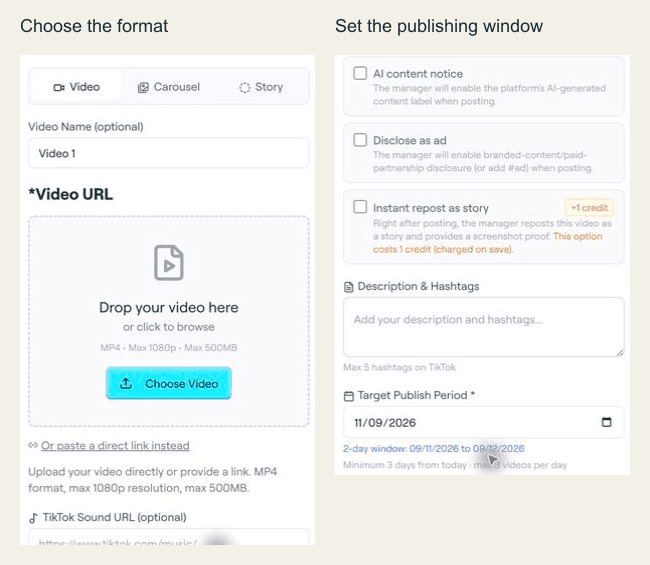
Follow account setup status. For a delivered account, organize content and captions in the appropriate slots and use the available publishing workflow and dates.
Measure the result you actually sell
Review publishing status and account analytics alongside your own site visits, leads, app installs or purchases. Expand only when the content and operating process support the next launch.
Try the workflow in your assistant or n8n
For an AI assistant, connect TokPortal through MCP. Use an account-order preview to check the market and credit quote before creating anything. A connection is access to the workflow; it does not place an order.
The manual n8n US account preview checks available markets and returns a dry-run quote without purchase or publishing. For a delivered account, the MP4 configuration preview validates the intended content-slot change. Preview IDs are simulated and cannot be used as real account IDs.
Keep the handoff explicit: approved asset, account, slot, caption and intended date. Creating an account or publishing real content remains a separate action after preview.
Local operation and account access
Choose where the account is operated; measure who actually watches. TikTok describes recommendations as depending on multiple signals, including viewer interactions and content information. A local account does not guarantee country-only viewers, a specific reach or sales.
Delivered accounts are managed inside TokPortal. Revealing login credentials is a separate, irreversible choice with its own fee and consequences for management and support. Read the account-access terms before requesting it.
Frequently asked questions
What is a TikTok device farm alternative for brands?+
Can I run a US account while my team is abroad?+
How much does one account with five publishing slots cost?+
Can I connect TokPortal to an AI video workflow?+
Does local account operation guarantee US views?+
Do I get account credentials automatically?+
Start with a launch you can measure
Choose one market, prepare your brand and review the account and publishing cost.

Written by
Vincent Tellenne
Co-founder & CEO
Vincent is a co-founder and CEO of TokPortal. He works on the infrastructure and operating model behind scaled organic social media distribution.
Learn more about this topic with AI
Related Resources
How to Create a US TikTok Account From Abroad
Create a US TikTok account from abroad: local setup, audience geography, real product screenshots and a practical launch brief for AGD.
How to Manage Multiple TikTok Accounts for One Brand
Build a multi-account TikTok and Instagram plan with real examples, an account register, a content-capacity calculator and an AGD review process.
Related Countries
From the guide to your first campaign
You make the content.
TokPortal runs the account operations.
Create and operate TikTok and Instagram accounts in your target market. Local operators handle the account work and native publishing. You control the brief, content and campaign from the dashboard, API or MCP.
- 01Choose your market
- 02Define each account
- 03Schedule your content
Review market availability and pricing before ordering. No reach forecast is built into your plan.