
On this page
Choose a UGC distribution platform by the deliverable: creator assets, posts on a creator's account, scheduling for existing profiles, paid amplification or managed account operations. AGD uses purpose-built organic accounts; match production rights, publishing responsibilities and measurement to that plan.
Choose a distribution method before choosing a UGC platform
Sources & real examples
Public accounts, original posts and primary references. Each example is linked where it is discussed.
View all 6 sources and review notes
- Bliq: TikTok case study ↗
Provider-reported localized paid campaign using creator assets. Used to explain production scope; it is not evidence of organic AGD results.
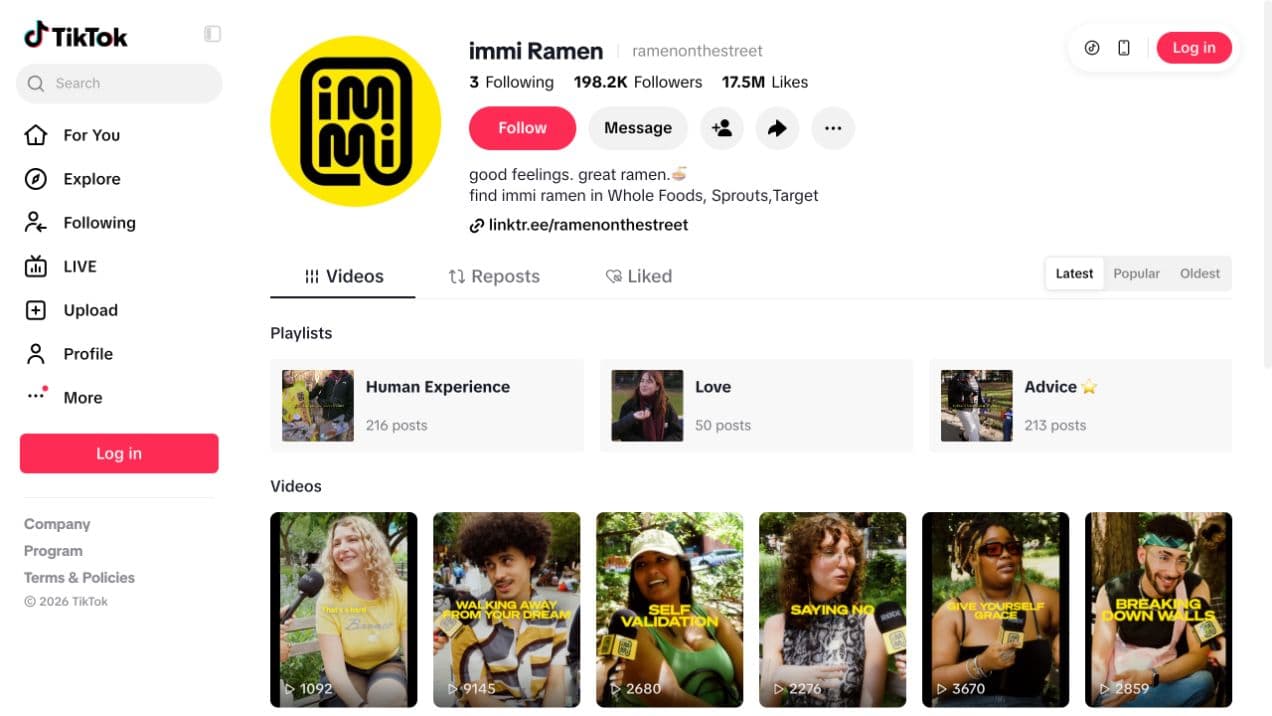
- immi Ramen on TikTok ↗
Public recurring-format example with a captured profile and direct video links. Private sales and account infrastructure are not inferred.
- Instagram Trial Reels ↗
Official description and product visual for testing a format with non-followers. The illustration's numbers are not our campaign data.
- Metricool multi-account guide ↗
Vendor documentation for its existing-account scheduling and reporting proposition. No independent product test or price comparison is asserted.
- TikTok Business Center ↗
Official linked-account permissions workflow for advertising; scope should be checked before treating it as an organic publishing solution.
- TikTok Direct Post ↗
Official app and account-authorization requirements for API publishing, rather than a source for growth predictions.
The best platform to distribute UGC videos depends on which part of the job you need to buy. A creator can produce an asset without publishing it. A scheduler can publish to an account you already control. A paid campaign can buy distribution without creating a lasting organic account. A managed account service can coordinate account setup and publishing while your team remains responsible for the creative.
These products are easy to confuse because they all show videos in their marketing. Start with a concrete deliverable: “We need six approved product demonstrations,” “We need these videos published to our existing profiles,” or “We need a network of distinct accounts serving different audiences.” A useful quote answers who supplies the account, who supplies the content, who publishes it and what evidence comes back.
This guide compares distribution models rather than declaring a universal winner. TokPortal provides managed account creation and publishing, so we have a commercial interest in that category. The comparison also identifies situations where an existing-account workflow or paid distribution is the more direct fit.
UGC production, organic distribution and ads: what you receive
Feature
What you need
What to verify before buying
UGC production
Creator distribution
Existing-account scheduling
Paid amplification
Managed account distribution
Ask providers to quote the same unit. A price for one edited video cannot be compared directly with a price for one published post or a month of account operation. Write down what you still need to supply. A low production price can be useful, but it does not answer where the video will reach people or who handles comments after publication.
A practical shortlist: match the named platform to the task
Metricool, for existing-account coordination. Its multi-account TikTok guide describes a dashboard for scheduling and account reporting. Put it on your evaluation list when your accounts already exist and coordination is the bottleneck. Check current plan limits, supported formats and account permissions with your own workflow; this is not a hands-on product test.
TikTok Business Center, for account permissions in advertising. The official account-access workflow lets an administrator request authorization and assign members. It is relevant when UGC will be used through an authorized account in an ad campaign. Do not assume those permissions create a new account or include every organic publishing action.
FOAP through TikTok Creative Exchange, for the production brief illustrated below. The Bliq case documents creator-produced assets for a localized paid launch. Treat it as a production-route example and verify current availability, deliverables and rights before commissioning a similar project.
Instagram Trial Reels, for a native format experiment. Check the option on your account when you want to try a reel with non-followers before broader sharing. This solves a specific test, rather than the full account-management problem.
TokPortal, for managed account operations. Evaluate it when account creation, a selected available market and managed publishing are part of the requirement. You still need an approved creative brief and a measurement plan. Compare the current quote and access terms with the other options using the same responsibilities and period.
A real app example: Bliq's localized creator videos
In TikTok's Bliq case study, the app's Warsaw campaign used 12 videos from two UGC creators through FOAP and TikTok Creative Exchange. The example is useful because it connects creative production to a specific launch market and campaign, rather than treating “UGC” as a generic style.
This is a paid advertising case reported by TikTok, not proof of organic AGD performance. The practical lesson is to specify the market, product action and distribution route in the brief. If you order creator videos for a new app launch, decide whether the output is intended for your own organic profiles, the creator's account, paid ads or several separately licensed uses.
For an illustrative meal-planning app campaign, ask a creator to show the actual journey from selecting meals to checking a shopping list. Request one version for a first-time user and another answering a recurring objection, such as cooking for one person. The valuable variation is the demonstrated problem and answer, not simply an alternate opening sentence.
What useful organic distribution looks like on a real account
The public immi Ramen account illustrates why account identity matters alongside asset quality. The branded microphone, street-interview setting and Human Experience, Love and Advice playlists create an expectation that extends beyond one clip. Open the “Self validation” video from the captured grid to examine a concrete example.
For a brand commissioning UGC, the equivalent question is: what recurring promise will make the next post feel worth watching? A creator file is an input. A useful series supplies context, consistency and a reason for the audience to return. This public example does not establish immi's private operating model, supplier relationships or business results.
Where AGD fits: build accounts around audience needs
Account-Generated Distribution (AGD) is an organic growth model where content is distributed through a network of purpose-built social accounts instead of relying on a single brand account or external creators for reach. It changes the unit you plan: the account's audience and recurring content become part of the campaign, rather than a destination added after the videos are finished.
For a consumer app, one account might explain everyday beginner problems while another demonstrates advanced use cases. For a music release, accounts could explore genuinely different contexts in which the track belongs. Each needs its own editorial reason, appropriate rights and original execution. The number of profiles is an operating choice; it is not evidence that the strategy works.
Canvas UGC can be one input to that system when a creator works within a repeatable creative framework. AGD remains the distribution strategy. Buying a Canvas UGC deliverable does not automatically create an account network, establish publishing rights or arrange operations. See the Canvas UGC comparison for the production-side distinction.
Test a new Instagram format before multiplying accounts
Instagram's Trial Reels provide a concrete example of a platform-native test: eligible users can first show a reel to non-followers and review engagement before sharing it more widely. When your question is “does this format interest new people?”, check whether that workflow can answer it on an existing profile.
If your question is “should this audience have a dedicated recurring account?”, plan the identity, production budget and review process separately. An experiment on one reel cannot establish the economics of a whole network. Use the multi-account guide to make that decision explicit before paying for additional accounts.
An AI UGC file still needs a real example and a rights check
AI tools can help write a script, assemble an edit or produce an illustrative scene. They do not turn a fictional testimonial into a real customer experience. If a video claims that a person used your product, that claim needs a factual basis. If it demonstrates an app, the interface and result should match the actual product. Label illustrative scenarios clearly.
Keep the approved script, source material and permitted uses together. Check the rights to a creator's likeness, footage, music and any third-party material for the intended use. Organic posting permission and paid-ad usage can be different deliverables. Document the platforms, accounts, duration and editing permissions you agreed to rather than assuming that receiving an MP4 settles everything.
At publishing time, review the platform's applicable commercial-content and synthetic-media settings for the particular asset. The TikTok content disclosure guide explains the brand-versus-partnership distinction. Keep the disclosure decision in the handoff so the publisher is not left to guess from a filename.
Build a handoff that reaches a verified published post
Copy a UGC distribution handoff
Campaign and business goal:
Audience / platform / account URL:
Approved asset and version:
Creator / original footage / rights record:
Organic use / paid use / permitted dates:
Caption, cover and disclosure decision:
Destination URL and tracking parameters:
Approver and publishing owner:
Intended publishing window:
Completion evidence: [public post URL + status]
Review window and conversion event:
Action if publishing fails:
A file being accepted by a tool is not the same as a public post being available. Keep the intended account, asset version and publishing status connected. When a job completes, inspect the public result where accessible: account, framing, audio, caption, disclosure and destination. Log a failure separately from a delivered post so your completion rate remains meaningful.
For a custom integration, TikTok's Direct Post documentation describes an authorized publishing flow. Check the supported formats and your application's actual permissions. For managed TokPortal accounts, use the dashboard or documented API workflow and keep real account and slot identifiers explicit. A dry-run preview is useful for validating a request; it is not a published result.
Budget for creative capacity, then compare distribution costs
Can your team feed this account network?
Adjust the planning assumptions. Include scripting, editing, captions and review in the time per post. These are workload calculations, not recommended posting limits or reach predictions.
- Finished posts needed
- 48
- Production hours / week
- 9.0
Shortfall: 1.0 hours each week. Reduce the network or cadence, or increase production time. Your production budget supports 2 accounts at this cadence.
The calculator estimates finished content required by an account plan. It deliberately does not predict views or sales. Once that workload is feasible, price production, rights, account operations and any paid media separately. You can then compare like-for-like quotes instead of treating all “UGC packages” as the same service.
For TokPortal, check current account, publishing and Coverage pricing and the actual workspace quote. For an internal device operation, include people, connectivity, software and hardware allocation; the phone-farm alternative guide contains a worked cost model. Keep paid spend outside an organic-distribution cost comparison unless both options include it.
Measure a business outcome that matches the brief. A paid-install campaign, a creator-awareness post and an organic account launch have different immediate outputs. Track completed posts and attributable visits, then the conversion you can observe. Do not report total video views as acquired customers or compare a boosted post with an unboosted post without noting the difference.
Choose the smallest complete workflow for your campaign
If the accounts already exist and the bottleneck is coordination, start with publishing and approvals. If you need credible demonstrations, solve the production brief and rights first. If you need predictable paid distribution, build the campaign and measurement plan. If you need purpose-built accounts and local operations for an AGD strategy, include account creation and management in the scope.
A four-week pilot can be a useful planning window, not a universal success deadline. Define the audience, supply enough original material to test a recurring series, inspect published outputs and schedule a decision. Expand when the operating process works and the content produces evidence worth following. A larger order should buy a clearer experiment, not simply a larger content queue.
Plan managed distribution for your UGC
Bring your approved creative, choose platforms and available markets, and review the account and publishing scope in TokPortal.

Written by
Vincent Tellenne
Co-founder & CEO
Vincent is a co-founder and CEO of TokPortal. He works on the infrastructure and operating model behind scaled organic social media distribution.
Learn more about this topic with AI
Related Resources
How to Manage Multiple TikTok Accounts for One Brand
Build a multi-account TikTok and Instagram plan with real examples, an account register, a content-capacity calculator and an AGD review process.
Canvas UGC vs Traditional UGC: Costs, Accounts and Deliverables
Canvas UGC vs traditional UGC: compare account ownership, workload, rights, pricing and delivery with real examples and a scope-comparison worksheet.
TikTok Content Disclosure Setting: Brand vs Paid Partnership (AGD)
Use TikTok’s content disclosure setting for organic brand and creator posts, with an AGD decision workflow and copyable publishing checklist.
Related Countries
Put your AGD strategy to work
You make the content.
TokPortal runs the account operations.
Create and operate TikTok and Instagram accounts in your target market. Local operators handle the account work and native publishing. You control the brief, content and campaign from the dashboard, API or MCP.
- 01Choose your market
- 02Define each account
- 03Schedule your content
Review market availability and pricing before ordering. No reach forecast is built into your plan.