
On this page
TikTok’s content disclosure setting identifies a commercial relationship on a post. If the content promotes your own business, the documented selection is Your brand. If it promotes another brand or business through a commercial relationship, the documented selection is Branded content, which produces a Paid partnership label. Decide the relationship from the actual arrangement, not from whether the video looks like an ad.
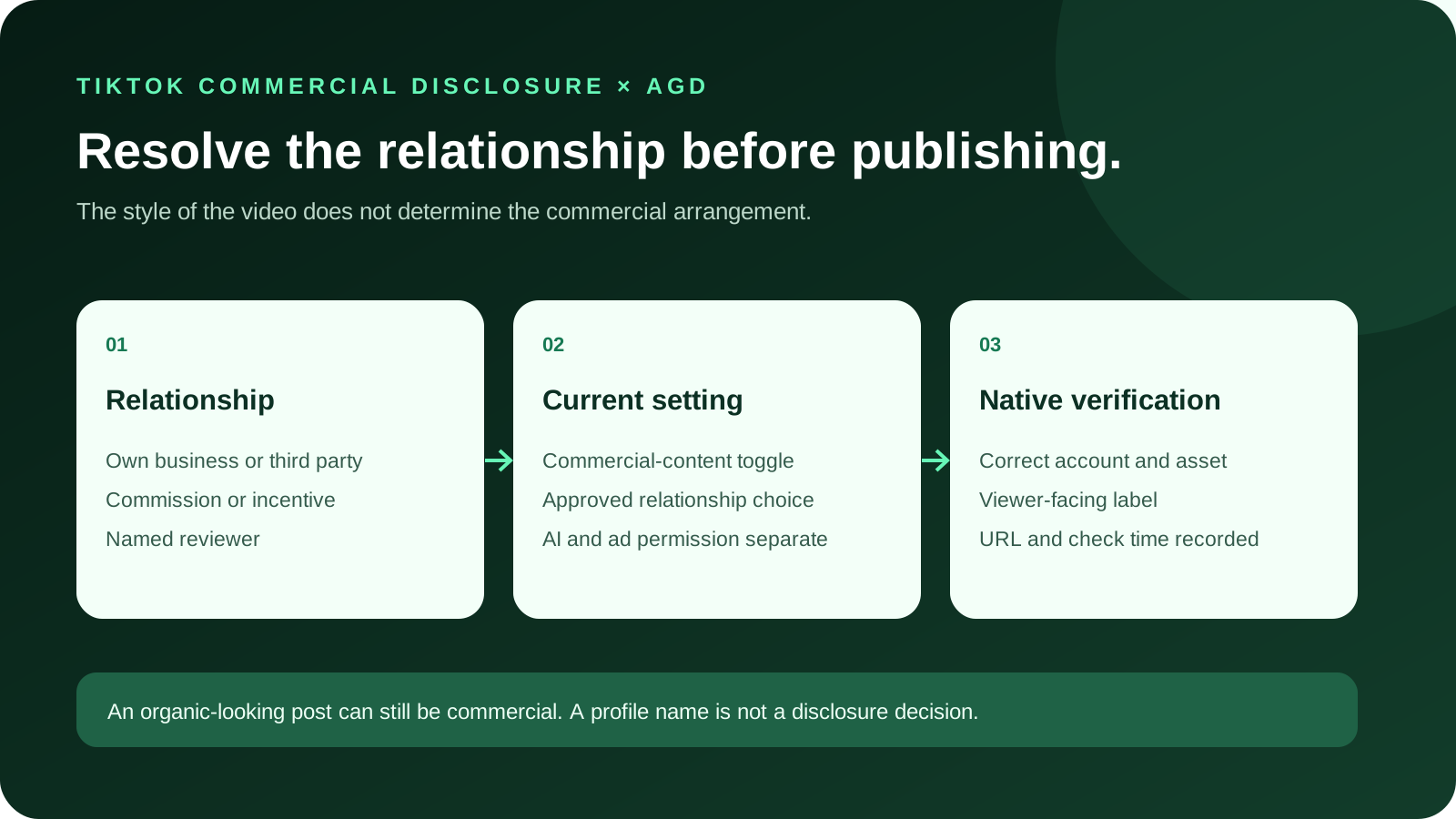
An organic post can still be commercial. A dedicated account, a casual script, a screen demo or a faceless character does not remove the underlying promotion. The practical task is to resolve the relationship before publishing and to verify the correct label on the native post afterward. This guide provides an AGD workflow and a copyable disclosure card for the handoff between marketer, creator, reviewer and operator.
A public UGC creator question asks whether undisclosed content on new or dedicated accounts performs better. It expresses a real operational uncertainty, not a reliable A/B test. We do not repeat commenter performance claims or treat the absence of a visible label as a growth tactic. Exact keyword volume and difficulty remain unmeasured.
Sources & real examples
Public accounts, original posts and primary references. Each example is linked where it is discussed.
- TikTok: commercial content disclosure setting ↗
- TikTok Help: promoting a brand, product or service ↗
- TikTok for Developers: content sharing guidelines ↗
View all 7 sources and review notes
- TikTok: commercial content disclosure setting ↗
Official January 2026 business help read September 13 via direct public HTML. App, existing-post, browser and TikTok One workflows; no reach experiment performed.
- TikTok Help: promoting a brand, product or service ↗
Official indexed text read September 13, including own-brand/third-party labels and its stated distribution policy. Direct page returned no body, so that limitation is preserved.
- TikTok for Developers: content sharing guidelines ↗
Official August 4, 2026 guidelines read September 13. User-controlled commercial disclosure UX applies to the documented Direct Post integration, not every publishing product.
- TikTok: AI-generated content guidance ↗
Official guidance read in prior AGD source review. Used to distinguish AI labeling from commercial relationship disclosure; no output-specific ruling or distribution promise.
- r/UGCcreators: disclosure on dedicated brand accounts ↗
Indexed original question excerpt read September 13. The author asks about disclosure and performance on dedicated accounts; full body was not retrievable. Comments and advertised workflows are not empirical evidence.
- Sab Yang: original Notion tutorial ↗
Original video and expanded description inspected September 10; genuine screenshot re-inspected September 13. Creator declared a Notion partnership. YouTube example, not a verified TikTok disclosure setting or AGD campaign.
- Duolingo: original TikTok profile ↗
Original profile inspected September 8; genuine screenshot re-inspected September 13. Public brand identity does not expose private settings, account operators or every commercial relationship.
Organic distribution does not mean a non-commercial relationship
Organic describes the distribution method: the post is published without buying that delivery as an advertising campaign. Commercial describes why and for whom the content is being made. A company explaining its own product can be doing both organic publishing and commercial promotion at the same time. A creator receiving an incentive to promote another company can also publish organically.
Account-Generated Distribution (AGD) is an organic growth model where content is distributed through a network of purpose-built social accounts instead of relying on a single brand account or external creators for reach. Each purpose-built account therefore needs an editorial role and a clear statement of the commercial arrangement. The marketer should not leave the operator to infer that arrangement from a username, an avatar or the presence of a product in the frame.
For a campaign, separate three decisions: who the account represents, what the particular post promotes and whether anyone receives an incentive connected to the promotion. Keep any uncertainty as a review question. If the relationship cannot be explained in one sentence, finish that conversation before filling the publication calendar. A well-defined account identity helps viewers understand the content, but it is not a substitute for a required post-level disclosure.
Your brand and Branded content answer different questions
TikTok’s official help distinguishes promotion of your own business from branded content on behalf of another business. The corresponding labels are Promotional content and Paid partnership. Its guidance states that enabling the disclosure setting does not affect feed distribution. That is TikTok’s stated policy, not an independent experiment we ran or a promise about an individual post.
Consider a hypothetical app company publishing a feature demo on an account that represents its own business. The reviewer can document that ownership and promotion before choosing the appropriate own-brand setting. Now consider a creator contracted to promote an unrelated app on a dedicated account. The absence of the creator’s personal follower base does not erase the third-party arrangement. The exact contractual and account relationship should be resolved by the responsible reviewer.
Do not reduce the choice to who uploaded the file. A local operator may publish approved content without being the commercial beneficiary. A studio may make a video that later appears on a brand’s own account. Production, account operation and promotional relationship are separate fields in the brief. Assign someone who knows the arrangement to approve the final selection.
A brand profile is useful context, not proof of settings
The public Duolingo TikTok profile uses the owl identity, the brand name and a product link. Those visible elements make the account’s brand context legible. They do not show the private disclosure screen for each post, the account operator or every agreement behind the content. We do not infer undisclosed settings from a screenshot.
For an AGD team, adapt the clarity rather than copying the identity. Write what the account represents in the account brief and check that its name, bio and recurring content agree with that role. Then review the particular post. A clear company profile can still carry a collaboration with another company; a character-led account can still promote the business that commissions it.
This distinction prevents an operational shortcut: marking an account once in a spreadsheet and assuming every future post inherits that decision. Account identity is relatively stable. Post relationships can change with a collaboration, incentive or new product. The publishing record should preserve both levels so a later reviewer can see why the setting was selected.
A declared creator partnership is a different kind of evidence
In Sab Yang’s original Notion tutorial, the expanded public description inspected on September 10 declares a Notion partnership. The captured frame shows a calendar demonstration with a creator overlay. The commercial relationship comes from that explicit declaration, not from guessing why the interface is visible.
This is a YouTube example, not a demonstrated TikTok campaign or proof of a TikTok toggle. Its practical lesson is to keep the relationship attached to the asset when a team discusses a short-form adaptation. If a marketer commissions a new video based on a similar product task, the brief should state who commissions it, which business it promotes and where the approved asset will be used.
A file detached from its original context is easy to misclassify. Do not send a creator’s video to several account operators with only a caption and a due date. Include the relationship, approved usage and reviewer. Public inspiration does not grant permission to reuse the footage, and a declared partnership on one platform does not automatically select the correct settings for a new post elsewhere.
Set the relationship before the operator reaches Post
The official business help describes the current app route through Content disclosure and ads, sometimes under More options, followed by the commercial-content toggle and relationship selection. It also documents browser uploads and existing-post workflows. Interface wording and available controls can differ, so use the current screen in the actual publishing account.
In your handoff, ask the reviewer to complete the relationship line before scheduling. Ask the operator to check the account and approved file, then apply the documented setting. The operator should pause if the selected account, promoted business or caption differs from the approved brief. That is a specific correction request, not a reason to improvise a new relationship.
Before publication, review the preview for content, caption, destination and required labels. After publication, retain the native URL and confirm the actual viewer-facing result. A completed internal form does not prove that a setting survived the upload. Verification closes the handoff and gives the marketer a record that can be checked without asking the operator to remember every tap.
Keep commercial disclosure separate from AI labels and ad permission
Commercial disclosure answers who is promoting what through which relationship. An AI-generated content label answers a different question about the production or editing of the content. A post may need both considerations. An animated or generated persona is not automatically a non-commercial speaker.
Ad authorization is also separate. A post can be correctly disclosed without the creator having agreed to every future paid use. When a team wants to amplify it, record the approved campaign, duration and authorization process in the paid handoff. Do not treat the disclosure label as unlimited asset rights or a blank permission to reuse the post across a network.
Keep these fields distinct on the disclosure card: commercial relationship, AI-label review, asset usage and ad authorization. A single checkbox called compliant hides too many different decisions. The reviewer should be able to see which question has been answered, which evidence supports it and which permission is still missing. This is especially useful when production, account operation and media buying are handled by different people.
Automated publishing still needs a deliberate selection
TikTok’s Direct Post guidelines require user-facing controls for commercial disclosure, including the own-brand and third-party choices. They also describe preview, awareness and consent requirements for that documented integration. These are requirements for the specified API workflow, not a claim that every external scheduler implements the same screen or behavior.
For a publishing integration your team uses, inspect the actual mapping from the campaign brief to the selected account and post settings. Confirm which person supplies the relationship and which person verifies it. Do not assume a successful upload response proves the viewer-facing label is correct. The native post check remains the final evidence.
If you discover a mismatch, keep the request narrow: native URL, expected relationship, observed label, approved asset and responsible reviewer. Avoid sending credentials or personal account data in the correction note. The marketer needs the result and the relevant decision, not a copy of the operator’s whole session. A precise record also prevents the same ambiguous brief from being reused on the next account.
Copy the TikTok disclosure card
Fill this card for one real post. Use an explicit question when the relationship is unresolved. Keep the approved version with the creative record, then append the published URL and verification. The card is an operating checklist, not a contract or a complete legal assessment for every territory.
TikTok commercial disclosure card
TIKTOK DISCLOSURE CARD

POST
Approved asset and version:
Native account / account editorial role:
Business or product promoted:

RELATIONSHIP
Own business / third-party commercial relationship / unresolved:
Who knows and approves the arrangement:
Incentive or commissioning context relevant to this post:
Selected platform setting and expected label:

SEPARATE CHECKS
Approved asset usage and platforms:
AI-generated or materially edited elements and label review:
Ad authorization: included / separate / not requested:
Claims or territory-specific review still needed:

PUBLICATION
Operator / scheduled time:
Actual account and preview checked:
Caption and destination checked:
Commercial setting checked on the current screen:
Native URL after publication:
Observed viewer-facing label and verification time:

CORRECTION
Mismatch and exact approved expectation:
Reviewer decision:
Resolved native URL or next action:
Send a correction brief that names the mismatch
A useful correction request contains the native URL, the approved relationship, the observed label and the person responsible for deciding the next step. It should also say whether the underlying problem is the label, the account, the asset or a changed commercial arrangement. Those are different errors and may need different platform actions.
For example, a marketer can write: “This post was approved for our own-business account, but the published URL belongs to the creator campaign account. Please verify the routing and ask the relationship reviewer to confirm the correction.” This is a hypothetical note, not an instruction to alter a live account. It avoids asking the operator to choose a commercial relationship from a vague complaint that the post looks wrong.
Review exceptions without guessing from a view count
If a post is restricted or the label is wrong, review the specific platform notice and the actual relationship. Keep the notice, native URL and decision together. Do not remove required disclosure simply because the first observation has fewer views than expected. That would change a relationship label in response to a performance guess.
For a hypothetical campaign, imagine that a scheduled student-app demo appears on the wrong dedicated account. The correct response is to verify the account, approved relationship and platform options, then ask the reviewer for the appropriate correction. Changing the caption alone cannot settle an account-routing error. Keep the example marked hypothetical; we have not performed this correction in a customer account.
When reviewing performance, separate whether a post was properly published from whether it earned attention. Those questions can lead to different actions: fix a label or routing error, improve the next original demonstration, clarify a claim or revise the account’s editorial boundary. A small count is not enough evidence to identify which action is needed.
Make disclosure part of the AGD production brief
Add the completed card to the AGD campaign brief and use the app demo brief to make the product proof visible. For creator learning, the Canvas UGC beginner guide explains how to prepare samples and agree on a first recurring scope. These steps solve different parts of the same handoff.
TokPortal supports the account operations and native distribution layer while your team defines the product, content and commercial relationship. The useful standard is simple: the reviewer can explain why a setting was chosen, the operator can apply it on the actual account and the marketer can verify the published result from its native URL. That makes a growing account network easier to manage without relying on memory or visual guesswork.

Written by
TokPortal Editorial
Guides and operating playbooks
Practical guides from TokPortal, using the founder’s AGD framework, attributed source material and clearly labelled planning examples.
Related Resources
Related Tools
Resolve the relationship before the operator posts
Complete the disclosure card for one actual asset, identify the reviewer and verify the published label with its native URL.
Copy the disclosure card →