
On this page
An AI UGC agency sells reviewed, usable marketing content made with AI-assisted production. Start with a narrow product category, a paid creative test and a quality checklist. Price the approved output, including failed generations and human review, then decide whether publishing and account operations belong in the package.
Part of Vincent Tellenne’s agency-building series, adapted from his original white-label TokPortal essay. Worked budgets and sample offers below are illustrations, not customer results.
You can generate a talking person in a few minutes. That does not mean a brand has a video it should publish.
The interesting business sits in the work around that generation: choosing a useful angle, showing the real product, checking every claim, editing the result, getting approval and putting it in front of an audience. If you can do those things reliably, an AI UGC agency can be a sensible service to build.
If your pitch is only “I have access to an AI video tool,” the client can probably buy the same subscription. Give them a reason to hire your judgment.
Sources & real examples
Public accounts, original posts and primary references. Each example is linked where it is discussed.
- Vincent’s original white-label essay ↗
- TikTok AI-generated content guidance ↗
- Commercial content disclosure ↗
View all 5 sources and review notes
- Vincent’s original white-label essay ↗
Founder perspective and commercial thesis. The linked post is the source for this series; illustrative budgets are developed in each guide.
- TikTok AI-generated content guidance ↗
Review labels and restrictions for the specific creative.
- Commercial content disclosure ↗
Promotional content has a separate disclosure workflow.
- Bliq creator campaign ↗
Human-creator paid campaign used as a briefing example, not as AI-performance evidence.
- TokPortal content configuration ↗
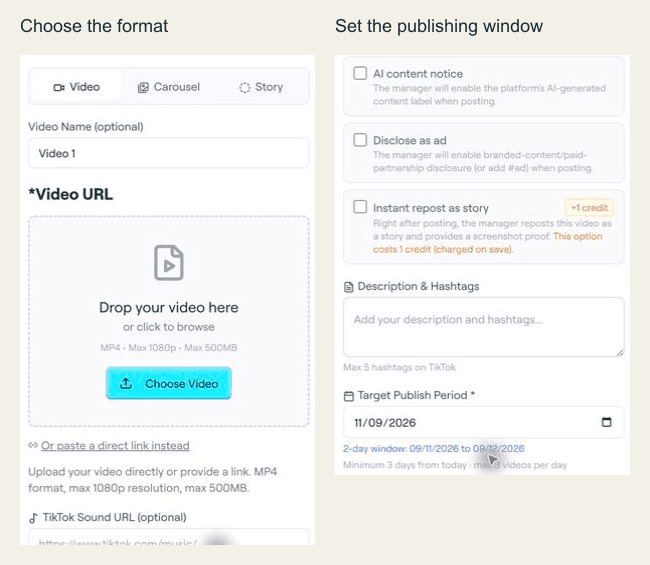
Publishing configuration after the creative has been approved.
Decide what you mean by AI UGC
The term covers different production methods. One team uses AI for scripts and captions while a real creator films. Another combines real product footage with synthetic narration. Another generates a presenter. These have different costs, creative strengths and approval requirements. Show the client an example of the exact service before selling it.
A synthetic presenter is not a real customer. Do not write “I used this for thirty days” unless a genuine person actually did and the statement is supportable. A product explanation can be useful without pretending to be a testimonial. Make that distinction part of the brief.
For a first offer, I would choose a format where the product itself carries the value: a real app walkthrough, an authorized product demonstration, or an explanation supported by real footage. Use AI where it makes that explanation easier to produce or adapt.
Pick a client who has facts, footage and a reason to publish
A language-learning app with a working demo gives you something to show. A retailer with approved product footage gives you something to edit. A vague business idea with no available product leaves you inventing scenes and claims. That is a harder first client than it looks.
Ask for the current product, its approved claims, existing footage, brand references and three recurring sales objections. Then choose one audience. “Short demo videos for mobile subscription apps launching an English-language feature” is specific enough to design a repeatable process.
Make a rejection rule as well. Decline work that requires you to fabricate customer experiences or show a product doing something it cannot do. You will save time, and your portfolio will be stronger. A clever-looking video that misrepresents the product is a bad deliverable.
Sell a creative test, not a pile of AI generations
Here is an illustrative starting offer: three product angles, two openings for each, six approved vertical videos, captions, one review round and a short recommendation for the next batch. State which assets are generated, which are real and who supplies the product footage. Paid-media rights and publishing can be separate line items.
For a budgeting app, the angles could be splitting a shared bill, seeing subscriptions in one place and planning a grocery budget. The proof should be a real recorded flow using demonstration data. The opening can vary without changing the product fact underneath it.
Do not sell thirty almost identical versions as thirty creative ideas. If the only difference is the face or background, explain that these are variations of one concept. A buyer comparing approaches needs to know what changed and what stayed constant.
What a real UGC campaign can teach an AI agency
The public Bliq campaign used localized creator videos for a Warsaw app launch. It was a paid campaign with human creators, not evidence that synthetic content performs the same way. Use its embedded creatives as a reference for how a product and a local use case can become the center of a brief.
The question for your sample is simple: does a viewer understand a useful product benefit from something they can actually see? If the answer depends on a generic presenter saying “this app is a game changer,” you still have creative work to do.
Build a quality check you can repeat on every delivery
Watch each export with sound, then without sound. Check the product name, interface, price, subtitles, pronunciation and every on-screen claim against the approved brief. Look for discontinuities in hands, packaging, screens and movement. A mistake that lasts half a second is still part of the video the client receives.
Check that the opening matches the payoff. A hook promising an exact saving must lead to an explanation you can substantiate. A demo should show the current product, not a generated approximation of its interface. Keep the approved source files so corrections do not require rebuilding the entire asset.
Then review the publishing context. TikTok has separate guidance on AI-generated content and promotional-content disclosure. Review both for the actual video; an AI label and a commercial disclosure answer different questions. Include the relevant settings in the handoff to whoever publishes.
AI UGC approval checklist
Product and version shown:
Audience question answered:
Real footage / generated footage / synthetic voice:
Approved claims and their source:
No invented customer experience:
Creator likeness, voice, music and asset permissions:
Screen, packaging, subtitle and pronunciation check:
AI-label and commercial-disclosure review:
One approving client contact:
Final asset version and destination:
Revision reason recorded for the next batch:
Calculate cost per approved video
A model’s generation price is only one input. Suppose a batch uses $72 in generation credits, $120 of licensed footage or voice costs, three editing hours at $30, and two hours of review and client communication at $40. That is $362. If eight videos are approved, the modeled cost is $45.25 per approved video. If only four survive review, it is $90.50.
These are invented example costs. The point is the denominator: approved assets, not exported files. Track failed attempts, rejected scripts and rework. Do not quietly count the founder’s evenings as free labor, then wonder why the agency cannot hire someone to take over.
Price a revision boundary. A correction to your mistake is different from a client changing the product offer after approval. Define both in plain language. Offer a fixed first batch before an open-ended subscription so that you learn what the work actually costs.
Build an offer you can actually deliver
Agency retainer calculator
Editable example in USD. These are invented planning assumptions, not TokPortal prices or a promised agency margin. Include rejected generations in the cost per approved video.
Modeled monthly cost
$1,177.00
Contribution
$623.00
Contribution margin
34.6%
Where the delivery budget goes
- Production: $540.00
- Account operations: $160.00
- Your time: $280.00
- Other costs: $90.00
- Contingency: $107.00
Contribution = client price minus production, operations, valued labor, allocated costs and contingency. This is not net profit. Add tax, payment fees, acquisition costs and any overhead not entered above. Quote one-time setup separately or include it when modeling month one.
Keep your offer draft
PILOT OFFER DRAFT — assumptions, not a quote
Customer: Independent hotels with existing room footage
Monthly client price: $1,800.00
Approved videos: 12
Production: $540.00
Account and publishing costs: $160.00
Delivery/support: 8 hours × $35.00
Other allocated costs: $90.00
Contingency: 10% = $107.00
Total modeled monthly cost: $1,177.00
Contribution before tax, sales costs and unmodeled overhead: $623.00
Contribution margin: 34.6%

Before sending: confirm account count, platforms, country, first-month setup costs, usage rights, included revisions, approval owner, payment schedule, reporting, and exit process. Obtain the current supplier quote. No guaranteed reach or sales.
Make distribution a useful service, not an excuse for more videos
Many clients already have more drafts than publishing capacity. If that is the problem, making production cheaper will simply fill the folder faster. Ask how the content will be approved, published, reviewed and used to decide the next batch.
Account-Generated Distribution (AGD) connects the production plan to purpose-built accounts. An app might have a student-use-case series and a separate small-business series, each with an honest identity and its own content promise. The accounts distribute useful material; they should not pose as independent customers endorsing the same product.
You can use TokPortal for managed TikTok and Instagram account and publishing operations while keeping your own agency brand and client process. Start with the smallest account plan your team can supply with distinct, approved content. Add accounts when a new audience or format justifies the extra work.
Get your first AI UGC client with a specific before-and-after
Build one permissioned sample around a product the buyer understands. Show the original product footage, your finished edit and a short note explaining the intended audience and test. This makes the value visible without hiding behind an impressive tool stack.
Ask a founder or marketer what makes their current content unusable. Common possibilities to investigate are weak product demonstrations, slow revisions, inconsistent language adaptation or no clear publishing owner. Propose a paid pilot that solves the actual problem they describe. Do not assume AI is their preferred production method; show why the result works.
After the first batch, report approved output, revision causes, cost, time to approval and any available campaign results. Keep paid and organic results separate. If the creative has not run, say so. A professional production report is more credible than presenting a predicted engagement score as customer revenue.
When should you hire or automate?
Automate repeated handoffs after you know what a correct handoff looks like. A folder structure, asset-version rule and approval checklist may solve your immediate problem before a custom dashboard does. Hire for the bottleneck you can see in your time log: editing, creative review or client communication.
A useful expansion test is whether another person can deliver one batch from your brief without you explaining every decision in a call. If they cannot, improve the brief. More clients amplify an unclear process.
Start with one clear promise, prove you can deliver it and keep the feedback loop short. The agency becomes valuable because it knows what deserves to go live.
Offer more than a video export
Explore how to add managed account distribution to your AI UGC service, with clear responsibilities and a scoped first pilot.
Choose your next guide: UGC agency · AI UGC agency · AI marketing agency · TikTok marketing agency · Publishing API for SaaS.

Written by
Vincent Tellenne
Co-founder & CEO
Vincent is a co-founder and CEO of TokPortal. He works on the infrastructure and operating model behind scaled organic social media distribution.
Learn more about this topic with AI
Related Resources
How to Start a UGC Agency: Your First Clients, Offers and Pricing
Build a UGC agency around a clear niche, a paid pilot and repeatable delivery. Includes a client brief, real examples and an editable retainer calculator.
How to Start an AI Marketing Agency: Pick a Niche and Get Clients
Choose an AI marketing business customers can understand. Build a narrow offer, validate demand, price delivery and turn a paid pilot into a retainer.
How to Start a TikTok Marketing Agency: Services, Pricing and Clients
Launch a TikTok agency with a specific niche and a four-week pilot. Learn what to sell, how to price it and when to add white-label account distribution.
White-Label Social Media API: Add TikTok & Instagram to Your AI SaaS
Add managed account creation and publishing to an AI SaaS. Compare the API models, test a dry run and design billing, approvals and delivery status.