
On this page
Canvas UGC is a creator-content arrangement in which someone makes recurring videos for a dedicated social account associated with a brand, rather than selling access to their own established following. The brand or its operator supplies the campaign, while the creator supplies the performance and production. The practical question is not how many followers the creator has. It is who controls the publishing account, what work is included and how that work is paid.
The name is still used inconsistently. It can describe a managed creator program, a direct brand arrangement or an opportunity advertised through a platform. It is not a synonym for Canva, and a page using the words Canvas UGC is not necessarily a single official service. Start with the arrangement behind the label. This guide explains that arrangement through public sources, a real creator explanation and a campaign worksheet you can use before agreeing to anything.
Sources & real examples
Public accounts, original posts and primary references. Each example is linked where it is discussed.
- A+ Socials original Canvas/Tech UGC comparison ↗
- Original Canvas UGC legitimacy question ↗
- Blank Canvas UGC program ↗
View all 5 sources and review notes
- A+ Socials original Canvas/Tech UGC comparison ↗
Original video page, caption and visible frame inspected 9 September 2026. Creator perspective; no rate survey, verified campaign results or claimed AGD adoption.
- Original Canvas UGC legitimacy question ↗
Original public question and replies inspected. Replies contain commercial promotion; offers and allegations are not independently verified or recommended.
- Blank Canvas UGC program ↗
Original public package inspected and captured 9 September 2026: $12,000 monthly, eight creators and 480 advertised videos. Provider offer, not purchased service or verified results.
- Billo explanation of Canvas UGC ↗
Primary publisher text read. Used to document category terminology, not its market-size, ownership or performance generalizations.
- TikTok Spark Ads creation guidance ↗
Official June 2026 documentation read. Authorized identities and post codes; no promise that organic results predict paid performance.
A simple example of how Canvas UGC works
Imagine a meal-planning app commissions a creator to run a dedicated account about making weekday dinners easier. This is an illustrative brief, not an actual campaign result. The creator records a shopping-list demonstration, a realistic cooking problem and a response to a common question. Each post has its own useful point, but all three fit the account's continuing subject. The app appears because it helps demonstrate the solution, not because every video repeats the same advertisement.
A complete arrangement must decide who creates the account, holds recovery access, approves scripts, posts the video and responds to comments. It must also define the production fee and any performance payment. Those decisions matter more than calling the arrangement Canvas. If the agreement covers only delivery of a video file, the brand still needs someone to publish and operate the account. If it covers posting too, the scope should identify the actual destination.
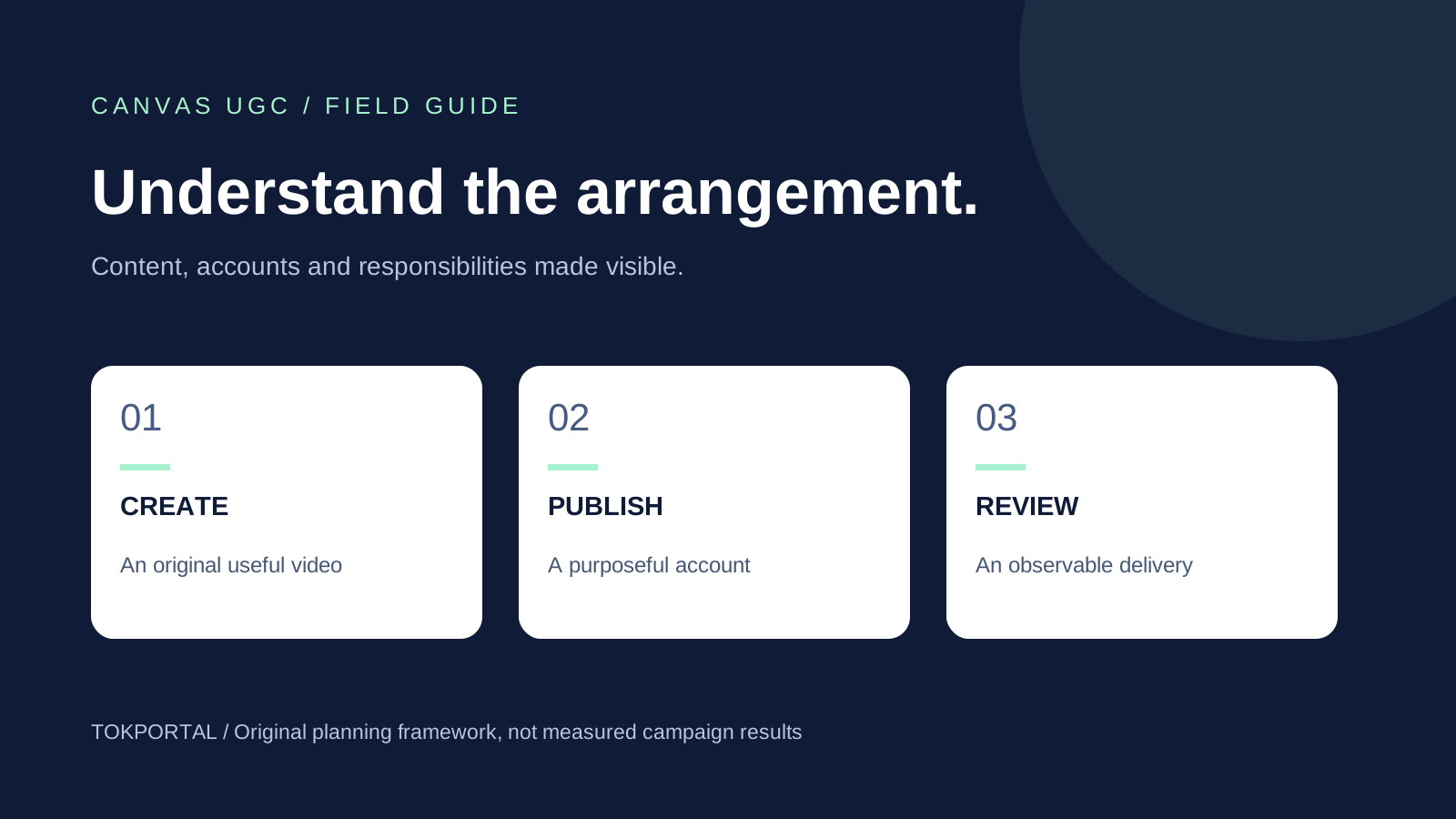
Create
Creator and reviewer agree on a useful, accurate product demonstration.
Publish
An authorized operator places approved content on the agreed account.
Review
The team checks the delivered URL, observation window and next decision.
The three responsibilities above separate jobs that are often bundled together. Making content, publishing it and measuring the result require different decisions. One person can perform all three, but each job still needs an owner. This is useful for creators as well as brands: a fee for filming should not silently turn into an unlimited obligation to moderate a feed, re-edit old footage or explain analytics every night.
What real public sources show
In this original TikTok video by Anna at A+ Socials, the creator contrasts recurring work on a fresh brand account with delivering a finished asset for a technology company. The split-screen performance makes the two workloads easy to compare. Her caption also discusses pay and workload; those figures are her description of the market, not independently verified rates or earnings we promise here.
The important observation is the distinction between the outputs. The creator's public explanation includes filming and posting as recurring responsibilities. A buyer who hears only “UGC video” could miss that ongoing commitment. Conversely, a creator who hears only “no followers needed” could underestimate the work. Watch the original video for its full framing; the captured image is one visible moment, not a transcript of everything said or proof of a campaign's commercial performance.
A different kind of evidence comes from Blank Canvas UGC's public program. At our September 9, 2026 inspection, its package described eight creators, recurring monthly output and posting on brand-owned accounts across three short-video platforms. This is a provider's published offer, not confirmation that we bought the package or verified the campaigns it advertises. Its usefulness here is that it makes the account-and-production bundle explicit.
A Billo explanation of Canvas UGC likewise describes dedicated brand-account production and notes the informal nature of the category. These sources help establish how the term is being used. They do not establish a universal contract, industry-wide earnings, or a guarantee that any particular account will receive reach. Our cost guide examines actual package inclusions separately from the general definition.
Why people ask whether Canvas UGC is legitimate
A public UGCcreators discussion starts with exactly this confusion: the author encountered the term through social posts and course promotion, then asked whether the underlying work existed. Replies include people promoting agencies and application routes. That is evidence of a question and commercial activity, not independent verification of every reply or a recommendation to use its links.
Separate three things when evaluating an opportunity: the type of work, the organization offering it and the specific agreement. A real category can contain weak offers. An attractive-looking website can still leave important questions unanswered. A course about a practice is not the same thing as an actual paid campaign. You do not settle those questions by finding more people repeating the category name; you settle them by inspecting the offer and what it commits each party to do.
For a creator, ask for the named commissioning party, a written scope, the method and timing of payment, and the process for accepting work. For a brand, ask who recruits and supervises talent, how content is reviewed, who controls the accounts and what survives termination. Keep the answers with the campaign record. If an essential answer is missing, mark it as unresolved rather than filling it in from another provider's marketing page.
Does Canvas UGC require followers?
An arrangement built around a dedicated account does not inherently require renting the creator's existing audience. That does not mean every program accepts everyone or has no selection criteria. A brand can still require a particular language, location, age eligibility, production quality, subject knowledge or ability to demonstrate its product. Inspect the actual program requirements before investing time in an application or buying equipment.
A useful beginner portfolio shows the work the program needs. A concise screen recording can demonstrate an app feature; a spoken explanation can show clarity; a short scene can show whether a creator understands a viewer's problem. These examples should be original and accurately described. A sample made to demonstrate your skills is not a past paid partnership. Label it as a sample and avoid suggesting that a brand hired you when it did not.
For brands, a portfolio review should match the intended content. A polished beauty testimonial does not automatically show that someone can explain software. Ask whether the creator can make the product understandable, follow a brief and produce distinct ideas over time. Recurring production rewards an ability to keep finding useful situations, not merely an ability to make one attractive introduction. Review an appropriate sample before committing to a large calendar.
Who owns the account and the videos?
Account control, content rights and a creator's identity are separate questions. A brand might control login and recovery while obtaining only specified uses of the footage. A creator might publish to a dedicated account while retaining rights to a voice recording or raw files outside the agreed scope. Never infer the entire arrangement from who knows the password. Write down the account administrator, permitted access and the content-use terms separately.
Make a simple handover record before the first post. It should identify the account, its authorized operator, recovery responsibility, approved profile description and the location of final assets. Do not put credentials into a shared content brief. Store permissions and access through the systems intended for them, then record only who is responsible. At the end of the engagement, verify access changes and the disposition of scheduled posts rather than assuming a creator's final invoice also completed the handover.
If a post may become an advertisement, plan that permission separately. TikTok's Spark Ads instructions describe authorized identities and creator-provided post codes as ways to source creatives. Having a video file is not the same thing as having the platform authorization needed for a particular paid use. Confirm the destination, identity and applicable authorization period with the people responsible for the campaign.
What a useful Canvas UGC brief contains
Start with the viewer and the reason the account should exist. “People trying to plan dinner without wasting ingredients” gives a creator a useful direction. “Post lots of app videos” describes output without giving the audience a reason to care. The brief should then state one product capability that can be demonstrated accurately, the limitations the creator must preserve and the action the viewer can take next.
Divide the content calendar by questions rather than by almost identical scripts. One video could explain how to edit the shopping list. Another could show what happens when someone changes a dietary preference. A third could answer whether the plan works for a shared household. These are hypothetical examples of distinct demonstrations. The actual product must support each claim, and the recording should use an appropriate test account without exposing customer information.
Specify the delivery unit. Does one deliverable include a script, raw footage, captions, a final edit and a posted URL? How many revision rounds are included? Are three platform uploads three deliverables or three placements of one creative? What happens if a product change makes the approved script inaccurate? Resolving these questions before production avoids disagreements that no amount of posting volume can fix later.
Your Canvas UGC campaign brief
CANVAS UGC CAMPAIGN BRIEF
Brand / product / public account / intended viewer:
One useful reason to follow the account:
Creator / content approver / authorized posting operator:
Recovery responsibility (no credentials in this worksheet):
Product capability we can actually demonstrate:
Original episode questions 1 / 2 / 3:
Script / footage / captions / revisions included:
Original creatives versus platform placements:
Account affiliation / disclosure / permitted content uses:
Fixed compensation / bonus formula / cap / payment timing:
Accepted-delivery evidence / posted URL / observation date:
Unresolved scope questions / decision owner / deadline:
Next review and handover responsibilities:
Use the worksheet as a working agreement checklist, not a replacement for the actual contract. Both sides should be able to identify what is confirmed, what remains open and who can answer it. Keep a short change log when the scope evolves. If the brand adds comment management after the first week, record the new work and compensation explicitly rather than allowing the original scope to expand silently.
Measure the account without confusing attention with customers
A post can receive attention without generating useful visits. A visitor can reach the app store and decide not to install. An install can fail to produce an activated user. Build the measurement plan around the decision you need to make, and record which parts of that journey are observable. Public views alone cannot tell an outsider whether an account produced profitable acquisition or whether the viewers matched the intended market.
Keep account, post URL, creative idea, publication time and observation time together. Comparing a two-hour-old post with a two-week-old post is a poor way to choose the next brief. If one creative becomes a Spark Ad, record when paid promotion begins so its later totals are not casually described as entirely organic. When attribution is incomplete, leave an unknown field rather than allocating every install that occurred that day to the most visible video.
Review the questions and comments for product understanding too. A viewer asking where a demonstrated setting lives suggests a different next action from someone repeatedly misunderstanding the product's basic promise. Use those observations to refine the explanation. Do not manufacture engagement to make the account appear more credible; build useful responses from genuine questions and clearly distinguish an observed question from one you invented for a sample script.
How to choose your next step
If you are a creator, begin with the workload and the terms. Decide how much recurring production you can reliably deliver, assemble a relevant sample and inspect actual programs. Avoid treating advertised earnings as a personal forecast. The most useful first question is whether the arrangement pays fairly for the full set of tasks you are accepting, including communication and revisions, not whether someone else posted an impressive revenue screenshot.
If you are a brand, decide whether you need content assets or a continuing publishing operation. Read our Canvas UGC versus traditional UGC comparison to separate those choices, then use the Canvas UGC budget calculator to model your own scope. The calculator uses explicit assumptions; it does not tell you what an untested campaign will earn.
When your creative team is ready and account distribution is the missing part, TokPortal provides a place to plan that operation. Keep production, account execution and measurement responsibilities visible in the brief even when tools connect them. Canvas UGC becomes easier to evaluate once it describes concrete work: the right creator, a purposeful account, original content, clear permissions and an observable delivery process.
Written by
Alexis Klein
Co-founder
Alexis is a co-founder of TokPortal, working with brands on localized organic distribution and campaign strategy.
Learn more about this topic with AI
Related Resources
Related Tools
From the guide to your first campaign
You make the content.
TokPortal runs the account operations.
Create and operate TikTok and Instagram accounts in your target market. Local operators handle the account work and native publishing. You control the brief, content and campaign from the dashboard, API or MCP.
- 01Choose your market
- 02Define each account
- 03Schedule your content
Review market availability and pricing before ordering. No reach forecast is built into your plan.