
On this page
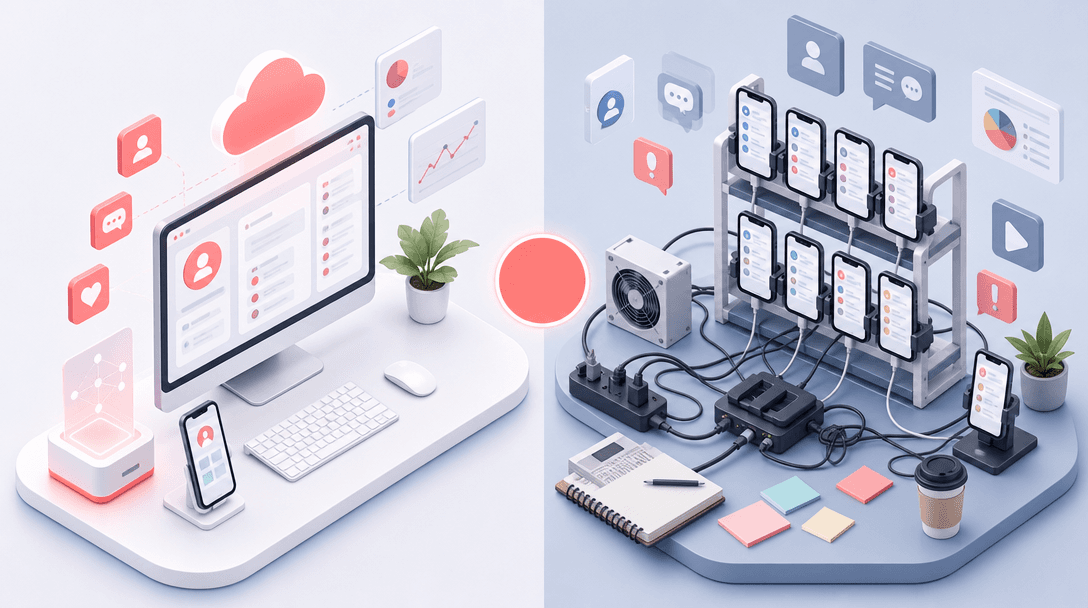
TokPortal is programmable organic social-media distribution infrastructure for teams that would otherwise build a room of phones, SIMs, operators, and QA workflows. The choice is simple: run multi-device posting as an internal operations business, or buy it as usage-based infrastructure across 20 countries.
TokPortal is The Human API for organic social distribution: real accounts on real physical smartphones, local SIM cards, and human operators in 20+ countries, controlled through API, MCP, SDKs, and webhooks. An in-house multi-phone setup can work when you have a small number of accounts and a founder-level operator watching every post; it becomes a device logistics business once you need country coverage, native in-app posting, QA, warming, approvals, analytics, and repeatable throughput.
This page compares TokPortal against building your own multi-phone TikTok, Instagram, and YouTube operation. If your question is mostly about software posting APIs, read the TokPortal versus TikTok Content Posting API comparison and the TokPortal developer documentation.
20+
countries with real local-device distribution
150,000+
accounts under TokPortal management
4,276
active business clients
6B+
organic video views generated
What is the cost of running your own TikTok multi-phone team?
The cost is not just phones. The real in-house cost model is: physical devices + local SIM lines + replacement stock + workspace + device monitoring + operator time + QA + account warming + posting approvals + reporting. For a 100-account operation, the cleanest physical model starts with 100 smartphones and 100 SIM lines before you hire anyone to run the workflow.
TokPortal turns that same workflow into credits: 25 credits per account, 2 credits per video upload, 7 credits for niche warming, 40 credits for Instagram deep warming, 3 credits for video editing, and 1 credit for sound-volume control. That matters because you can scale campaign volume without turning your growth team into a hardware, staffing, and compliance operations unit.
If you are already spreadsheeting phones, SIMs, operators, and account status by hand, compare this page with the DIY TikTok account time and cost comparison.
Should you build or buy multi-device social posting?
Feature
In-house multi-phone setup
TokPortal distribution infrastructure
Best fit
Device model
Geographic coverage
Native in-app posting
Automation layer
Cost shape
Operational risk
Is hiring operators better than using a distribution network?
When hiring operators makes sense
- You need high-touch creative judgment on a small number of brand-owned accounts
- You operate in one country and already have trusted local staff
- Your posting calendar is simple enough that missed retries, approvals, and analytics do not require engineering
- You want every social action to be manually reviewed by your internal team before publishing
Where a distribution network wins
- You need 10, 50, or 100+ active accounts without building a device logistics function
- You need country-native distribution using real phones and local SIM cards
- You need API, MCP, SDK, webhook, n8n, Make, or Zapier control instead of a chat-based task queue
- You need native in-app capabilities such as TikTok sounds, location tags, and in-app edits at repeatable volume
- You need a predictable operating layer for agencies, AI-UGC pipelines, clipping networks, or ecommerce launch campaigns
How many phones do you need for 100 accounts?
For a clean in-house operating model, plan as if 100 active accounts require 100 physical smartphones and 100 local SIM lines. Some teams try to consolidate, but the moment accounts post daily, use native sounds, need location consistency, and require approval logs, device sharing becomes a scheduling and QA problem.
The phone count is only the first constraint. You also need spare devices, charging capacity, SIM management, platform app updates, local-language operators, handoff documentation, content queues, reporting, and escalation workflows. This is why the build-versus-buy decision changes around 20 to 50 active accounts: below that, the founder or social lead can still see the whole system; above that, the system becomes its own department.
If you are deciding between local SIM devices and browser/proxy workflows, read the proxies versus local SIM phones comparison.
Is social distribution capex or opex?
An in-house multi-phone setup is mostly capex plus fixed operating load: you buy devices, maintain SIM lines, replace phones, pay operators, and absorb idle capacity between campaigns. That can be rational if distribution is your permanent internal moat and you have enough volume to keep the devices busy every week.
TokPortal is mostly opex tied to campaign usage. You allocate credits to accounts, uploads, warming, video editing, and controls, then scale up or down by campaign. For agencies and AI video teams, this matters because demand is lumpy: one client may need 80 localized posts for a launch week while another needs no distribution until next month.
The same logic applies to paid versus organic budget planning. For budget allocation context, compare organic versus paid TikTok distribution.
When should you move from DIY multi-phone to TokPortal?
Move when account count becomes the bottleneck
If your team can create content faster than it can safely schedule, post, review, and report across accounts, distribution is now constraining growth.
Move when geography becomes strategic
If campaign results depend on local presence in the USA, UK, Brazil, Germany, Indonesia, Mexico, Japan, or other markets, managing local phones yourself becomes slow.
Move when operators are managed in chat
If approvals, post links, retries, and analytics live in Slack, WhatsApp, or spreadsheets, you need infrastructure rather than more coordination.
Move when official APIs do not cover native needs
TikTok, Instagram, and YouTube APIs are useful, but native in-app actions such as TikTok sounds, location tags, and platform-specific edits require a different operating layer.
Move when your content engine scales
AI video and AI-UGC teams often generate 50 to 500 variants before they have a reliable distribution layer. TokPortal is designed for that post-generation step.
Original growth insight: traffic is not distribution
Where TokPortal is not the right answer
Do not use TokPortal if you only need one brand account, one market, and a few posts per week. A trained social media manager with native platform access is simpler. Do not use TokPortal if your real problem is creative strategy, offer positioning, or landing-page conversion; distribution cannot fix weak content-market fit.
TokPortal becomes compelling when the content already exists and the bottleneck is trusted, geo-native, repeatable publishing and engagement infrastructure. If you are choosing between a VA bench and a managed network, the distribution network versus social media VA comparison is the closest adjacent read.
Price a 100-account distribution plan
Compare your in-house device, SIM, operator, and QA cost against TokPortal credits for accounts, uploads, warming, and native posting.
Is TokPortal cheaper than running an in-house multi-phone team?+
Can we start in-house and move to TokPortal later?+
How many phones would an in-house team need for 100 accounts?+
Does TokPortal replace social media management tools?+
Can official TikTok, Instagram, or YouTube APIs replace a multi-phone setup?+
Who should choose an in-house setup instead of TokPortal?+

Written by
Vincent Tellenne
Co-founder & CEO
Vincent is a co-founder and CEO of TokPortal. He works on the infrastructure and operating model behind scaled organic social media distribution.
Learn more about this topic with AI
Related Resources
TokPortal vs Social Media VAs: 100-Account Scale
Compare VA teams with TokPortal: 25 credits/account, 2 credits/upload, real devices in 20 countries, and a switch point for 100-account posting.
Organic vs Paid TikTok: When to Use Each Strategy
Organic vs paid TikTok: discover when to use each strategy, key differences, costs, and how top marketers combine both for scalable results in 2026.
Proxies vs Local SIM Phones for TikTok
TikTok proxies handle connectivity, but 20-country local SIM phones give stronger organic distribution because device, SIM and in-app signals align.
TokPortal vs Doing It Yourself: The Real Time and Cost Comparison
Thinking about building your own TikTok multi-account infrastructure? Here's the honest time and cost breakdown of DIY vs TokPortal — including what most people don't account for.
TokPortal vs TikTok Content Posting API
TokPortal is an alternative to the TikTok Content Posting API when agencies need native sounds, local devices, Spark Codes, and 20-country posting.
From the guide to your first campaign
You make the content.
TokPortal runs the account operations.
Create and operate TikTok and Instagram accounts in your target market. Local operators handle the account work and native publishing. You control the brief, content and campaign from the dashboard, API or MCP.
- 01Choose your market
- 02Define each account
- 03Schedule your content
Review market availability and pricing before ordering. No reach forecast is built into your plan.