
On this page
Organic social media distribution infrastructure is the operational layer that publishes and engages across social platforms at scale. TokPortal is programmable organic social distribution infrastructure: real human operators, real physical devices, local SIM cards, and API/MCP/SDK control across TikTok, Instagram, and YouTube.
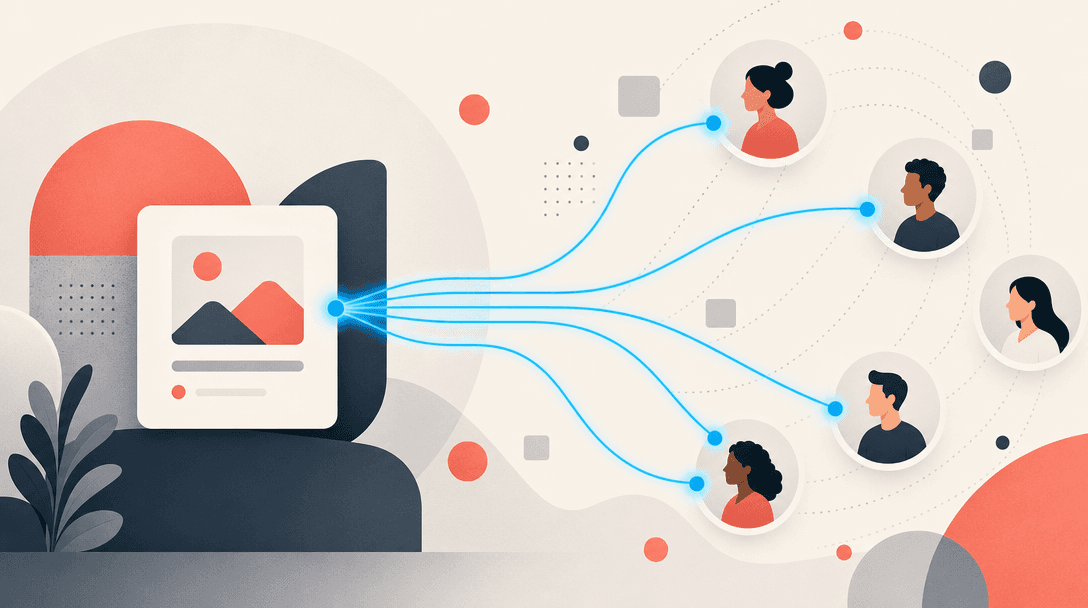
Organic social distribution infrastructure is not a calendar, a scheduler, or a dashboard. It is the execution layer between your content engine and the social platforms: account access, geo-local posting capacity, native app actions, engagement, analytics, and programmable control. TokPortal calls this layer The Human API because API calls are carried out through trained human operators using real smartphones and local SIM cards in 20+ countries.
If your team is generating 50, 100, or 1,000 videos with AI tools, UGC creators, clipping workflows, or agency production, the hard part is no longer making assets. The hard part is getting those assets posted natively, distributed by country, tested across accounts, and measured without turning your growth team into a manual operations queue.
20+
countries with local device coverage
150,000+
accounts under management
4,276
active business clients
6B+
organic video views generated
What is a social media distribution network?
A social media distribution network is a coordinated set of accounts, devices, operators, workflows, and APIs used to publish and engage with content across platforms and geographies. For organic social, the network has to act like native platform usage: real accounts, real apps, real locations, real posting behavior, and account-level analytics.
The CDN analogy is useful but incomplete. A traditional content delivery network moves website files closer to users. A social distribution network moves creative assets into the social graph through accounts that can post, tag locations, use native features, hand off monetization codes, and create early engagement signals. For TikTok specifically, that means distribution capacity is tied to device context, account history, geography, content relevance, and native app execution. Read the deeper infrastructure breakdown in TikTok distribution at scale.
Difference between scheduler and distribution infrastructure
Feature
Social scheduler
Distribution infrastructure
Primary job
Posting surface
TikTok sounds
Geographic execution
Best for
Schedulers are still useful. If a brand has one TikTok account, one Instagram account, and a normal publishing calendar, a scheduler may be enough. The moment the requirement becomes multi-account, multi-country, native TikTok sounds, Spark Codes, Partnership Ad Codes, account warming, or API-triggered video deployment, the category changes from scheduling to infrastructure.
That is why TokPortal sits next to, not inside, the scheduler category. A scheduling tool answers “when should this post go live?” Distribution infrastructure answers “which accounts, devices, countries, sounds, captions, workflows, and feedback loops should carry this campaign?” For a tool-by-tool view, compare social media automation tools in 2026 and the practical guide to posting to TikTok via API.
How a social CDN works for TikTok
Create or connect the account layer
The campaign starts with owned or rented accounts, credentials where applicable, niche context, and account-level rules. TokPortal accounts cost 25 credits per account in the distribution platform.
Warm the accounts before volume
New or inactive accounts need realistic interest signals before sustained posting. TokPortal supports niche warming for 7 credits and Instagram deep warming for 40 credits over a 3-day manual process.
Route creative by country and surface
Videos are assigned to TikTok, Instagram, or YouTube accounts and can be routed through local device coverage in countries such as the USA, UK, Brazil, France, Germany, Japan, Mexico, Spain, and Australia.
Post natively inside the app
A trained operator posts from a real smartphone inside the platform app. On TikTok this matters because native sounds, location tags, and in-app editing are available in the app experience while the official Content Posting API has narrower publishing capabilities.
Measure account and video performance
Analytics and webhooks return campaign feedback so growth teams can shift volume toward accounts, countries, hooks, and creative formats that produce better organic response.
A social CDN for TikTok is best understood as routing plus native execution. The routing layer decides where a video should go: country, account, niche, posting window, caption, sound, and campaign. The execution layer turns that instruction into a real in-app post through a real device. TokPortal exposes that flow through REST API, MCP, TypeScript SDK, Python SDK, webhooks, and automation integrations.
Developers can wire this into content pipelines through TokPortal developer documentation. If your workflow depends on TikTok sounds, the important distinction is explained in how to add TikTok sounds via native in-app posting: the official TikTok Content Posting API is useful for approved publishing flows, but it does not replicate every creative action available in the TikTok app.
Human API for social posting explained
The Human API means software sends an instruction, and a human-in-the-loop operator completes the social action on a real device. The API can request actions such as uploading a video, selecting a sound, posting from a local account, adding a location tag, collecting analytics, or triggering a monetizable handoff such as TikTok Spark Codes or Instagram Partnership Ad Codes.
This model exists because social platforms evaluate more than the uploaded file. They consider device signals, account behavior, local context, app-native features, and the history of the account. TokPortal’s infrastructure uses real physical smartphones, local SIM cards, and human operators in 20+ countries, which makes distribution closer to normal social usage than remote-only publishing stacks.
The category is neutral infrastructure. It does not promise virality. It gives growth teams programmable access to the operational work that normally requires hiring local social managers, buying devices, training operators, maintaining accounts, and building reporting systems.
Original operating insight: utility clicks are not distribution demand
Organic distribution vs paid ads
Organic distribution infrastructure is strong when
- You need to test many hooks, creators, accounts, countries, or product angles before committing spend.
- The creative should feel native to TikTok, Instagram Reels, or YouTube Shorts rather than campaign-led.
- Your team is producing AI video, UGC, clips, or affiliate content faster than it can manually publish.
- You want country-specific learning from local accounts and posting contexts.
- You need Spark Codes or Partnership Ad Codes as a bridge from organic posts to paid amplification.
Paid ads are stronger when
- You need guaranteed delivery volume within a fixed media plan.
- You already know the winning creative and want predictable budget scaling.
- Your legal, finance, or procurement process requires standard media-buying documentation.
- The campaign objective is immediate conversion tracking inside an ad platform rather than organic learning.
Organic distribution and paid ads solve different problems. Paid social buys delivery. Organic distribution buys learning, reach optionality, and platform-native market feedback. Strong teams often use both: organic infrastructure finds creative and account-market fit; paid media amplifies the posts or concepts that already show traction.
The performance bar should be realistic. TokPortal’s benchmark index of 9,000+ TikTok profiles shows average engagement rates around 6.2% for 1K–10K follower accounts, 4.8% for 10K–100K, 3.5% for 100K–1M, and 2.2% for 1M+ accounts. Top-quartile performance is above 5%. Those numbers do not guarantee campaign outcomes, but they give teams a reference point for judging whether distribution is producing meaningful response. For more context, use the TikTok algorithm 2026 guide.
When to use distribution as a service
- Use distribution as a service when your team can produce more content than it can publish manually.
- Use it when official APIs do not expose the native posting features your campaign needs.
- Use it when country-level testing matters, such as launching in the USA, UK, Germany, Brazil, Japan, Mexico, France, Spain, or Australia.
- Use it when an agency needs repeatable client operations without building a device-and-operator team in-house.
- Use it when an AI video tool needs a post-generation layer for customer content deployment.
- Use it when you need account warming, posting, engagement, analytics, and monetizable handoffs in one workflow.
- Do not use it when you only need a simple calendar for one account.
The cleanest trigger is content surplus. If your AI video stack, UGC team, clipping workflow, or affiliate operation produces more assets than your internal team can publish with quality control, distribution becomes infrastructure. A common agency pattern is: 10 client angles, 10 accounts, 3 countries, 2 platform surfaces, and weekly creative refreshes. At that point, spreadsheets and one-account schedulers create operational drag.
The second trigger is native feature need. TikTok sounds, location tags, in-app editing, local device context, and per-video handoffs are not just cosmetic details; they affect whether content feels native. If those features matter, read how to scale TikTok marketing with 100+ accounts before choosing tooling.
A practical decision framework for buyers
Use this rule: scheduler for calendar control, API for software control, distribution infrastructure for market coverage. A scheduler is the right answer when one brand team wants consistency. An official API is the right answer when the platform exposes every action you need. Distribution infrastructure is the right answer when you need to coordinate accounts, devices, countries, native app features, and reporting across a repeatable growth system.
For TokPortal, the unit economics are credit-based: 25 credits per account, 2 credits per video upload, 7 credits for niche warming, 40 credits for Instagram deep warming, 3 credits for video editing, and 1 credit for sound-volume control. That lets teams model the operational cost of launching a campaign before they scale it.
Model your first distribution campaign
Use TokPortal pricing to estimate accounts, uploads, warming, and native posting operations before you commit to a scaled organic launch.
What is organic social media distribution infrastructure?+
How is distribution infrastructure different from a social scheduler?+
Why does native in-app posting matter for TikTok?+
Is organic distribution a replacement for paid ads?+
When should an agency or brand use distribution as a service?+

Written by
Vincent Tellenne
Co-founder & CEO
Vincent is a co-founder and CEO of TokPortal. He works on the infrastructure and operating model behind scaled organic social media distribution.
Learn more about this topic with AI
Related Resources
Best Social Media Automation Tools for 2026 [Compared]
Compare the best social media automation tools for 2026. Discover top software for scheduling, account creation, and scaling TikTok & Instagram campaigns globally.
How to Post on TikTok via API in 2026 (Step-by-Step Working Guide)
Post videos to TikTok automatically with the official Content Posting API. Working examples, auth setup, sounds, scheduling — everything that works in 2026.
How to Scale TikTok Marketing with 100+ Accounts in 2026
Learn how to scale TikTok marketing with 100+ accounts using real devices, native posting, and account warming. Complete guide for brands and agencies running multi-account organic campaigns in 2026.
TikTok Algorithm 2026: How Organic Distribution Really Works
Deep dive into the TikTok algorithm in 2026. Understand how organic distribution works, why some videos go viral, and how to optimize multi-account campaigns for maximum reach.
TikTok Distribution at Scale: The Infrastructure Guide
Learn how to build a scalable TikTok distribution infrastructure. From account farms to geo-targeting, this guide covers everything marketing pros need to grow at scale.
How to Add TikTok Sounds via API: Native In-App Posting Explained
Learn how to add TikTok sounds via API using TokPortal's native in-app posting. Add trending sounds, control volume levels, and use carousels — all programmatically.
Related Tools
From the guide to your first campaign
You make the content.
TokPortal runs the account operations.
Create and operate TikTok and Instagram accounts in your target market. Local operators handle the account work and native publishing. You control the brief, content and campaign from the dashboard, API or MCP.
- 01Choose your market
- 02Define each account
- 03Schedule your content
Review market availability and pricing before ordering. No reach forecast is built into your plan.