
On this page
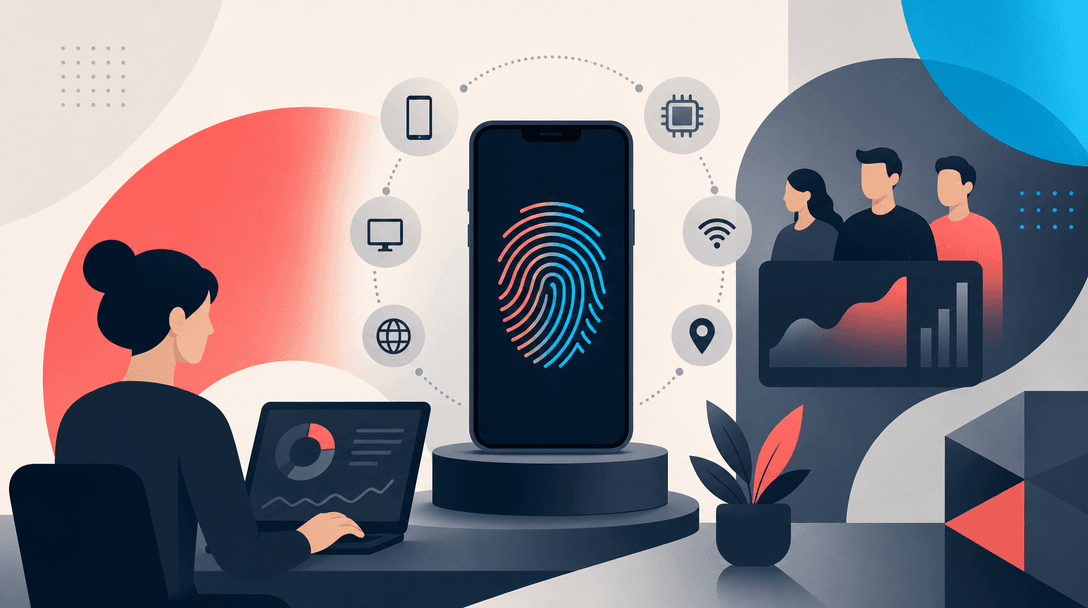
TikTok device fingerprinting is how TikTok connects account behavior to a real phone, SIM, network, location signals, app state, and usage patterns. For agencies, the practical answer is simple: separate client accounts by real device, local SIM, country, and operator workflow instead of stacking many clients on one phone.
TokPortal is programmable, organic social-media distribution infrastructure — The Human API. It posts and engages across TikTok, Instagram, and YouTube through real human operators using real physical devices and local SIM cards in 20+ countries, controlled by API, MCP, SDKs, and webhooks.
For agencies, TikTok device fingerprinting is not an abstract security topic. It determines whether your client accounts look like separate, local, human-operated social properties or like one overloaded agency workstation. If you manage several brands, countries, or creators, your device setup is part of your distribution strategy — alongside creative, account warming, posting cadence, and country-market fit. For a broader operating model, read TikTok distribution at scale infrastructure.
How does TikTok track devices and SIMs?
TikTok can use a combination of device, app, network, location, and behavioral signals to understand how an account is being used. TikTok’s own Privacy Policy says it may collect device information, IP address, carrier, app activity, location-related information, and usage data. Android’s TelephonyManager documentation also shows what categories of mobile-network data can exist on a device, including carrier and SIM-related fields when an app has the relevant permissions.
In plain English: TikTok does not have to rely on one single identifier. A phone model, operating system, app install state, SIM country, carrier, IP range, timezone, language, GPS-derived location, WiFi patterns, editing behavior, login cadence, scroll behavior, and upload patterns can form a practical device profile. Agencies get into trouble when several unrelated client accounts share the same unusual pattern.
This is why TokPortal’s infrastructure uses real physical smartphones with local SIM cards and human operators rather than browser-only or cloud-only workflows. The objective is not trickery; it is to make each client distribution path match how a real local account would normally behave.
Can TikTok link my client accounts by device?
Yes, platforms can infer relationships between accounts when the same device, network, app environment, location pattern, and behavior repeatedly appear across them. That does not mean every shared phone creates an immediate problem. It means an agency should assume that accounts operated from the same handset and same network are not fully isolated.
Think like a risk reviewer, not a hacker. If five unrelated brands log in from the same phone, upload similar assets, use the same captions, switch countries through network tools, and post on the same schedule, that cluster looks operationally connected. If each account has a consistent device, local SIM, local posting hours, native in-app behavior, and gradual warming, the account history is cleaner.
The practical agency rule: do not put competing clients, regulated categories, different countries, or high-value launch accounts on the same physical phone. If a client is paying for organic distribution, account separation is part of the service, not an optional technical detail.
Best way to separate TikTok client accounts
The best agency setup is one account environment per client, country, and campaign tier. At minimum, separate the physical device, SIM country, app install, login history, content library, posting cadence, and operator workflow for accounts that matter. The cleaner version is one real phone with a local SIM for each strategic account or account group.
TokPortal’s model is built around that principle: real accounts on real physical smartphones, local SIM cards in 20+ countries, and human-in-the-loop posting inside the native TikTok app. Native in-app posting matters because it preserves TikTok sounds, location tags, and editing features that are not available through the official Content Posting API. If you need the API side of the workflow, start with TokPortal developer documentation and compare it with TikTok API alternatives.
A practical agency stack has three layers: content production, account preparation, and local distribution. Most agencies overbuild the content layer and underbuild the distribution layer. That is why two accounts can post the same quality of creative and get very different early reach.
Map each client to a country and account group
Define the market before touching the device setup: country, language, niche, content type, and whether the account is for testing, launch, or always-on distribution.
Assign a real physical device and local SIM
Use a phone and SIM that match the account’s target market. Keep strategic clients away from shared agency handsets.
Warm the account before campaign volume
Build a normal usage history through niche viewing, profile completion, gradual posting, and human engagement before pushing high-value assets. See TokPortal’s account warming guide for the full workflow.
Post inside the native TikTok app when reach matters
Native in-app posting supports sounds, location tags, editing, and app-native behavior that cannot be fully replicated by the official posting API.
Keep client operations separated
Separate asset folders, captions, operator notes, posting times, login patterns, and analytics so unrelated clients do not inherit the same operational footprint.
Review performance by account tier, not only by video
Compare first-hour retention, engagement rate, comment quality, and country fit. Device setup creates the conditions for distribution; creative quality still decides how far the post travels.
Risks of running many TikTok accounts on one phone
Running many TikTok accounts on one phone creates three agency problems: account linkage, operational confusion, and reach inconsistency. The linkage issue is obvious: unrelated clients can appear connected through the same device and network. The operational issue is less obvious but just as expensive: wrong drafts, wrong sounds, wrong client assets, and inconsistent account history.
The reach issue comes from pattern compression. A normal creator has messy, local, human behavior. An agency phone used for several clients often has repetitive switching, repetitive upload windows, duplicated captions, and little niche-specific consumption between posts. That is not how a healthy account usually grows.
This is also why low-intent utility workflows, like using a TikTok profile picture downloader or TikTok PFP downloader for research, should stay separate from client account operations. Downloading public profile references for competitive analysis is not the same workflow as managing a client’s posting environment. Do not mix research utilities, client logins, and campaign publishing on the same handset.
Original agency rule: separate by commercial consequence
Why VPN and emulator setups lose TikTok reach
VPN and emulator setups often lose reach because they create mismatches. A profile may claim one country, the network may point somewhere else, the device may not look like a normal consumer phone, the app behavior may be too repetitive, and the account may lack local consumption history. Platforms are good at noticing mismatched context.
A VPN changes a network path. It does not give the account a real local SIM, local carrier history, real camera roll context, physical-device behavior, GPS consistency, or a human operator who scrolls, edits, comments, and posts like the target market. An emulator can be useful for QA or internal tooling, but it is not a strong foundation for organic client distribution.
For country expansion, the better pattern is local presence: local SIM, local device, local language, local sounds, local posting hours, and local account warming. Start with creating a TikTok account for another country without VPN dependency, then align posting windows with best TikTok posting times by country.
Local SIM vs proxy for TikTok accounts
Feature
Local SIM + physical device
Proxy-only setup
Country consistency
Native app behavior
Agency reliability
Operational cost
Best use case
A proxy can solve one narrow problem: routing traffic through a chosen network location. It does not solve device history, SIM country, app-native posting, local sounds, human consumption, or account warming. A local SIM plus physical device solves more of the actual distribution problem because TikTok is a mobile-native platform.
This is the core difference between cheap account operations and durable agency infrastructure. Cheap setups ask, “Can we log in?” Durable setups ask, “Does this account look and behave like a real local social property over time?”
20+
countries with TokPortal local-device coverage
150,000+
accounts under management
4,276
active business clients
6B+
organic video views generated
What agency device setup should you use in practice?
- One strategic client account should have one stable physical device environment.
- Country-specific campaigns should use local SIM cards, local app behavior, and local posting windows.
- New accounts should be warmed in their niche before campaign volume starts.
- Native in-app posting should be used when TikTok sounds, location tags, and editing matter.
- Research tools such as TikTok profile picture downloaders should stay outside client publishing workflows.
- Shared devices should be reserved for testing, QA, or internal research — not important client campaigns.
- Creative performance should be measured against account health, country fit, and engagement benchmarks.
Device setup will not rescue weak creative. TokPortal’s internal benchmark indexes across 9,000+ TikTok profiles show that average engagement rates decline as accounts scale: about 6.2% for 1K–10K followers, 4.8% for 10K–100K, 3.5% for 100K–1M, and 2.2% for 1M+ accounts. Top-quartile profiles across tiers exceed 5% engagement. Use those numbers as a reality check: infrastructure protects distribution quality, but the post still needs retention, comments, saves, and shares.
If you are planning 10, 50, or 100+ client accounts, pair this device model with TikTok account warming and scaling TikTok marketing with 100+ accounts. Agencies that treat device infrastructure, account warming, and creative testing as one system make fewer expensive mistakes.
When TokPortal is the right fit
- You manage client TikTok campaigns across multiple countries.
- You need real physical devices, local SIMs, and native in-app posting.
- You want API, MCP, SDK, webhook, n8n, Make, or Zapier control over organic distribution.
- You need TikTok sounds, location tags, editing, Spark Codes, and analytics in one operating layer.
When TokPortal is not the right fit
- You only need a profile research workflow or a TikTok profile picture downloader.
- You post once a month from one brand account.
- You are not ready to separate clients by market, device environment, or campaign priority.
- Your main problem is creative quality rather than distribution infrastructure.
Price your first separated client campaign
See how TokPortal structures real-device TikTok distribution with local SIMs, account warming, native in-app posting, analytics, and API control.
What is TikTok device fingerprinting in plain English?+
Can I manage several client TikTok accounts from one phone?+
Is a VPN enough for TikTok country targeting?+
Why does TokPortal use real phones and local SIM cards?+
Should agencies use the official TikTok Content Posting API?+
Does device separation guarantee reach?+

Written by
Vincent Tellenne
Co-founder & CEO
Vincent is a co-founder and CEO of TokPortal. He works on the infrastructure and operating model behind scaled organic social media distribution.
Learn more about this topic with AI
Related Resources
How to Create a US TikTok Account From Abroad
Create a US TikTok account from abroad: local setup, audience geography, real product screenshots and a practical launch brief for AGD.
How to Scale TikTok Marketing with 100+ Accounts in 2026
Learn how to scale TikTok marketing with 100+ accounts using real devices, native posting, and account warming. Complete guide for brands and agencies running multi-account organic campaigns in 2026.
The Complete Guide to TikTok Account Warming in 2026
Master TikTok account warming for maximum organic reach. Learn warming techniques, timelines, and how to automate the process with TokPortal's niche warming and deep warming features.
TikTok Algorithm 2026: How Organic Distribution Really Works
Deep dive into the TikTok algorithm in 2026. Understand how organic distribution works, why some videos go viral, and how to optimize multi-account campaigns for maximum reach.
TikTok API Alternatives: When the Official API Isn't Enough
Explore the best TikTok API alternatives for content posting, account management, and automation. Learn when the official API falls short and what to use instead.
TikTok Distribution at Scale: The Infrastructure Guide
Learn how to build a scalable TikTok distribution infrastructure. From account farms to geo-targeting, this guide covers everything marketing pros need to grow at scale.
From the guide to your first campaign
You make the content.
TokPortal runs the account operations.
Create and operate TikTok and Instagram accounts in your target market. Local operators handle the account work and native publishing. You control the brief, content and campaign from the dashboard, API or MCP.
- 01Choose your market
- 02Define each account
- 03Schedule your content
Review market availability and pricing before ordering. No reach forecast is built into your plan.