
On this page
You publish on two accounts. One video gets attention; the other barely moves. The tempting explanation is that the weaker account is damaged, the device is wrong or the platform recognized a duplicate. The counts alone cannot distinguish those explanations. Before replacing an account or producing another batch, establish what was actually published, what the platform tells you and which comparison you are making.
Account-Generated Distribution (AGD) is an organic growth model where content is distributed through a network of purpose-built social accounts instead of relying on a single brand account or external creators for reach. A network makes comparisons possible, but it also creates more opportunities to confuse an account problem, a delivery problem and an ordinary difference between posts. The purpose of this guide is to separate those cases and choose a useful next action.
Here, reposting means uploading the same or substantially similar creative again, including across your own accounts. It is different from using TikTok's native Repost feature to share an existing post. The diagnostic below combines current TikTok help, a real public creator question and an original production review. It does not infer a private enforcement decision from a public counter or claim that any posting cadence is guaranteed safe.
Sources & real examples
Public accounts, original posts and primary references. Each example is linked where it is discussed.
View all 7 sources and review notes
- Public creator question ↗
Self-reported unequal views; incomplete conditions, not a controlled causal result.
- TikTok account status ↗
Account check reports restrictions on specific account features.
- TikTok content and eligibility decisions ↗
Review, removal and For You ineligibility are distinct; reason and appeal instructions.
- TikTok account recommendation notice ↗
Account-level notice and appeal route; low views alone are not that notice.
- TikTok recommendation explanation ↗
Several categories of recommendation signals; not a formula for diagnosing an individual post.
- Zach King Shorts feed ↗
External creative example. Rounded public counts are not a TikTok benchmark.
- Zach King Lego spacecraft Short ↗
Specific visual premise; screenshot does not reveal production method or cause of reach.
The real question behind unequal views
In this public creator discussion, the author reports that the same material receives different attention on two accounts. The question is recognizable because it appears to isolate one variable: change the account, keep the video. But the surrounding conditions are not established by that short report.
The thread does not supply a complete export of post ages, traffic sources, audience histories, eligibility notices or every previous upload. Its numbers are the author's self-report. It is useful evidence that creators ask this question, and useful language for describing the problem. It is not a controlled experiment demonstrating that one account has an algorithmic penalty.
For your own network, reconstruct those missing details before acting. Which exact post URLs are involved? How old was each post when measured? Were both public? Did they use the same sound, caption and complete export? Had either already been removed, restricted or replaced? A comparison becomes more useful as those fields become observable, even if some remain unknown.
First establish that the intended post exists
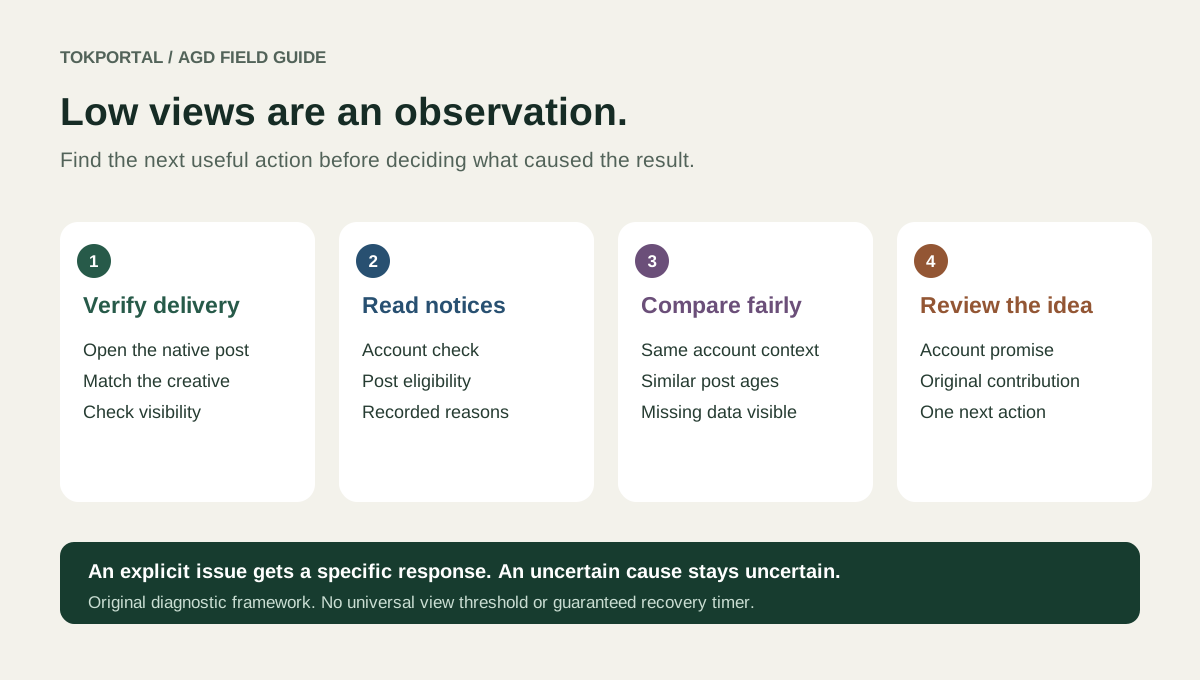
Open the native post from the delivery record. Confirm the account identity, intended asset, actual caption, sound where relevant and visibility settings. If the URL is missing, inaccessible or points to another post, investigate delivery first. A scheduled task or workflow acknowledgment cannot substitute for the viewer-facing result you intend to measure.
Record the state in plain language. “Scheduled for tomorrow,” “post opens but is private,” “native URL missing” and “public post with a low displayed count” describe different situations. Each should lead to a different owner and next action. Grouping all of them under zero views can send the creative team into unnecessary edits while an operational issue remains unresolved.
For TokPortal workflows, the infrastructure guide connects the approved asset, operation and native post. Use that record to verify what was delivered. If the asset is wrong, request a specific correction through the available workflow. Repeating the whole assignment before understanding the mismatch can create a second problem to diagnose.
Read the platform's notice before inventing a diagnosis
TikTok's account status help describes Account check in TikTok Studio and the Safety Center. It surfaces restrictions involving features such as posting, comments, profile editing or login. Check the actual warning and affected feature; a clean result on one check should not be rewritten as a guarantee of future reach.
TikTok separately documents content violations and recommendation eligibility. A post may be under review, removed, or ineligible for the For You feed. For an ineligible post, the help page describes viewing the reason through its insights or analytics and appealing a decision you believe is mistaken. Record the exact notice and its date before choosing an action.
There is also an account-level recommendation notice. TikTok says affected accounts receive information in their inbox and profile, with a route to review flagged content and appeal. That is a specific platform state. A lower count than yesterday is an observation, not the same kind of evidence.
When a restriction is explicit, work from that reason and the platform's stated process. Do not move the same material to another account to avoid an enforcement decision. If no notice is available, write “no notice observed” and continue the investigation. That statement is narrower and more accurate than declaring either a hidden ban or a completely healthy account.
Separate a weak post from a change in the baseline
A single low result may be unusual, but it cannot by itself establish a persistent account decline. Compare the post with a recent, relevant group from the same account. Use similar observation ages, preserve the individual values and record changes in format or audience promise. If those conditions differ, name the difference before drawing a conclusion.
The AGD relative-performance guide provides a descriptive baseline and worked example. For this diagnostic, the key question is whether the current observation differs from ordinary comparable posts, or only from a selected hit. A peak is a real event, but it is a poor default expectation for every subsequent episode.
Avoid replacing an absent baseline with a universal view threshold. A young series may not yet have enough comparable observations for a stable description. Label that situation honestly and keep collecting a defined set. An account that has published three unrelated experiments gives you a different kind of evidence from an established series with a consistent audience promise.
Keep the observation clock consistent. A snapshot taken shortly after publication and one taken several days later are not interchangeable. If the platform's reporting has not updated, preserve the recorded time and check again through the normal reporting process. There is no general waiting period in this guide that diagnoses or cures a reach problem.
Inspect audience response without claiming to reverse-engineer ranking
TikTok's recommendation explanation describes several categories of signals, including user interactions, content information and user information. It also distinguishes recommendation eligibility from simply remaining on the platform. This helps explain why two uploads do not have identical distribution conditions, even when their files look similar.
For a post that is publicly available and has no observed restriction notice, inspect the metrics actually provided to the account. Keep their definitions and time windows attached. Then watch the video itself. Does the opening make a clear promise? Does the content fulfill it? Is the essential demonstration visible, and can somebody unfamiliar with the product understand the result?
A retention change can suggest where to inspect the creative, but it does not prove the cause of a ranking decision. A comment asking what a product does can identify a missing explanation without measuring how many other viewers were confused. Use each observation for the question it can answer. Avoid turning a plausible editorial explanation into a claim about a hidden platform mechanism.
Audit the creative contribution before adjusting the export
Place the two actual posts beside their briefs. Describe what a viewer learns, feels or watches unfold in each. If the answers are identical because both use the same footage and payoff, a different caption or crop has not created a new episode. This is an editorial judgment about audience value, not a technical recipe for evading duplicate detection.
A useful comparison comes from Zach King's public Shorts feed. The captured feed presents different situations within a recognizable style of visual illusion. The Lego spacecraft Short gives one concrete example: a physical model and table become the setting for an impossible-looking event. Watch the original to inspect the complete execution; the still frame alone does not reveal how it was produced.
The transferable idea is to repeat a creative promise while commissioning a new situation. A tutorial account can solve another real problem. A performance account can record another arrangement. A product experiment can investigate a different question. These proposals require new substance. Zach King's public work is an external creative reference, not evidence that a given variation will fix TikTok reach or that his team uses AGD.
For each proposed replacement, write the new contribution in one sentence before editing. “Show how to complete the task with a different real constraint” can guide production. “Change the first frame so the platform does not recognize it” does not improve the viewer's experience and rests on an unverified mechanism. Choose the former as an editorial brief, without promising a particular distribution outcome.
Check whether the account's promise still fits the post
A network can drift when every strong asset gets sent to every account. The beginner tutorial page receives an inside joke, the product demonstration page receives a founder diary, and the local-language series receives an untranslated export. Each video might be useful somewhere. The diagnostic question is whether it belongs where it was published.
Read the profile and its recent posts as a new visitor. Write what you would expect to see next. Then compare that expectation with the disputed post. A mismatch is a reason to revisit the brief, not proof that the platform punished the account. The formatted versus varied AGD guide helps decide which kind of recurring promise the team can sustain.
Preserve the difference between account identity and content execution. Two accounts may legitimately address related audiences while using distinct original episodes. Two different handles carrying the same repeated exports may offer little reason to follow both. The isolation guide turns that distinction into a planning exercise before the next batch is commissioned.
Choose one response that matches the evidence
An explicit platform notice, a broken delivery and a weak creative hypothesis should not trigger the same remedy. Use the table as an original triage aid. It identifies the next piece of work; it does not assign probabilities to causes or forecast a recovery time. Several rows may apply, in which case resolve the observable delivery or status issue before interpreting performance.
Feature
What the evidence supports
Useful next action
Missing native post
Explicit restriction
Unmatched comparison
Repeated creative
No clear cause
Write down why you chose the action and what would change your mind. If the problem is an incorrect sound, the next check is whether the corrected post has the intended sound. If the hypothesis is that the opening lacks context, the next production should actually supply that context. A modest result after a correction does not mean the correction failed its operational purpose.
Avoid a burst of simultaneous changes that leaves no useful record. Replacing the account, changing the format, altering the audience and moving the schedule all at once may produce a different outcome, but it makes the explanation less clear. Organic distribution is not a controlled laboratory; even a carefully documented comparison should be treated as directional evidence rather than a guaranteed causal test.
Run a documented review of the next original episode
Before producing the next post, record the question you want to investigate, the account role and the new creative contribution. Keep the rest of the brief clear enough that another teammate can identify what actually changed. Choose the observation windows in advance based on how your team reviews that series, and use the same definitions in the follow-up.
When the post is live, repeat the delivery and notice checks. Add the native URL, publication time and observation timestamps to the same incident record. If the result is still weak, preserve the evidence instead of deleting the history to make the feed look cleaner. Your private working record can remain useful even when a later editorial decision changes what the public sees.
Close the review with a concrete next decision: fix a destination, clarify the account promise, commission a stronger original episode or continue collecting comparable observations. If the evidence remains inconclusive, say so. A diagnostic process earns its value by narrowing the next action, not by attaching a confident algorithm story to every fluctuating counter.
Keep AGD growth attached to editorial capacity
The durable response to a repetitive network is a better production system. Give each account an owner, an audience promise and a supply of original episodes. Keep the delivery record connected to the creative brief so the analyst can identify what viewers actually encountered. Add destinations when the team can sustain their distinct roles, rather than using new accounts as a response to every disappointing post.
TokPortal can organize the account operating layer around that plan. Bring the approved assets and the account briefs into the buyer campaign flow, then review the resulting posts against the same records. Use the worksheet below to investigate the current issue before scaling the next batch. The aim is to make the next decision clearer and the next publication more useful to its intended viewer.
Your AGD reach-drop incident worksheet
AGD REACH-DROP INCIDENT WORKSHEET
OBSERVATION
Account URL / editorial role / investigator:
Post URLs / publication times / measured at:
Exact metric and source / values / missing fields:
What prompted this investigation?

DELIVERY CHECK
Correct account / approved creative / caption / sound:
Public URL works? Visibility observed by / date:
Workflow-only state or verified native result?

PLATFORM STATE
Account check finding / checked at:
Post eligibility notice / exact reason / date:
Account recommendation notice / affected content:
Appeal or correction reference / current state:
No notice observed is not proof of a ranking diagnosis.

COMPARISON
Same account baseline / selected post URLs:
Comparable ages / formats / audience promise:
What differs or remains unknown?

CREATIVE AUDIT
Contribution of each compared post:
Repeated footage / new material / new viewer payoff:
Fit with the account promise:

NEXT ACTION
Observable issue or hypothesis:
One concrete correction or original production:
What stays comparable / what changes:
Review owner / observation windows / success criterion:
Outcome / uncertainty / next decision:

Written by
Vincent Tellenne
Co-founder & CEO
Vincent is a co-founder and CEO of TokPortal. He works on the infrastructure and operating model behind scaled organic social media distribution.
Learn more about this topic with AI
Related Resources
Related Tools
Put your AGD strategy to work
You make the content.
TokPortal runs the account operations.
Create and operate TikTok and Instagram accounts in your target market. Local operators handle the account work and native publishing. You control the brief, content and campaign from the dashboard, API or MCP.
- 01Choose your market
- 02Define each account
- 03Schedule your content
Review market availability and pricing before ordering. No reach forecast is built into your plan.