
On this page
A publishing calendar can tell you that a video was scheduled. It cannot, on its own, tell you whether the right account received the right creative, whether the native post contains the intended sound, or whether the person reviewing performance is looking at the same asset. Those gaps become expensive when a team operates several accounts and hands work between an editor, an operator and an analyst.
Account-Generated Distribution (AGD) is an organic growth model where content is distributed through a network of purpose-built social accounts instead of relying on a single brand account or external creators for reach. Its infrastructure has to preserve the purpose of each account all the way into the published result. More destinations are useful only when the team can keep their content, responsibilities and observations intelligible.
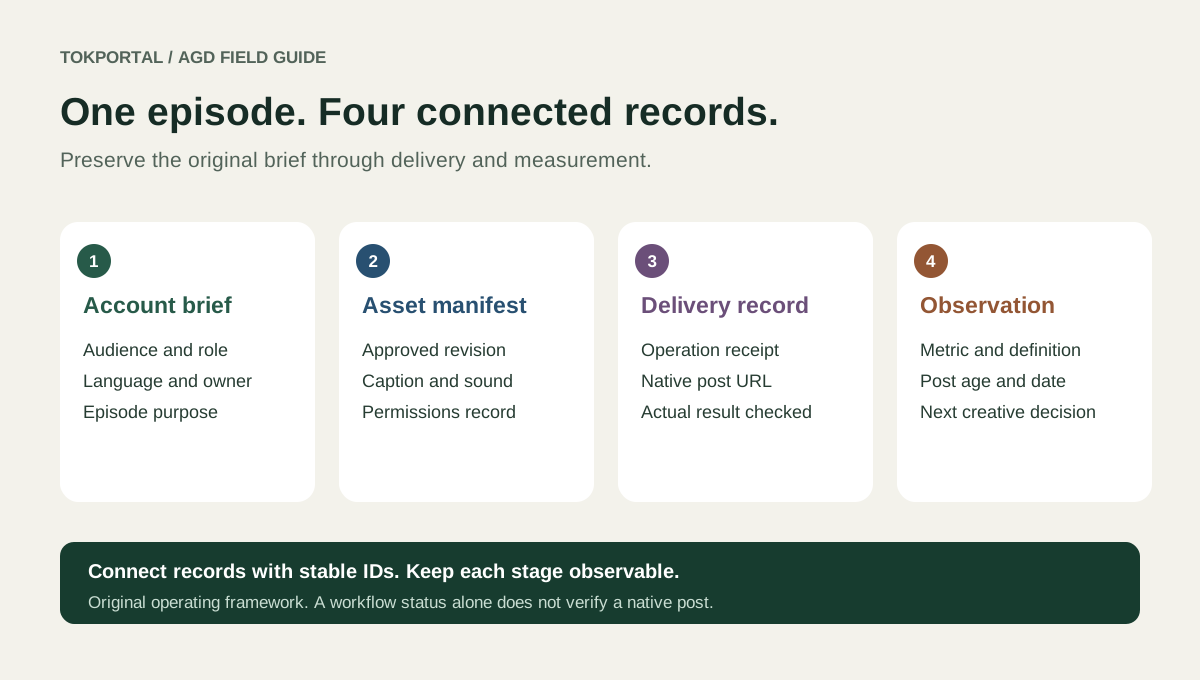
This guide offers an original operating design: a brief, an asset manifest, a delivery record and an observation ledger connected by stable identifiers. Public Duolingo profiles illustrate the editorial information worth preserving. Platform documentation explains why workflow acknowledgments and native publication need separate checks. Neither example reveals a brand's private production system or establishes that it uses TokPortal.
Sources & real examples
Public accounts, original posts and primary references. Each example is linked where it is discussed.
View all 7 sources and review notes
- Duolingo main profile ↗
Public editorial surface; no inference about private operations.
- Duolingo Japan profile ↗
Language and feed context visible in the captured profile; audience geography is not measured.
- TikTok Get Post Status ↗
Official asynchronous posting status documentation; not a guaranteed publication time.
- YouTube video implementation ↗
Upload and processing are distinct platform states. Not a claim of TokPortal YouTube API support.
- TokPortal Video Actions ↗
Current command semantics, scheduling adjustments and delivery review window; inspected in browser.
- TokPortal video capabilities ↗
Current public API platform support. Use action-specific documentation for command semantics.
- TokPortal webhook catalog ↗
Emitted lifecycle events and verification contract; no invented metrics event.
Begin with the account's job, not its login
A roster containing handles, passwords and countries is an access inventory. An editorial roster answers a different question: why should someone follow each account? Write the audience, language, recurring promise, exclusions and person responsible for each profile. These fields give the operator a reason to stop when a perfectly valid file belongs to the wrong destination.
Consider the public Duolingo main profile and Duolingo Japan profile. The captured profiles share the owl identity while presenting different language and feed contexts. From the outside, we can observe those editorial surfaces. We cannot infer their device arrangements, internal approvals, account ownership contracts or the geographic composition of their viewers.
For an AGD team, this comparison becomes a routing question. If an editor labels a file only “Duo final,” which destination should receive it? A useful handoff would identify the intended account, language reviewer, series and approved caption. These are proposed operating fields inspired by the visible difference between profiles, not a reconstruction of Duolingo's actual process.
Make the account promise available wherever the work is assigned. If it lives only in a strategy deck, the person scheduling a video cannot easily check it. A short profile brief beside each assignment helps preserve identity when the network grows. The account and content isolation guide explains how to distinguish an editorial role from a new handle attached to the same feed.
Connect four records instead of building one giant spreadsheet
Give the account a stable internal identifier and retain its public URL separately. Handles can change; the historical record should remain attached to the same editorial role. Give every original episode its own identifier too. These identifiers belong to your operating system and do not need to imitate platform IDs or API field names.
The brief describes the intended experience. The asset manifest identifies the approved material. The delivery record connects that material to the operation and resulting post. The observation ledger records what was measured later. Separating these records lets the creative team revise a future brief without accidentally rewriting the description of a post that is already live.
A proposed example is an original product demonstration recorded for a beginner tutorial series. Its episode ID stays the same while an editor produces two revisions. Only the approved revision enters the delivery record. If the resulting post uses an earlier export, the reviewer can name the discrepancy. “Wrong version” becomes a specific correction with a traceable source file.
Keep the system as small as the team can reliably maintain. A shared table and an asset folder can hold these relationships for an initial pilot. A database and event receiver become useful when several people need to update different stages concurrently. The requirement is a dependable connection between records, not a particular software stack.
Build an asset manifest an operator can act on
The approved asset should arrive with the intended account, original source location, final export, caption, sound reference where applicable and requested date. Add the responsible reviewer and the scope of any permissions. A file name containing “approved” is weaker than an explicit approval attached to one version, especially when several exports circulate in chat.
A content hash can help your software detect that the bytes at an asset URL changed after review. It does not tell you whether the video is original, useful or permitted. Those are editorial and rights decisions. Preserve both kinds of evidence: the technical identity of the file and the human decision authorizing that file for this use.
Inspect the asset as a viewer as well as a file. Open the complete video, check that the text is legible, confirm the audio is present and verify that the ending matches the opening promise. For a carousel, read the slide order as a sequence. An automated validation can catch a missing file; it cannot decide whether the explanation leaves out the essential step.
When a source file changes, create a new revision and identify which future assignments should receive it. Avoid quietly replacing a shared URL that is already attached to several scheduled posts. Explicit revisions make a correction easier to scope and keep an old campaign report understandable when somebody revisits it months later.
Treat a publish request as a handoff with its own receipt
Read the meaning of the operation you call. TokPortal's Video Actions documentation describes publishing a configured slot as making work available for the account manager to begin. Its response can carry a workflow status named published. That response alone is not the native social post URL or evidence that somebody can already watch the video.
Store the request's operation identifiers, returned state and effective schedule together. The same documentation describes adjustments when requested dates have become stale. Use the returned dates when that happens. Otherwise the creative team may expect a launch-day post while the operator's actual schedule now describes a different day. These scheduling fields belong to TokPortal's workflow, not TikTok recommendation behavior.
The distinction also exists in other publishing systems. TikTok's Get Post Status documentation provides status checks for its Content Posting API, with asynchronous processing and status updates. YouTube's video implementation guide separately explains checking processing after an upload. These are platform-specific examples of why a submission receipt and a completed viewer-facing result are different records.
This comparison does not imply that every route is available through TokPortal. Its current video documentation says public API bundle creation supports TikTok and Instagram; YouTube ordering is not open through that API. Choose a supported operation for the intended platform and check its current requirements before building a recurring workflow around it.
Use events to refresh state, then verify the result
TokPortal's webhook catalog lists supported lifecycle events such as video.in_review, video.pending_corrections and video.finalized. Subscribe to the events that correspond to decisions your team actually needs to make. A review event can create a review task; a correction event can keep an unresolved delivery visible. Do not invent event names for metrics or public posting that are absent from the current catalog.
The webhook documentation also defines signature verification and an event identifier. Use those documented mechanisms in your receiver. Keep authentication material in the server's secret store. For event types with retry delivery, deduplicate using the stable event identifier so receiving the same notification again does not create another assignment or repeat a consequential action.
Our recommended design treats an event as a reason to refresh the current item before acting. A delayed notification can arrive after someone has already handled a correction. Reading the current record prevents an old event from reopening completed work merely because it arrived later. Keep the received event and the state you acted on in the same incident history.
Plan for silence as well as notifications. A scheduled reconciliation can list the items your own ledger still considers unresolved and compare them with current workflow records. If an event was missed, the item remains discoverable. This is an original reliability pattern for the integration, not a claim that TokPortal supplies your reconciliation database or a ready-made exception dashboard.
Review the native post before closing the assignment
The reviewer needs the public post URL and the approved brief side by side. Open the result on the intended platform. Check the account identity, the actual creative, caption, sound attachment if relevant and the viewer's next destination. Record the time of inspection and any visibility limitation encountered. A link that opens for its owner may still require another visibility check appropriate to the intended audience.
Make corrections concrete. “Wrong sound” should name the requested sound reference and the one currently visible. “Text unreadable” should identify the frame or slide. “Wrong account” should identify both destinations. Specific observations help the responsible person resolve the problem without having to reinterpret the whole campaign brief.
TokPortal's review and correction instructions describe a limited review window and finalization behavior. Assign the reviewer when the work is commissioned, then use the current documented window when setting the task deadline. Do not let a general Friday review ritual replace a delivery-specific deadline that may expire earlier.
Separate delivered correctly from performed well. A post can satisfy the brief and receive modest attention. Another can gain attention despite containing an incorrect destination. Closing the delivery task should reflect the first question; the observation ledger handles the second. Keeping the two decisions separate makes both the operational review and the later creative discussion more precise.
Make exceptions visible without creating a second campaign
A failed download, an inaccessible post, a revised date and an editorial correction need different responses. Give each unresolved item a named owner, the observable problem, its current evidence and the next action. Avoid a single “failed” column that mixes technical availability, incomplete work and disappointing performance. A team cannot prioritize well when those situations look identical.
Feature
Evidence to retain
Next responsible action
Asset unavailable
Date changed
Wrong native result
Metric missing
Keep retry decisions attached to the existing assignment. If a network timeout leaves a request's result uncertain, inspect the current item before creating another order. When the API documents idempotency or a dry-run facility for the operation, follow that contract. Do not assume a successful dry run reserved capacity or that an uncertain response means nothing happened.
Add an escalation path for the cases automation cannot resolve. The asset owner can replace an unavailable export. The editor can clarify a mismatched brief. The account operator can investigate a native posting problem. The analyst can correct a reporting definition. Routing the problem to the right role is often more useful than adding another automatic retry.
Measure the operating system and the content separately
The operating review can count assignments awaiting assets, unresolved deliveries and corrections by cause. Define each number from your own records and include its time window. These are team measures, not a promised TokPortal dashboard. Their purpose is to identify work that is stuck and changes that would reduce repeated errors.
The content review begins with verified post URLs. Record each metric's source, definition, observation time and post age. A missing value stays missing; it does not become zero just because a report expects a number. Use the relative performance guide when comparing a post with its account's ordinary results, rather than letting the network's biggest outlier define every account's target.
Do not combine a platform view count, a website visit and a purchase into a single performance score without explaining the relationship. Each describes a different observation. Campaign links can help connect the web portion of a journey, while platform attribution gaps may remain. Your infrastructure should preserve those gaps so the strategy team can make decisions from the evidence it actually has.
Expand when the next account has both content and an owner
Before adding another account, run the complete loop with the roles you already operate. Can an editor hand off an approved episode without a private explanation? Can an operator find the exact intended version? Can a reviewer trace a native post to its brief? Can the analyst identify what was measured and when? These are practical expansion questions, not a prescribed account count.
New accounts increase the need for original material and clear ownership. Estimate those costs alongside account operations. A team that can fund publication but cannot sustain the promised series will accumulate empty slots or repetitive posts. The distribution planner helps estimate the operating layer; keep production, editing and review time in the campaign budget too.
Use TokPortal when the account roles and creative plan are ready to become operational work. Bring the roster, approved assets and review owner into the campaign setup. Keep the worksheet below as your connecting record. The useful outcome is a network in which every published post can be traced back to a purposeful brief and forward to an observation that improves the next one.
Your AGD delivery ledger
AGD DELIVERY LEDGER / PLANNING FIELDS, NOT AN API PAYLOAD
ACCOUNT
Internal account ID / current public URL:
Audience / language / recurring promise:
Editorial owner / operator / review owner:

APPROVED EPISODE
Episode ID / series / creative contribution:
Source asset / approved export / revision / optional hash:
Approval record / permitted uses:
Caption / sound reference / expected destination:

WORKFLOW RECEIPT
Provider / operation / item IDs:
Requested date / returned effective date:
Returned status / recorded at:
Current state checked at / next action owner:

NATIVE DELIVERY REVIEW
Public post URL / actual account / publication time:
Approved version matched? Caption / sound / destination checked?
Visibility observed / reviewer / checked at:
Correction / evidence / deadline / resolved at:

OBSERVATION
Metric / definition / data source:
Value or missing / observed at / post age:
Attribution limits / comparison set:
Next editorial decision / owner:

Written by
Vincent Tellenne
Co-founder & CEO
Vincent is a co-founder and CEO of TokPortal. He works on the infrastructure and operating model behind scaled organic social media distribution.
Learn more about this topic with AI
Related Resources
Related Tools
Put your AGD strategy to work
You make the content.
TokPortal runs the account operations.
Create and operate TikTok and Instagram accounts in your target market. Local operators handle the account work and native publishing. You control the brief, content and campaign from the dashboard, API or MCP.
- 01Choose your market
- 02Define each account
- 03Schedule your content
Review market availability and pricing before ordering. No reach forecast is built into your plan.