
On this page
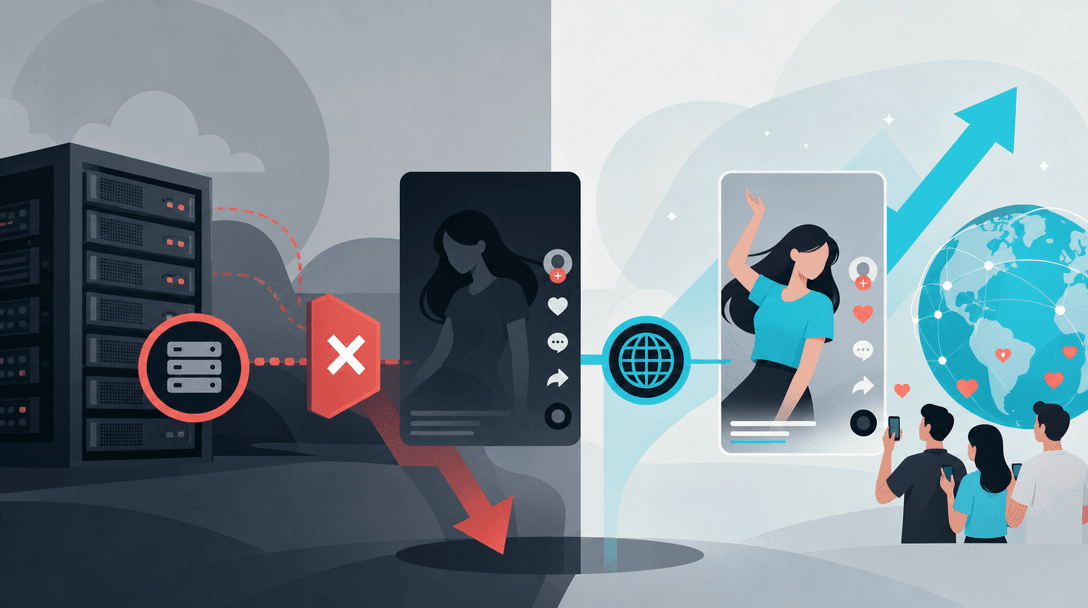
Datacenter IP TikTok posting is a reach risk because TikTok can observe IP address, device signals, location context, and behavior patterns, not just the video file. If many uploads come from the same server IP, test reach can compress. The fix is geo-native posting from real devices, warmed accounts, and normal in-app behavior.
TokPortal is programmable, organic social-media distribution infrastructure — The Human API. It posts and engages across TikTok, Instagram, and YouTube at scale through real human operators using real physical devices and local SIM cards in 20+ countries, controlled via API, MCP, and SDKs.
If your TikTok views dropped after moving uploads into a server, scheduler, or one centralized workflow, diagnose the upload path before rewriting the creative strategy. TikTok’s own privacy disclosures say it can process IP address, device information, network data, approximate location, and usage behavior. That means a TikTok post is not just evaluated as a video file; it is also contextualized by the account, device, network, and behavior around the upload. For the infrastructure view, see TikTok distribution at scale infrastructure, or compare the official route in how to post to TikTok via API.
Is it bad to post TikTok from a datacenter IP?
Posting TikTok from a datacenter IP is not automatically a problem for every use case, but it is a poor default for organic reach campaigns. A datacenter IP usually means the upload originated from cloud infrastructure rather than a normal mobile environment. For one-off publishing, that may be acceptable. For repeated organic distribution across many accounts, it creates a pattern that looks unlike normal creator behavior.
The issue is not only the IP address. It is the combination of server IP, repeated upload timing, account switching, missing local mobile context, and identical operational behavior. If 30 accounts publish from the same network path, TikTok has more correlated signals than if 30 local devices publish natively in their own markets.
Datacenter posting is most risky when you are trying to scale UGC, AI-generated video, affiliate clips, music seeding, or multi-country campaigns. These programs depend on clean first impressions in the initial test audience. If the account and network context are weak, good creative may never receive a fair early read.
How do the TikTok algorithm and IP reputation connect?
The TikTok algorithm is usually discussed through watch time, rewatches, shares, comments, saves, and viewer-topic fit. Those are still core content signals. But distribution systems also need integrity signals: where the post came from, what device posted it, whether the account behaves like a normal local user, and whether the upload pattern resembles real usage.
TikTok’s privacy policy states that the platform can process data such as IP address, device identifiers, network information, approximate location, app activity, and usage patterns. That does not mean IP alone decides reach. It means IP reputation can be one input in a broader trust and context model.
The practical growth takeaway: do not optimize only the video. Optimize the posting context. A strong video uploaded through weak infrastructure can underperform the same asset posted through a warmed, local, real-device workflow. For the content-side model, read TikTok Algorithm 2026: how organic distribution really works.
Does VPN affect TikTok views?
A VPN can affect TikTok views when it creates inconsistent location and network signals. If an account normally behaves like a French user on a French mobile connection, then suddenly posts through a U.S. VPN endpoint, the account context becomes less coherent. The same applies when many accounts rotate through the same consumer VPN pool.
VPNs are especially weak for country targeting. A VPN changes the visible network endpoint; it does not recreate the full local environment of a physical phone, local SIM, carrier history, GPS context, language habits, app behavior, and human interaction. For multi-country TikTok distribution, local devices beat location masking.
If your goal is to reach another market, do not treat a VPN as distribution infrastructure. Build or rent local posting capacity instead. For a country-specific version of this problem, see how to create a TikTok account in another country without a VPN.
TikTok posting from residential vs datacenter: what changes?
Feature
Residential or mobile real-device posting
Datacenter or centralized server posting
Network context
Device context
Geo coherence
Native posting features
Best fit
How does IP fingerprinting change TikTok reach?
IP fingerprinting matters because it helps connect an upload to a broader environment. A platform can compare the visible IP address with device data, app behavior, account history, location context, language, time zone, and engagement patterns. When those signals agree, the account looks coherent. When they conflict, the system has less reason to distribute aggressively.
Think of reach as a sequence of tests, not a single decision. A post is exposed to an initial audience; the platform reads retention and engagement; then it expands or stalls. If infrastructure signals reduce confidence before that first test, the post may receive a smaller or lower-quality test audience, making performance harder to judge.
This is why teams misdiagnose creative. They see 200 views and assume the hook failed. Sometimes it did. But if every account posted through the same server IP within the same workflow window, the distribution test itself may have been compromised.
Do centralized posting tools reduce TikTok reach?
Centralized posting tools are not automatically bad. They are useful for calendars, approval flows, asset management, and reporting. The reach issue appears when the publishing layer turns many accounts into one operational pattern: same server path, same upload timing, same metadata defaults, same missing native app context.
The official TikTok Content Posting API is a legitimate developer route for supported workflows, and teams should use official documentation when it fits. But official server-side posting is not the same as native in-app posting. Native posting inside the TikTok app can use TikTok sounds, location tags, app-native editing, and normal device context. For that distinction, read how to add TikTok sounds via native in-app posting and compare broader options in best social media automation tools for 2026.
Also separate posting traffic from read-only utility traffic. A TikTok profile picture download, TikTok profile picture downloader, or TikTok pfp downloader workflow touches public profile media; it is not the same operational risk as uploading campaign videos from the same network path across many accounts.
For developers building distribution systems, the right question is not “Can I upload?” It is “Can I preserve organic posting context at scale?” TokPortal exposes programmable distribution through TokPortal developer docs, API, SDKs, MCP, and webhooks.
How do you fix low views due to posting IP?
Separate creative failure from infrastructure failure
Pick 10 recent videos with similar hooks, topics, and editing quality. Compare posts uploaded from the server path against posts uploaded natively from coherent local devices. Do not judge the whole strategy from one account.
Audit the upload path
Record the account, upload method, IP type, country, device type, posting time, caption workflow, sound usage, and first-hour view pattern. Look for repeated same-IP or same-workflow clusters.
Stop routing scaled organic posts through one server pattern
Keep the server for orchestration, storage, approvals, and analytics, but move reach-sensitive publishing to real mobile environments when organic distribution is the KPI.
Warm accounts before scaling volume
Use niche-relevant browsing, engagement, and posting behavior before increasing output. TokPortal supports niche warming and deeper manual warming where a campaign needs stronger account context. See <a href="/learn/tiktok-account-warming-guide" class="text-[#FF0050] hover:underline">the TikTok account warming guide</a>.
Match country, device, and content intent
If the campaign targets Germany, Brazil, Japan, or the United States, the posting environment should make geographic sense. Align SIM, carrier context, language, local posting windows, and creative references.
Measure first-test recovery
Track first 60 minutes, 24-hour views, engagement rate, comment quality, and saves after changing the posting path. If reach improves on the same creative category, infrastructure was part of the issue.
20
countries with TokPortal real-device distribution coverage
150,000+
accounts under management
4,276
active business clients
6B+
organic video views generated
9,000+
TikTok profiles analyzed in TokPortal benchmark indexes
>5%
top-quartile TikTok engagement rate across TokPortal benchmark tiers
Original diagnostic: the device-IP-content triad
Build a real-device TikTok posting layer
Use TokPortal’s API, SDKs, MCP, and webhooks to route organic campaigns through real devices and local operators instead of one server-side posting pattern.
Can posting TikTok videos from the same server IP cause low views?+
Is the official TikTok Content Posting API the wrong choice?+
Will a VPN fix TikTok reach from the wrong country?+
How do I know if low views are caused by creative instead of posting infrastructure?+
What is the safest operational fix for scaled TikTok posting?+
Where does TokPortal fit in this workflow?+

Written by
Vincent Tellenne
Co-founder & CEO
Vincent is a co-founder and CEO of TokPortal. He works on the infrastructure and operating model behind scaled organic social media distribution.
Learn more about this topic with AI
Related Resources
Best Social Media Automation Tools for 2026 [Compared]
Compare the best social media automation tools for 2026. Discover top software for scheduling, account creation, and scaling TikTok & Instagram campaigns globally.
How to Post on TikTok via API in 2026 (Step-by-Step Working Guide)
Post videos to TikTok automatically with the official Content Posting API. Working examples, auth setup, sounds, scheduling — everything that works in 2026.
The Complete Guide to TikTok Account Warming in 2026
Master TikTok account warming for maximum organic reach. Learn warming techniques, timelines, and how to automate the process with TokPortal's niche warming and deep warming features.
TikTok Algorithm 2026: How Organic Distribution Really Works
Deep dive into the TikTok algorithm in 2026. Understand how organic distribution works, why some videos go viral, and how to optimize multi-account campaigns for maximum reach.
TikTok Distribution at Scale: The Infrastructure Guide
Learn how to build a scalable TikTok distribution infrastructure. From account farms to geo-targeting, this guide covers everything marketing pros need to grow at scale.
How to Add TikTok Sounds via API: Native In-App Posting Explained
Learn how to add TikTok sounds via API using TokPortal's native in-app posting. Add trending sounds, control volume levels, and use carousels — all programmatically.
From the guide to your first campaign
You make the content.
TokPortal runs the account operations.
Create and operate TikTok and Instagram accounts in your target market. Local operators handle the account work and native publishing. You control the brief, content and campaign from the dashboard, API or MCP.
- 01Choose your market
- 02Define each account
- 03Schedule your content
Review market availability and pricing before ordering. No reach forecast is built into your plan.