
On this page
To keep an AI character consistent across videos, reuse an approved visual reference set, keep a separate voice reference, and review each complete clip against the same character brief. Change the episode's situation while preserving the traits that make the character recognizable. This guide covers that planning and review workflow, with a worksheet you can use for a recurring social account.
The face looks right in the first image. In the next episode the eyes move, the voice changes, and the supposed product expert suddenly talks like a different person. An account can lose its identity even when every individual clip looks polished. The solution starts before generation: decide which parts of the character stay recognizable and which parts of each episode must bring something new.
Account-Generated Distribution (AGD) is an organic growth model where content is distributed through a network of purpose-built social accounts instead of relying on a single brand account or external creators for reach. A persona gives one of those accounts a point of view, a voice and a continuing reason to exist. It can be performed by a person, animated, assisted by AI or generated with AI. Those production methods do not remove the need for an editorial identity.
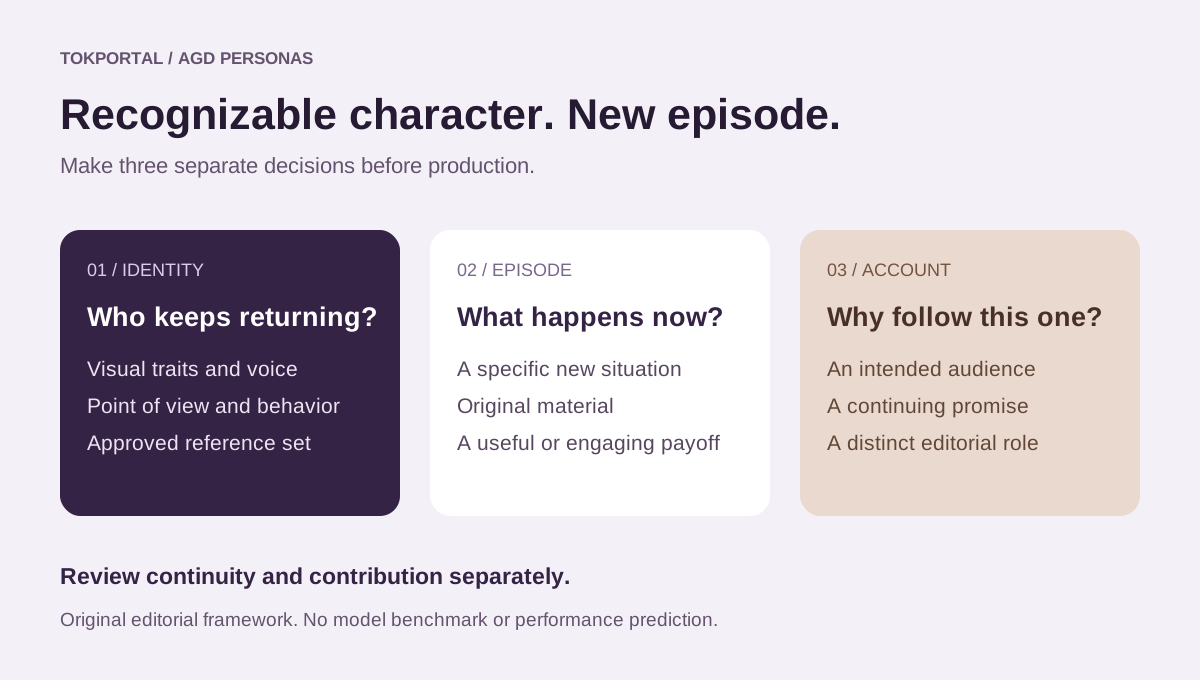
This guide builds a practical character brief around three separate decisions: identity, episode and account role. Public Nobody Sausage posts provide an inspectable example of a recurring visual world. A recent creator question and Adobe's reference workflow help frame the AI continuity problem. The proposed briefs are original exercises; the public character is not presented as an AI production demonstration, a TokPortal customer or an independently declared AGD practitioner.
Sources & real examples
Public accounts, original posts and primary references. Each example is linked where it is discussed.
View all 6 sources and review notes
- Nobody Sausage profile ↗
Actual profile and visible feed captured 9 September 2026. External animated character example, not a verified AI production workflow or AGD adoption.
- Nobody Sausage shower episode ↗
Actual original video page and frame inspected. No audio description, production technique or causal performance inference from the still.
- Public avatar consistency question ↗
Public question concerns visual and voice continuity. Thread contains promotional product references; claimed tool results are not independently tested.
- Adobe character-sheet tutorial ↗
Official July 2026 workflow separates character sheets and background references. Documentation, not our model comparison or reproduction.
- Adobe style-reference guidance ↗
Style guidance concerns look and feel; it is not itself proof of an unchanged character identity.
- TikTok AI content guidance ↗
Primary help text describes labels and prohibited uses. No distribution result is promised.
The question creators are already asking
In this public discussion about avatar consistency, the author describes changes in expression, lighting and voice across a series of generated ads. The concern is broader than whether one face resembles another: the sequence stops feeling like the same presenter. That is a useful starting point for an organic account too, where a returning viewer encounters episodes over time.
The thread contains product mentions and replies promoting particular workflows. Those statements are not an independent comparison of tools, and we have not reproduced their claimed results. Use the discussion to identify the production questions: what should remain stable, what reference material exists, and who decides whether a new clip still belongs to the same character?
Separate visual continuity from editorial continuity. A technically consistent face can still deliver an incoherent account if its knowledge, attitude and relationship to the audience change every day. Conversely, an animated character can change its expression, costume or setting while preserving an unmistakable identity. A good brief gives the team a way to evaluate both kinds of consistency.
Nobody Sausage: a recognizable world with different situations
The inspected Nobody Sausage TikTok profile has a bright tubular character as its avatar and a short promise about making people laugh. The visible feed includes a shower, a face-washing scene, an athletics setting and a character carrying a drink. The bodies, large eyes and expressive poses create a family resemblance, while the situations give the viewer different things to recognize.
This is a snapshot of a public feed, not a complete catalog or a set of matched performance observations. Some visible figures have different colors and hair. The useful observation is therefore a recognizable character world, rather than a claim that every post uses one identical design. The profile's public Linktree connects its other surfaces; those links establish where to inspect the work, not a private account-network strategy.
Look at the specific shower episode. In the captured frame, a pink character stands under running water against turquoise tiles with its arms raised. The overlaid situation concerns singing without knowing much of a song. That scene gives an abstract character a familiar human predicament. The still image supports this visual description; it does not reveal the animation pipeline or prove what caused the post's reach.
For your own persona, borrow the planning question rather than the character: what recognizable behavior can appear in a fresh situation? An impatient fictional guide might rush past a setting and then need it. A meticulous explainer might find one overlooked detail in each workflow. The next episode needs a real situation, demonstration or comic development, not simply a new background behind the same speech.
Write the account promise before the character description
Start with the person the account serves. Are they learning a product, comparing ways to perform a task, enjoying a recurring joke or following an invented world? Write the reason they would return without mentioning your publishing volume. “A fictional guide who makes confusing software settings understandable” is an editorial promise. A list of facial features is a production specification.
Then define the character's relationship to that promise. What do they notice first? What do they find frustrating? What can they explain, and what do they need to investigate? These decisions shape scripts and episode selection. They also prevent a character from becoming an interchangeable narrator who can be placed in front of any product message.
Keep the account's commercial relationship legible. A team-operated fictional guide should not pretend to be an independent customer recounting purchases it never made. It can explain an actual product workflow, introduce a clearly fictional scene or present a demonstration that the team has verified. The audience should be able to distinguish the invented character from the factual material it introduces.
Build a character bible small enough to use
A character bible is a reusable reference for the people producing the account. It does not need to become a long biography. The useful version identifies the recurring visual traits, voice, point of view, knowledge boundaries, relationship to the product and approved reference assets. Keep the decisions specific enough that an editor can flag a mismatch without guessing the founder's intention.
Separate fixed identity from allowed variation. A distinctive silhouette, name and speaking rhythm might remain stable. Expressions, camera angle, setting and episode topic may change. Some details require a decision: is a different outfit ordinary variation, a deliberate story event or an accidental generation error? Write the answer for this character instead of imposing a universal rule on every persona.
Feature
Keep recognizable
Vary with purpose
Visual identity
Voice
Point of view
Account role
Include a short example of the character reacting to an ordinary problem, then another example showing what would sound out of character. These are writing references, not scripts to repeat in every post. If the team cannot explain why the second example fails, the persona may still be too vague to guide production.
Give the brief a version and an owner. When you intentionally change a defining trait, record the change and decide which future episodes should use it. Keep earlier approved material identifiable. Quietly replacing the reference sheet can make old and new productions disagree while everyone believes they followed the correct brief.
Use visual references as inputs, not as automatic approval
Adobe's character-sheet tutorial demonstrates separating character references from backgrounds and recombining them for new compositions. It is useful primary documentation of that workflow. It is not an independent guarantee that every generated angle will preserve identity, and this guide does not rank models or claim to have reproduced the tutorial's output.
For your own production, prepare approved views that make the intended features understandable. Choose reference material you are authorized to use. Identify which image is the character, which is a prop and which supplies the scene. If a generation tool supports those references, follow its current documentation and inspect the result against your own brief.
A style reference and a character identity reference answer different questions. A picture can establish lighting or a visual treatment without defining the same individual. Adobe's style-reference guidance describes influencing the look and feel of variations. Do not assume that matching the overall style has also preserved the face, costume details or product accurately.
Review the actual sequence, not only the best frame. Inspect the entrance, the moment of interaction and the ending. Look for an identity change during motion, an object that changes shape, or a product screen that ceases to match the demonstration. Record the frame or moment that needs work so the producer has a specific revision target.
Give voice its own continuity record
The creator discussion raises voice separately from appearance, and the production brief should do the same. Record the approved voice source, applicable permissions, pronunciation notes and intended delivery. Include an approved sample for comparison when available. A text description such as friendly can cover many different performances and may not be enough for a recurring presenter.
Keep identity distinct from emotion. The same persona can sound curious, frustrated or relieved without becoming a different character. Decide which changes serve the scene and which contradict the role. Listen to the complete output before delivery, particularly names, product terminology and transitions where separate generated segments meet.
If an episode has no spoken voice, define the other recurring signals. On-screen language, caption rhythm, gestures and the way a scene reveals information can carry personality. The Nobody Sausage example is useful as a visual reference without requiring us to infer an unheard voice performance from a screenshot. Your brief should reflect the channels the viewer actually encounters.
Create an episode engine with room for new work
An episode engine is the recurring question that gives the character something to do. For a fictional software guide, it might be finding the setting that solves one specific problem. The next script begins with a new problem and an actual verified solution. The character's point of view supplies continuity; the task supplies new substance.
Try this original planning exercise. Pick one workflow your team knows and list three genuinely different obstacles a beginner could encounter. For each obstacle, identify the screen, action or outcome needed to explain it. Only then decide how the persona enters the scene. If all three scripts resolve with the same demonstration, you may have three introductions to one episode rather than three useful episodes.
Do the same for entertainment. Change the predicament, interaction or development that makes the scene worth watching. A recurring joke can be recognizable without repeating the same exported clip. Use the account and content isolation guide to review whether a proposed variation changes the viewer's experience or merely the packaging.
Keep a record of unused premises too. A rejected idea may belong to another account role, or it may need material the team does not yet have. That record makes it easier to commission the missing work instead of filling a posting slot with an episode that does not fit.
Distinguish personas across an AGD network
One character's continuity and a network's diversity operate at different levels. The character should remain understandable within its account. Other accounts need their own editorial reasons to exist. Giving the same narrator a different shirt on each profile does not establish distinct audience relationships or produce original content for all of them.
A proposed product network might contain a fictional beginner guide, a real screen-demonstration series and a behind-the-scenes account operated by the team. Their subjects can overlap while their contributions differ: one explains the question, another demonstrates a complete task, and another documents an actual production decision. These are planning options, not a claim that opening three accounts causes growth.
Before commissioning an episode, name the account that should own it and why. If it belongs everywhere for exactly the same reason, inspect the roster. You may need clearer roles or fewer overlapping accounts. The formatted versus varied account guide helps separate a recurring identity from the decision to use one format or several.
Keep the fictional frame and AI disclosure clear
TikTok's AI-generated content guidance requires labeling realistic AI-generated images, audio and video and explains its creator and automatic labels. It also describes content that remains prohibited even with a label. Check the actual material and current guidance when preparing a post; an entertaining persona does not make disclosure irrelevant.
Use the character's profile and episode framing to explain what the audience is watching. A fictional guide can be named and visually recognizable without claiming to be a real employee or a satisfied buyer. Keep real demonstrations and sourced statements accurate even when the presenter is invented. When the scene is an illustration, make that context available where the viewer encounters it.
This is also useful creative direction. An openly fictional character can have exaggerated reactions and a distinctive world. Trying to pass it off as an ordinary independent customer may force the writing into implausible personal claims. Define the role the character actually plays, then let the production choices support that role.
Review identity and usefulness before distribution
Use two separate questions in the final review. Does this still look, sound and behave like the intended persona? Does this episode provide a new reason to watch? A clip can pass one and fail the other. That distinction makes corrections more precise than simply asking whether the output looks professional.
Attach the approved brief version, reference assets, final export, caption and disclosure instructions to the delivery record. Once published, inspect the native post and retain its URL. The AGD infrastructure guide explains how to connect those records without confusing a workflow acknowledgment with the actual viewer-facing result.
TokPortal can handle the account operating layer when those editorial decisions and approved assets are ready. Use the worksheet below to define a persona and its next original episodes before entering the campaign flow. The aim is an account people can recognize, a series that keeps contributing something new and a network whose roles remain distinct as production grows.
Your AGD persona and episode worksheet
AGD PERSONA AND EPISODE WORKSHEET
ACCOUNT ROLE
Public account / intended audience / editorial owner:
Reason to follow without mentioning posting volume:
Relationship to the product / fictional framing:

CHARACTER IDENTITY
Name / point of view / recurring behavior:
Visual traits that remain stable:
Voice source / permissions / pronunciation references:
Knowledge boundaries / claims the character cannot make:
Approved reference assets / brief version / owner:

ALLOWED VARIATION
Expressions / outfits / settings / formats that may change:
Changes that need an explicit story or editorial decision:
One in-character reaction / one out-of-character example:

NEXT THREE ORIGINAL EPISODES
1. New situation / actual material / viewer payoff:
2. New situation / actual material / viewer payoff:
3. New situation / actual material / viewer payoff:
What makes each a distinct contribution?
Which account owns each episode, and why?

SEQUENCE REVIEW
Identity at entrance / interaction / ending:
Voice and pronunciation / objects / actual product screen:
Factual demonstration or clearly identified illustration:
Specific correction and frame / revision owner:

DELIVERY
Approved brief version / export / caption / disclosure:
Requested account / delivered native post URL:
Result checked by / date / unresolved issue:
Next editorial decision:

Written by
Vincent Tellenne
Co-founder & CEO
Vincent is a co-founder and CEO of TokPortal. He works on the infrastructure and operating model behind scaled organic social media distribution.
Learn more about this topic with AI
Related Resources
Related Tools
Put your AGD strategy to work
You make the content.
TokPortal runs the account operations.
Create and operate TikTok and Instagram accounts in your target market. Local operators handle the account work and native publishing. You control the brief, content and campaign from the dashboard, API or MCP.
- 01Choose your market
- 02Define each account
- 03Schedule your content
Review market availability and pricing before ordering. No reach forecast is built into your plan.