
On this page
TokPortal is programmable organic social-media distribution infrastructure that uses real phones, local SIM cards and human operators instead of proxy-only setups. For TikTok organic reach, a proxy can mask network location, but a real phone supplies the full device, app, SIM and behavioral context platforms expect.
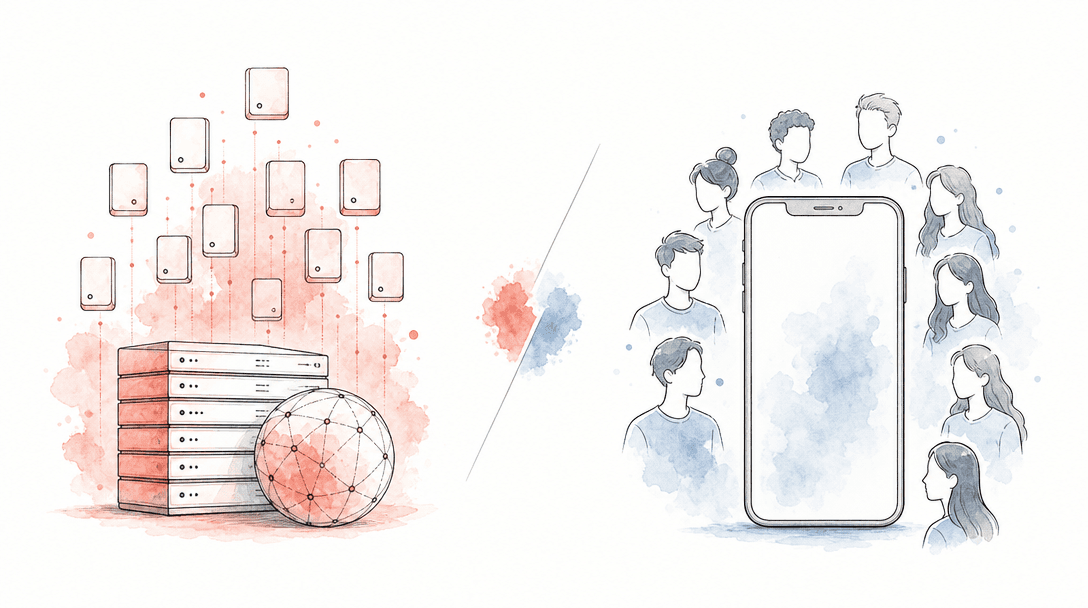
The short version: proxies are a network-layer workaround; real phones are a full posting environment. If your campaign depends on organic reach, local relevance, TikTok sounds, location tags and repeatable distribution across many accounts, a real mobile device with a local SIM is the stronger base layer.
This comparison is for growth teams, agencies, AI video tools and e-commerce operators running TikTok content at volume. It is not about scraping, shortcuts or vanity metrics. It is about choosing infrastructure that makes each post look like it came from a normal human-operated account in its local market.
Do TikTok proxies hurt reach?
A TikTok proxy does not automatically hurt reach, but a proxy-only setup creates weak context. TikTok can evaluate more than IP address: the device, app session, carrier, location signals, usage patterns and upload method all contribute to whether an account looks normal.
The practical risk is mismatch. A desktop browser, cloud server or repeated network swap may say one thing, while the device history and behavior say another. Organic reach tends to hold better when the account, device, SIM, language, location and posting routine point in the same direction.
If you are comparing proxy stacks to real-device infrastructure, start with the adjacent breakdown: why real devices beat virtual networks for TikTok distribution.
Residential proxy vs real phone TikTok: what is the actual difference?
Feature
Residential or mobile proxy stack
Real phone with local SIM
Network signal
Device signal
Posting environment
TikTok sounds and editing
Geo-native campaign fit
Operational scale
Is a mobile proxy enough for TikTok campaigns?
A mobile proxy is enough only if your problem is narrow network routing. It is not enough if your campaign depends on native posting, geo relevance, account history, sound usage, local operator behavior or consistent reach across many posts.
For one-off account access, a mobile proxy may look acceptable on paper. For a 10-account or 100-account organic campaign, the missing layers compound: no persistent physical device, no local SIM history, no native app routine and no human-in-the-loop quality control. That is why serious TikTok distribution teams move from proxy spreadsheets to real-device operations.
TokPortal’s distribution platform uses real accounts on real smartphones with local SIM cards in 20+ countries, controlled through API, MCP and SDKs. Developers can review the API layer at TokPortal developer documentation.
Cloud proxy vs physical device TikTok marketing: which scales better?
Cloud proxy setups scale cheaply in procurement, not necessarily in reach. You can buy more endpoints quickly, but you still need account trust, content variation, device consistency, local context and native app actions.
Physical-device infrastructure scales more slowly, but each account has a more complete operating environment. That matters for TikTok marketing because the upload is not just a file transfer. The account may need to use a local sound, tag a location, edit in-app, interact before posting, receive notifications and maintain a normal usage rhythm.
This is also where SaaS social schedulers and proxy dashboards fall short. They can queue content, but they cannot reproduce the full native-app path. For the broader SaaS comparison, see TokPortal vs social media management tools.
How TikTok detects datacenter IPs and weak posting environments
- Network type and IP reputation: consumer carrier traffic and datacenter traffic have different histories.
- Device fingerprint: operating system, app version, hardware traits and session persistence can be evaluated together.
- SIM and carrier context: a local SIM creates a stronger in-country signal than an isolated IP route.
- Location consistency: GPS, cell tower, WiFi and language behavior should not contradict the campaign market.
- Behavioral rhythm: viewing, scrolling, engaging, posting and responding should look like a normal account routine.
- Upload path: native in-app posting carries different context than a limited API or browser-based workflow.
- Account history: aged behavior, niche warming and consistent content category help reduce sudden context shifts.
TikTok’s own privacy documentation states that it may process device information, network information, location information and user activity. TikTok’s Content Posting API documentation also makes clear that API posting is a separate upload path with defined capabilities. For growth teams, the lesson is simple: do not treat IP address as the whole identity layer.
That is why real devices outperform virtualized TikTok account setups for campaigns where reach quality matters. The stronger setup is not just “better IP.” It is a complete mobile context.
Why TikTok reach can collapse when campaigns rely on proxies
Reach collapse usually happens when the distribution pattern becomes too thin or too inconsistent. The content might be strong, but the account environment sends mixed signals: a new location today, a different device tomorrow, repeated uploads from non-native workflows and little normal account activity between posts.
The fix is not “buy a better proxy.” The fix is to rebuild the campaign around real account operations: stable device, local SIM, local app behavior, niche warming, native posting and human review. TokPortal charges 25 credits per account, 2 credits per video upload, 7 credits for niche warming and 40 credits for deep warming on Instagram. That pricing only makes sense if you value sustained organic distribution over cheap network access.
20+
countries with real-device and local-SIM distribution coverage
150,000+
accounts under TokPortal management
4,276
active business clients using TokPortal infrastructure
6B+
organic video views generated through TokPortal distribution
Original decision rule: proxies solve routing; phones solve context
Best setup for TikTok organic reach: a practical selection framework
Define the campaign outcome
If the goal is one account login, evaluate network stability. If the goal is organic distribution across many posts, evaluate the full mobile environment.
Match the country to the device
Use a real phone and local SIM in the target market whenever the campaign depends on local relevance, language cues, location tags or region-specific content.
Use native in-app posting for TikTok-first creative
Native posting keeps TikTok sounds, app editing and location-tag workflows available, which the official Content Posting API does not fully replicate.
Warm accounts before volume
Build niche consistency before scaling uploads. TokPortal supports niche warming at 7 credits and Instagram deep warming at 40 credits.
Track reach by account cohort
Compare performance by device country, niche, posting time, sound, hook and account history rather than blaming one isolated variable.
Scale only after the cohort proves stable
Move from 3 accounts to 10, then 25, only when view distribution and engagement quality are consistent enough to justify more content.
When a proxy-based setup may be acceptable
- You need basic account access from a consistent country.
- The account is low-value and not central to campaign revenue.
- You are doing research, QA or dashboard work rather than native posting.
- The campaign does not rely on local sounds, location tags or in-app editing.
When a real phone is the better answer
- You are posting TikTok videos at scale for clients or brands.
- You need country-specific distribution across the USA, UK, Brazil, France, Japan or other local markets.
- You need native sounds, location tags and app-based creative edits.
- You are running AI-generated video variants and need a post-generation distribution layer.
- You need operator review, account warming and repeatable campaign operations.
One common confusion: tools like a TikTok profile picture downloader, TikTok profile picture download utility or TikTok PFP downloader are useful for research and profile audits, but they do not solve distribution. Profile research can help you study creators, niches and visual positioning. It will not make a post travel farther.
If you are building a real campaign, compare infrastructure choices, not surface-level utilities. The closest comparisons are proxies vs local SIM phones for TikTok, device farms vs real devices for TikTok posting and TokPortal vs the TikTok Content Posting API.
Launch a real-device TikTok distribution test
Start with a small country-specific cohort, post through native apps on real phones, and measure reach before scaling your campaign.
Are TikTok proxies the same as real mobile devices?+
Is a residential proxy better than a datacenter IP for TikTok?+
Why does native in-app posting matter for TikTok reach?+
When should an agency use real phones instead of proxies?+
Can TokPortal support country-specific TikTok campaigns?+
Do I own the accounts used for my TokPortal campaigns?+

Written by
Vincent Tellenne
Co-founder & CEO
Vincent is a co-founder and CEO of TokPortal. He works on the infrastructure and operating model behind scaled organic social media distribution.
Learn more about this topic with AI
Related Resources
Device Farm vs Real Devices for TikTok Posting
Real devices beat TikTok device farms for durable posting: compare cloud phones, proxies, APIs, and TokPortal’s 20-country network.
Real Devices vs Emulators on TikTok: Why Emulators Get Banned in 2026
TikTok detects every Android emulator within hours. Here's exactly how — and what real device signals you need to keep accounts alive in 2026.
Proxies vs Local SIM Phones for TikTok
TikTok proxies handle connectivity, but 20-country local SIM phones give stronger organic distribution because device, SIM and in-app signals align.
TokPortal vs Social Media Management Tools: The SaaS Comparison Nobody Else Will Write
Comparing TokPortal to Buffer, Hootsuite, Later, and other social media management tools for TikTok. Learn why traditional SaaS tools hit a hard wall when you need multi-account, multi-country TikTok distribution at scale.
TokPortal vs TikTok Content Posting API
TokPortal is an alternative to the TikTok Content Posting API when agencies need native sounds, local devices, Spark Codes, and 20-country posting.
TokPortal vs VPN: Why Real Devices Beat Virtual Networks for TikTok
Compare TokPortal vs VPN for creating TikTok accounts abroad. Real device accounts get 10x more reach than VPN-created accounts. Data-driven comparison for 2026.
Related Tools
From the guide to your first campaign
You make the content.
TokPortal runs the account operations.
Create and operate TikTok and Instagram accounts in your target market. Local operators handle the account work and native publishing. You control the brief, content and campaign from the dashboard, API or MCP.
- 01Choose your market
- 02Define each account
- 03Schedule your content
Review market availability and pricing before ordering. No reach forecast is built into your plan.