
On this page
TokPortal is a TikTok auto-posting alternative for teams that need native in-app distribution, not just scheduled uploads. Instead of pushing videos through limited scheduler APIs, TokPortal posts through real human operators on real smartphones with local SIM cards in 20+ countries.
Most social media auto-posting tools solve calendar management, not TikTok reach. They are useful when your main problem is approval flow, captions, and timing. They are weak when your problem is distributing 50, 100, or 500 videos through real TikTok surfaces with native sounds, location context, account history, and country-specific presence.
TokPortal is built for the second problem. It is programmable organic social-media distribution infrastructure — The Human API — for brands, agencies, AI content tools, and developers that need TikTok, Instagram, and YouTube posting through real devices rather than another browser dashboard. For API-driven workflows, start with the TokPortal developer documentation.
20+
countries with real local device coverage
150,000+
accounts under management
4,276
active business clients
6B+
organic video views generated
Why TikTok auto posting tools hurt reach
TikTok auto-posting tools can hurt reach when they make every account behave like the same software system: identical upload path, limited native context, repetitive timing, and fewer in-app creative signals. TikTok’s official developer surface is valuable, but it is not the same as a human opening the TikTok app on a local phone and publishing natively.
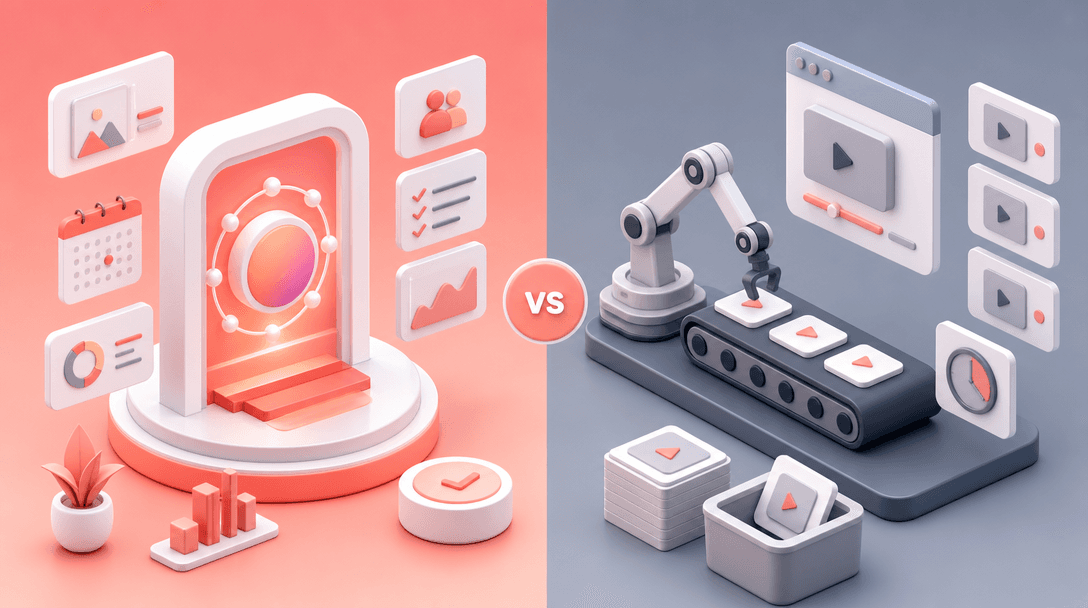
The issue is not that scheduling is always bad. A scheduler is fine for a brand account publishing a few approved posts per week. The problem appears when growth teams use a scheduler as a distribution layer for many accounts, many geographies, or AI-generated volume. The tool was designed for workflow convenience; the job requires organic distribution infrastructure.
If you are comparing infrastructure options, read TokPortal vs social media management tools and TokPortal vs Ayrshare for TikTok reach for a deeper SaaS-by-SaaS comparison.
The scheduler ceiling
TikTok scheduling API vs native posting
Feature
Classic TikTok scheduler
TokPortal native in-app posting
Primary job
Posting surface
TikTok sounds
Geo context
Best fit
Developer control
TikTok’s Content Posting API and Direct Post API are legitimate developer tools. They are best used when the requirement is controlled publishing into supported account types and supported fields. But the API does not replicate the full in-app creation flow, especially around native sound selection and app-native editing.
That distinction matters for performance teams. A TikTok-native post can carry the creative decisions that happen inside the app: sound choice, location tag, edits, and human pacing. A scheduled upload is structurally cleaner for operations, but less complete as a growth surface.
For a direct comparison, see TokPortal vs the TikTok Content Posting API.
Tool for posting with TikTok sounds at scale
If your workflow depends on TikTok sounds, you need native in-app posting. The official TikTok Content Posting API is not a full replacement for opening the app, selecting a sound, applying edits, and publishing from the local device context.
TokPortal handles this by routing tasks to real human operators using real smartphones. Your system can send the video, caption, account, country, and posting instructions through API or dashboard. The operator completes the in-app publishing step, including native sounds where the campaign requires them.
This is especially relevant for music marketers, consumer apps, e-commerce brands, clipping networks, and AI-UGC tools. In those workflows, the video file is only half the asset. The sound, account context, and country context are part of the distribution package.
Where TokPortal is stronger
- Native TikTok sounds, location tags, and in-app editing are available because posting happens inside the app.
- Campaigns can run across real local devices in 20+ countries.
- Developers can trigger distribution through REST API, MCP, SDKs, and webhooks.
- Agencies can scale multi-account campaigns without hiring a large manual posting team.
Where a scheduler is still better
- TokPortal is not the right tool if you only need one brand account scheduled three times per week.
- It is not a social inbox, approval calendar, or all-in-one community management suite.
- Human-in-the-loop native posting costs more than a simple scheduler queue.
- Teams still need a content strategy; distribution infrastructure does not rescue weak creative.
Multi account posting alternative to schedulers
For multi-account TikTok posting, the better alternative to schedulers is not more browser tabs or another approval calendar. It is an operating layer that controls accounts, devices, countries, posting tasks, and analytics in one programmable system.
TokPortal supports content posting across TikTok, Instagram, and YouTube; commenting and engagement; analytics; TikTok Spark Codes; Instagram Partnership Ad Codes; account warming; and account renting toggles for eligible inventory. Account setup uses first-party credit pricing: 25 credits per account, 2 credits per video upload, 7 credits for niche warming, and 40 credits for Instagram deep warming.
If your current workaround is a patchwork of remote devices, contractors, and spreadsheets, compare the operational cost against TokPortal vs freelancers for TikTok distribution and TokPortal vs social media VAs at 100-account scale.
- Use a scheduler when you manage one or two owned brand accounts and care most about approvals.
- Use TokPortal when the campaign requires many accounts, countries, or posts per week.
- Use native in-app posting when TikTok sounds, location tags, and app-native edits affect the creative.
- Use API distribution when AI tools generate more videos than a human team can publish manually.
- Use paid ads when you need guaranteed spend delivery rather than organic testing.
- Do not use a profile utility search, such as TikTok profile picture download or TikTok pfp downloader, as a proxy for buyer intent; that traffic is useful for tools, not distribution strategy.
AI video distribution vs classic social media tools
AI video teams have a different bottleneck than traditional social teams. A traditional team asks, “How do we schedule next week’s posts?” An AI video team asks, “What happens after we generate 100 usable clips?”
Classic social media tools were built around calendars, approvals, inboxes, and reporting. AI video distribution needs a post-generation layer: receive generated assets from Sora, Veo, Kling, Runway, Pika, Arcads, Creatify, Captions, HeyGen, or Topview; map each asset to an account and country; publish natively; collect results; and feed performance data back into the creative loop.
TokPortal’s API, MCP server, TypeScript SDK, Python SDK, and webhooks make that loop programmable. If your stack is agent-driven, use TokPortal’s MCP integration for AI agents. If your team is comparing surfaces by format, read TikTok vs Reels vs Shorts for AI videos.
Original decision rule: calendar problem or distribution problem?
Worked example: replacing a scheduler with a 10-account TikTok distribution test
Assume an AI-UGC tool or agency wants to test 40 videos across 10 TikTok accounts in two countries. In TokPortal credits, the core setup is simple: 10 accounts at 25 credits each equals 250 credits, and 40 video uploads at 2 credits each equals 80 credits. Optional niche warming adds 7 credits per account.
The point of the test is not to publish the same post everywhere at once. The point is to learn which hooks, accounts, countries, and native sounds create organic traction. TokPortal’s internal benchmark index across 9,000+ TikTok profiles shows that top-quartile TikTok engagement is above 5%, while 1K–10K follower accounts average about 6.2% engagement. That gives growth teams a practical threshold for deciding which accounts and creatives deserve more volume.
For channel mix decisions, compare this with organic vs paid TikTok and TikTok organic vs paid cost-benefit analysis.
When TokPortal is not the right alternative
TokPortal is not a replacement for every social media management platform. If your company needs a unified inbox, legal approval workflows, brand asset libraries, or executive reporting across LinkedIn, X, Facebook, Pinterest, and TikTok, a classic social suite may still be the right core system.
TokPortal is the better fit when TikTok reach is the constraint: native app posting, multi-account distribution, real local device coverage, API-triggered workflows, and human-in-the-loop execution. Many teams use both: a scheduler for owned brand channels and TokPortal for organic distribution experiments at scale.
What to use instead of a TikTok auto poster
Use this decision framework:
- Need a calendar? Use a scheduler.
- Need official API publishing into a small number of owned accounts? Use TikTok’s developer tools or a scheduler built on them.
- Need TikTok sounds, local context, and in-app publishing? Use native posting.
- Need 10, 50, or 100+ accounts? Use distribution infrastructure.
- Need an AI pipeline that turns generated clips into published tests? Use TokPortal’s API, MCP, SDKs, and webhooks.
The simplest test is operational: if the task cannot be described as “schedule this post,” it probably should not be solved with an auto-posting tool.
Launch your first native TikTok distribution test
Price a 10-account campaign, add video upload volume, and compare native in-app posting against your current scheduler workflow.
What is the best alternative to TikTok auto-posting tools?+
Why can TikTok schedulers underperform for reach?+
Can the TikTok Content Posting API add native TikTok sounds?+
Is TokPortal only for TikTok?+
Should I use TokPortal or a social media management suite?+
Do TikTok profile picture downloader searches relate to this page?+

Written by
Vincent Tellenne
Co-founder & CEO
Vincent is a co-founder and CEO of TokPortal. He works on the infrastructure and operating model behind scaled organic social media distribution.
Learn more about this topic with AI
Related Resources
Organic vs Paid TikTok: When to Use Each Strategy
Organic vs paid TikTok: discover when to use each strategy, key differences, costs, and how top marketers combine both for scalable results in 2026.
Real Devices vs Emulators on TikTok: Why Emulators Get Banned in 2026
TikTok detects every Android emulator within hours. Here's exactly how — and what real device signals you need to keep accounts alive in 2026.
TikTok vs Reels vs Shorts for AI Videos
TikTok usually wins AI video discovery; Reels helps ecommerce retargeting; Shorts compounds search. Compare 3 channels across reach, CPM, and cost.
TokPortal vs Ayrshare for TikTok Reach
Need an Ayrshare TikTok alternative? Compare API posting vs real-device native posting across 20 countries, sounds, pricing, and reach in 2026.
TokPortal vs Social Media Management Tools: The SaaS Comparison Nobody Else Will Write
Comparing TokPortal to Buffer, Hootsuite, Later, and other social media management tools for TikTok. Learn why traditional SaaS tools hit a hard wall when you need multi-account, multi-country TikTok distribution at scale.
TokPortal vs TikTok Content Posting API
TokPortal is an alternative to the TikTok Content Posting API when agencies need native sounds, local devices, Spark Codes, and 20-country posting.
Related Tools
From the guide to your first campaign
You make the content.
TokPortal runs the account operations.
Create and operate TikTok and Instagram accounts in your target market. Local operators handle the account work and native publishing. You control the brief, content and campaign from the dashboard, API or MCP.
- 01Choose your market
- 02Define each account
- 03Schedule your content
Review market availability and pricing before ordering. No reach forecast is built into your plan.