
On this page
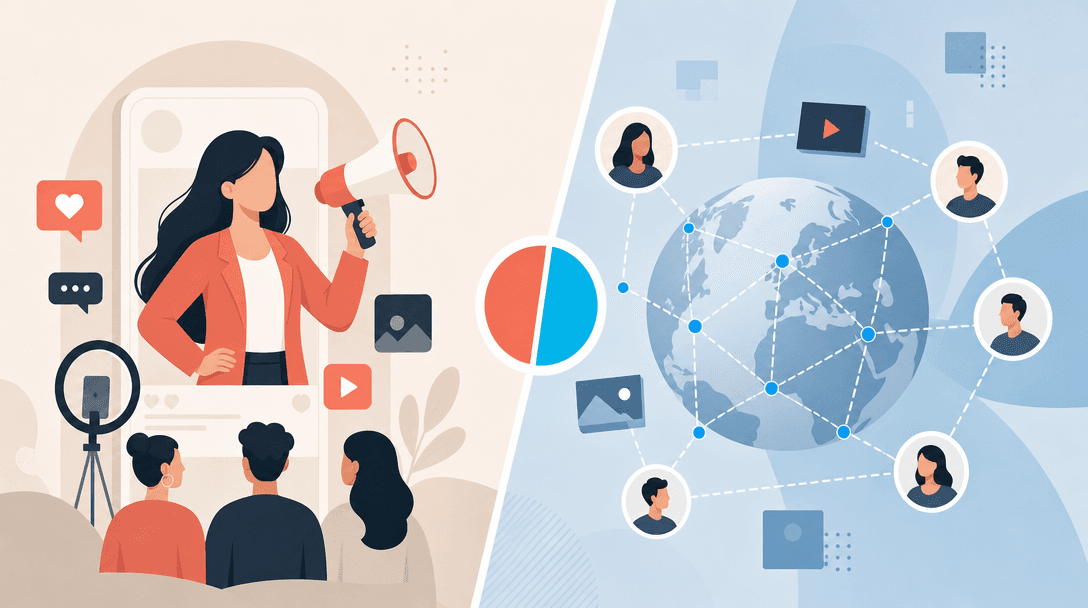
TokPortal is programmable organic social-media distribution infrastructure, while an influencer agency brokers creator relationships and sponsored posts. Use an agency when the creator’s identity is the asset; use a distribution network when you already have UGC and need controlled, repeatable posting across TikTok, Instagram, and YouTube.
Quick framing: influencer agencies are strongest when a named creator’s taste, face, and audience trust are the campaign. Organic distribution networks are strongest when the brand already has videos, UGC, AI-generated variants, product demos, or founder clips and needs those assets posted natively across many real social accounts with measurable iteration.
This comparison is for growth teams choosing between paying for influencer access and building a repeatable distribution layer. For a narrower TikTok UGC comparison, see TokPortal vs influencer agencies for TikTok UGC and organic TikTok distribution vs paying influencers.
20
countries with real-device, local-SIM distribution coverage
150,000+
accounts under TokPortal management
4,276
active business clients using TokPortal infrastructure
6B+
organic video views generated through the network
When should you use an influencer agency vs a distribution platform?
Feature
Influencer agency
Organic distribution network
Best use case
Primary asset
Creative control
Measurement
Speed of testing
Where it is not ideal
Cost comparison: influencer campaigns vs distribution infrastructure
Influencer agency cost is usually a bundled service: creator discovery, negotiation, contracting, briefing, approvals, usage rights, campaign management, and reporting. That can be worth it when one creator can shift perception or produce a high-trust endorsement. The downside is that spend concentrates into fewer creative bets.
Distribution infrastructure prices closer to operations. TokPortal uses credits: 25 credits per account, 2 credits per video upload, 7 credits for niche warming, 40 credits for Instagram deep warming, 3 credits for video editing, and 1 credit for sound-volume control. That model is better when you want many small tests across formats, accounts, and geographies instead of one expensive creator post.
A practical rule: use agencies for message validation through trusted humans; use distribution for volume testing once you already have winning angles. If you are weighing this against paid media, the adjacent comparison is organic vs paid TikTok.
How much control and measurement do distribution networks give brands?
A distribution network gives the brand operational control that most influencer campaigns cannot: which asset posts, where it posts, when it posts, what caption is used, which account category carries it, and how the result is measured. TokPortal supports posting across TikTok, Instagram, and YouTube, with REST API access, MCP support for AI agents, TypeScript and Python SDKs, and webhooks through TokPortal developer documentation.
The important technical distinction is native in-app posting. TikTok’s official Content Posting API is useful for permitted publishing workflows, but it does not provide every native app capability a human operator can use inside the app, such as adding TikTok sounds. Meta’s Instagram publishing API and YouTube’s videos.insert endpoint also serve official publishing use cases, but they are not the same as a human-in-the-loop, local-device distribution operation.
For measurement, think in test cells: hook, account, market, format, caption, sound, and publish window. Distribution infrastructure makes those cells repeatable. Influencer agencies can report performance, but the creative and audience variables are harder to isolate because each creator brings a unique audience and style.
How do brands seed content without big influencer fees?
Build a controlled creative batch
Start with 20 to 100 short videos: UGC testimonials, founder clips, product demos, AI-generated variants, comparison hooks, objection handlers, and localized captions.
Assign each asset a job
Tag every video by funnel role: awareness, problem education, proof, offer, retargeting angle, or creator-style native post. Do not test random creative with no hypothesis.
Choose markets and account categories
Use real local posting capacity where geography matters: USA, UK, Brazil, Germany, Japan, Indonesia, Mexico, France, Spain, and the other TokPortal-supported countries.
Post natively and track each cell
Publish inside the real social apps through human operators on real physical devices with local SIM cards, then compare video-level and account-level performance.
Promote the winners, retire the rest
Scale only the hooks that show strong early engagement, comments, saves, qualified clicks, or Spark Code and Partnership Ad Code potential.
Can you combine influencers with distribution infrastructure?
Yes. The strongest system is often not agency or distribution; it is creator trust plus controlled amplification. Use influencers to create or validate the message, then use distribution infrastructure to test derivative UGC, localized edits, alternate hooks, and repost-friendly formats across markets.
A clean hybrid workflow looks like this: pay a small number of creators for high-quality source assets, negotiate usage rights clearly, cut the assets into platform-native variants, distribute them through owned or rented accounts, then use TikTok Spark Ads or Instagram Partnership Ad Codes only on the posts that earn organic proof. For the whitelisting angle, compare UGC distribution vs influencer whitelisting.
This hybrid avoids the usual trap: spending the full budget before you know which hook, offer, or market actually works. The creator supplies trust and raw material; the distribution layer supplies iteration.
What pricing models should brands expect for UGC distribution?
- Credit-based pricing: pay for operational units such as account setup, video upload, warming, editing, and sound-volume control.
- Account-based pricing: useful when a brand wants dedicated account capacity for a campaign, geography, or vertical.
- Campaign-based pricing: common with agencies and managed services, usually bundling strategy, posting, reporting, and project management.
- Performance-assisted pricing: works when organic posts can hand off winners into Spark Codes, Partnership Ad Codes, paid media, or affiliate tracking.
- Software-only pricing: lower operational lift, but usually limited when official APIs cannot access every native in-app posting feature.
Where organic distribution infrastructure wins
- You can test more hooks, captions, offers, and markets from the same creative budget.
- You keep tighter control over posting cadence, account mix, geo targeting, and analytics.
- You can connect distribution to internal systems through API, MCP, SDKs, webhooks, n8n, Make, or Zapier.
- You can use native in-app posting features that standard social scheduling tools often cannot access.
- You can turn winning organic posts into monetizable handoffs through TikTok Spark Codes or Instagram Partnership Ad Codes.
Where influencer agencies still win
- A known creator can transfer trust faster than an unknown distribution account.
- High-consideration products may need expert-led explanation, not just repeated exposure.
- Some brand campaigns require a recognizable face, not infrastructure.
- Creator partnerships can create cultural moments that distribution alone cannot manufacture.
- If you have no creative backlog, you may need creators or a production partner before distribution becomes useful.
Original operating insight: do not optimize for vanity traffic
One benchmark helps set expectations. TokPortal’s internal TikTok engagement-rate index of 9,000+ profiles shows average engagement around 6.2% for 1K–10K follower accounts, 4.8% for 10K–100K, 3.5% for 100K–1M, and 2.2% for 1M+ accounts. That is why small and mid-sized distribution accounts can be useful: they often create cleaner test environments than a single large account with a broad audience.
If your alternative is hiring a broad social team or patching together tools, read TokPortal vs hiring a social media agency and TokPortal vs social media management tools.
Decision framework: which option should your team choose?
Choose an influencer agency if your campaign depends on creator identity, taste, credibility, audience affinity, or long-term ambassador value. This is common for beauty launches, fashion drops, consumer finance trust-building, expert-led education, and products where the messenger matters as much as the message.
Choose organic distribution infrastructure if your bottleneck is volume: too many videos sitting in a drive, AI-generated variants with no posting layer, UGC that needs market testing, or a growth team that wants to learn which hooks work before committing paid spend. TokPortal is built for that second problem: real accounts, real physical smartphones, local SIM cards in 20 countries, native in-app posting, API control, and human-in-the-loop operations.
Choose both when you can afford creator-grade source material and need a systematic way to distribute, localize, measure, and scale the winners.
Launch a controlled UGC distribution test
Compare influencer spend against a repeatable organic distribution layer across TikTok, Instagram, and YouTube using real-device posting and measurable campaign cells.
Is an organic distribution network an influencer agency alternative?+
Which is cheaper: influencer marketing or distribution infrastructure?+
Can a distribution platform post with native TikTok sounds?+
Should brands use influencers and distribution together?+
How should teams measure distribution network performance?+
When is TokPortal not the right choice?+

Written by
Vincent Tellenne
Co-founder & CEO
Vincent is a co-founder and CEO of TokPortal. He works on the infrastructure and operating model behind scaled organic social media distribution.
Learn more about this topic with AI
Related Resources
Organic TikTok Distribution vs Influencers
Compare TikTok influencers vs organic distribution: TokPortal pricing starts at 2 credits/video and 25 credits/account, plus when to use each.
Organic vs Paid TikTok: When to Use Each Strategy
Organic vs paid TikTok: discover when to use each strategy, key differences, costs, and how top marketers combine both for scalable results in 2026.
TokPortal vs Influencer Agencies for TikTok UGC
Compare TokPortal vs influencer agencies for TikTok UGC: costs, scale, and when 20-country real-device distribution beats a managed campaign.
TokPortal vs Hiring a Social Media Agency: A Brutally Honest Cost Analysis
Comparing TokPortal vs social media agencies for TikTok marketing? See the real cost breakdown, what agencies actually deliver, and when infrastructure beats outsourcing.
TokPortal vs Social Media Management Tools: The SaaS Comparison Nobody Else Will Write
Comparing TokPortal to Buffer, Hootsuite, Later, and other social media management tools for TikTok. Learn why traditional SaaS tools hit a hard wall when you need multi-account, multi-country TikTok distribution at scale.
UGC Distribution vs Influencer Whitelisting
Compare UGC distribution vs influencer whitelisting: when to use organic posting, Spark Ads, and TokPortal across 20 countries for agency scale.
From the guide to your first campaign
You make the content.
TokPortal runs the account operations.
Create and operate TikTok and Instagram accounts in your target market. Local operators handle the account work and native publishing. You control the brief, content and campaign from the dashboard, API or MCP.
- 01Choose your market
- 02Define each account
- 03Schedule your content
Review market availability and pricing before ordering. No reach forecast is built into your plan.