
On this page
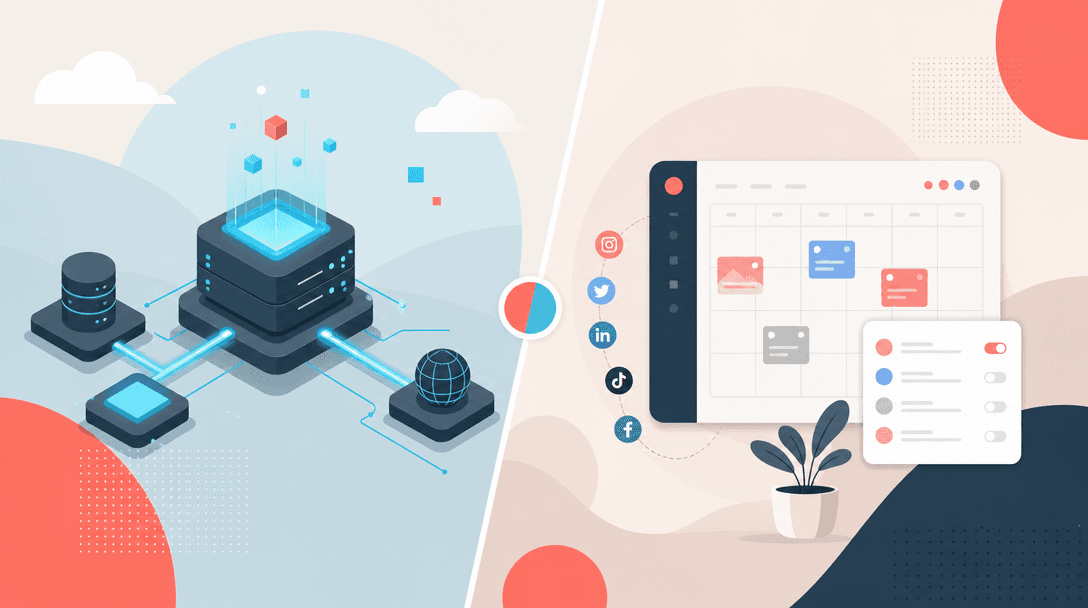
TokPortal is programmable organic social-media distribution infrastructure, not a traditional scheduler. A scheduler queues posts to accounts you already own; distribution infrastructure supplies real-device, human-operated, geo-native posting capacity across TikTok, Instagram, and YouTube through API, MCP, SDKs, and webhooks.
The practical difference is capacity. Buffer, Later, Hootsuite, and similar schedulers help a team plan and publish to accounts it already controls. TokPortal is built for the next problem: when one owned handle is not enough reach, not enough geography, or not enough posting surface for a campaign.
Official publishing APIs are useful for calendar workflows. TikTok documents its Content Posting API, Meta documents Instagram Content Publishing, and YouTube documents video upload endpoints. But those interfaces do not give you local SIM presence, human-operated real-device posting, TikTok sounds, location tags, Spark Codes, Partnership Ad Codes, account warming, or a network of accounts across 20 countries. That is the category line.
If you want the broader SaaS comparison, read TokPortal vs social media management tools. If your bottleneck is TikTok’s official publishing interface, start with TokPortal vs TikTok Content Posting API.
Difference between scheduler and distribution infrastructure
A social media scheduler is a workflow layer. It helps you draft, approve, queue, and publish posts to accounts you already own. It is excellent for governance, approvals, and consistency across a brand’s owned channels.
Social media distribution infrastructure is a capacity layer. It gives brands, agencies, AI video tools, and developers access to real accounts operated on real physical smartphones with local SIM cards. The goal is not merely to publish on time; the goal is to distribute more creative through more authentic geo-native surfaces.
This is why the scheduler-vs-distribution-network question matters most after content volume increases. If you have five posts per week, use a scheduler. If you generate 100 AI clips, 40 UGC variations, or a country-by-country launch package, the calendar is not the bottleneck. Posting capacity is.
Feature
Traditional social media scheduler
Social media distribution infrastructure
Primary job
Best user
Account layer
Posting method
TikTok sounds and native editing
Geo-distribution
Automation surface
When it stops being enough
Best alternative to social media schedulers
The best alternative to a social media scheduler depends on the bottleneck. If your bottleneck is approvals, a scheduler is still the right tool. If your bottleneck is reach, account capacity, native TikTok posting, or country-specific distribution, the alternative is distribution infrastructure.
TokPortal fits the second case. It is built for teams that already have creative supply: AI-generated video, UGC edits, product clips, affiliate content, localised launch assets, or short-form variants. Those teams do not need another content calendar. They need a way to publish through real local accounts without building a country-by-country operations team themselves.
For many buyers, the honest stack is both: keep a scheduler for owned-brand channels, then use TokPortal for campaign distribution. The scheduler remains the planning layer; TokPortal becomes the organic distribution rail.
When TokPortal is the better fit
- You need to distribute more content than one or two owned handles can absorb.
- You want native TikTok posting features such as sounds, location tags, and in-app editing.
- You need country-specific posting capacity in markets such as the USA, UK, Germany, France, Brazil, Japan, or Australia.
- You are building a programmatic workflow with API, MCP, SDKs, webhooks, n8n, Make, or Zapier.
- You want per-video handoffs such as TikTok Spark Codes or Instagram Partnership Ad Codes.
When a scheduler is still the better fit
- You only manage one brand account and post a few times per week.
- Your main pain is internal approval, asset storage, or calendar visibility.
- You need employee advocacy, inbox management, or comment moderation workflows.
- Your company requires every post to appear only on a single owned corporate handle.
Scale posting beyond Buffer and Later
To scale posting beyond Buffer, Later, or any calendar-first tool, separate planning from distribution. Planning answers: what should publish, when, and under whose approval? Distribution answers: where can this creative be posted so it receives authentic local exposure?
The first step is to keep your scheduler for owned handles. The second step is to route high-volume campaign assets into a distribution layer. TokPortal exposes that layer through a full REST API, MCP server, SDKs, and webhooks, so an AI video platform or agency backend can submit content, select markets, receive status updates, and collect analytics without hiring local posting teams.
This is especially important for AI video teams. Once a tool can generate dozens of Sora, Veo, Kling, Runway, or UGC-style variants in a day, the limiting factor is no longer creation. It is trustworthy organic distribution.
Keep the scheduler for owned-channel governance
Use Buffer, Later, Hootsuite, Sprout, or your current tool to manage brand-account calendars, approvals, and executive visibility.
Define the distribution job
Choose the campaign objective, content batch, target countries, platforms, account type, and whether the post needs TikTok sounds, location tags, Spark Codes, or Partnership Ad Codes.
Route campaign assets into TokPortal
Submit videos through the dashboard, REST API, MCP server, TypeScript SDK, Python SDK, or workflow integrations such as n8n, Make, and Zapier.
Publish through real local devices
Human operators post inside the native TikTok, Instagram, or YouTube app on real smartphones with local SIM cards in the selected markets.
Measure distribution separately from scheduling
Track posted status, account-level activity, analytics, Spark Code handoffs, and campaign performance instead of treating calendar completion as the success metric.
Social media CDN concept
A social media CDN is the closest mental model for TokPortal. A web CDN moves files closer to users through distributed infrastructure. A social CDN moves short-form video closer to audiences through real local social accounts, real devices, local SIMs, and human-in-the-loop publishing.
The analogy is not perfect. TikTok, Instagram, and YouTube are not open web servers, and organic reach is not a file-transfer problem. But the infrastructure logic is similar: centralised creative production is efficient, while localised distribution is what makes the asset travel.
That matters because platforms read more than the video file. Device fingerprinting, SIM carrier data, location signals, WiFi context, and behavioural patterns all shape whether publishing looks native to a market. TokPortal’s moat is that it does not rely on datacenter-style posting workflows. It uses real physical devices and local operators.
For a deeper infrastructure comparison, see why real local devices beat virtual networks for TikTok and when to use organic distribution versus paid TikTok.
20
countries with TokPortal real-device distribution coverage
150,000+
accounts under management
4,276
active business clients
6B+
organic video views generated
25
credits per account
2
credits per video upload
Original test: calendar completion is not distribution success
Distribution as a service for social video
Distribution as a service for social video means the brand supplies creative, while the infrastructure supplies the accounts, devices, operators, publishing workflow, and reporting surface. TokPortal applies that model to TikTok, Instagram, and YouTube.
The model is strongest when creative production has already scaled. AI video tools, clipping networks, affiliate teams, music marketers, agencies, and ecommerce operators can produce more assets than their owned pages can reasonably publish. TokPortal turns that excess creative into structured organic distribution: select surfaces, assign accounts, publish natively, collect analytics, and hand off monetisable ad codes where relevant.
It is also different from hiring individual freelancers. Freelancers can help with one market or a few accounts; infrastructure needs repeatable operations, account warming, status visibility, device coverage, and developer surfaces. For the operational tradeoff, read TokPortal vs freelancers for TikTok distribution.
- Native in-app posting for TikTok, Instagram, and YouTube
- Real physical smartphones with local SIM cards
- Human-operated workflows across 20 countries
- TikTok sounds, location tags, and native editing support
- Spark Codes for TikTok campaign handoffs
- Partnership Ad Codes for Instagram campaign handoffs
- Account warming with niche warming and Instagram deep warming options
- REST API, MCP server, TypeScript SDK, Python SDK, and webhooks
- n8n, Make, and Zapier workflow integrations
- Credit pricing: 25 credits per account and 2 credits per video upload
Price your first distribution layer
Compare credits, account capacity, and video-upload costs before you replace another scheduler with the wrong tool.
Is TokPortal a social media scheduler?+
Should I replace Buffer, Later, or Hootsuite with TokPortal?+
Why can TokPortal use TikTok sounds when some publishing APIs cannot?+
What is a social CDN for TikTok?+
Can developers connect TokPortal to an AI video pipeline?+
When is a traditional scheduler still the right choice?+

Written by
Vincent Tellenne
Co-founder & CEO
Vincent is a co-founder and CEO of TokPortal. He works on the infrastructure and operating model behind scaled organic social media distribution.
Learn more about this topic with AI
Related Resources
Organic vs Paid TikTok: When to Use Each Strategy
Organic vs paid TikTok: discover when to use each strategy, key differences, costs, and how top marketers combine both for scalable results in 2026.
TokPortal vs Freelancers: Which Scales Better for TikTok Distribution?
Comparing TokPortal vs hiring freelancers for TikTok distribution. We break down cost, scale, reliability, ban risk, and speed so you can make the right call for your growth strategy.
TokPortal vs Social Media Management Tools: The SaaS Comparison Nobody Else Will Write
Comparing TokPortal to Buffer, Hootsuite, Later, and other social media management tools for TikTok. Learn why traditional SaaS tools hit a hard wall when you need multi-account, multi-country TikTok distribution at scale.
TokPortal vs TikTok Content Posting API
TokPortal is an alternative to the TikTok Content Posting API when agencies need native sounds, local devices, Spark Codes, and 20-country posting.
UGC Distribution vs Influencer Whitelisting
Compare UGC distribution vs influencer whitelisting: when to use organic posting, Spark Ads, and TokPortal across 20 countries for agency scale.
TokPortal vs VPN: Why Real Devices Beat Virtual Networks for TikTok
Compare TokPortal vs VPN for creating TikTok accounts abroad. Real device accounts get 10x more reach than VPN-created accounts. Data-driven comparison for 2026.
From the guide to your first campaign
You make the content.
TokPortal runs the account operations.
Create and operate TikTok and Instagram accounts in your target market. Local operators handle the account work and native publishing. You control the brief, content and campaign from the dashboard, API or MCP.
- 01Choose your market
- 02Define each account
- 03Schedule your content
Review market availability and pricing before ordering. No reach forecast is built into your plan.