
On this page
TokPortal is programmable organic social-media distribution infrastructure for AI content tools that need TikTok reach after generation. The best stack depends on whether you need simple scheduling, creator collaboration, or native in-app posting through real human operators on real devices in 20+ countries.
TokPortal is programmable organic social-media distribution infrastructure — The Human API — for AI content teams that need native TikTok, Instagram Reels, and YouTube Shorts distribution after videos are generated. If your product can create 100 clips in minutes, your next bottleneck is not editing; it is geo-native posting, account operations, sounds, location tags, approvals, analytics, and repeatable reach.
The short version: use the official TikTok Content Posting API when you need compliant upload automation, use social schedulers when you need a calendar, use agencies when you need strategy, and use TokPortal when your AI video tool needs an API-controlled distribution layer backed by real accounts, real physical smartphones, local SIM cards, and human operators in 20+ countries.
What are the distribution options after generating AI videos?
After an AI tool generates videos, there are five practical distribution paths: manual posting, social media schedulers, official platform APIs, creator or agency workflows, and real-device distribution infrastructure.
- Manual posting works for testing 5–20 clips, but it collapses once you need countries, accounts, approvals, and daily volume.
- Social schedulers are useful for calendars, approvals, and brand teams, but they are not built as a post-generation rail for AI video volume.
- Official APIs are the cleanest developer primitive for uploads where the platform supports the use case. TikTok’s official Content Posting API is documented by TikTok for developers, but it does not replicate every native in-app posting surface.
- Agencies and freelancers add creative judgment, but operational consistency becomes expensive as account count rises. See TokPortal vs freelancers for TikTok distribution for the operating tradeoff.
- TokPortal is the infrastructure option when an AI content product needs programmatic control plus native posting by human operators on real devices.
How do AI video posting platforms compare?
AI video posting platforms should not be compared only on whether they can upload a file. For AI content tools, the deciding factors are native posting capability, account ownership, geo coverage, API depth, campaign operations, and whether the stack preserves organic reach signals.
A scheduler is strongest when the customer is a social media manager planning content. The official API is strongest when the requirement is upload automation inside the platform’s supported scope. An influencer marketplace is strongest when you need creator likeness and audience trust. TokPortal is strongest when your product has generated clips and needs the post-generation distribution layer: accounts, local devices, human-in-the-loop posting, sounds, locations, analytics, Spark Codes, Partnership Ad Codes, and webhooks.
If you are comparing this against standard SaaS tools, read TokPortal vs social media management tools. If your question is specifically official API versus native in-app posting, read TokPortal vs TikTok Content Posting API.
Feature
API scheduler or standard posting tool
TokPortal Human API distribution layer
Best fit
Posting method
TikTok sounds and native editing
Geo-local distribution
Developer control
Account operations
When not to use it
What infrastructure do AI TikTok tools actually need?
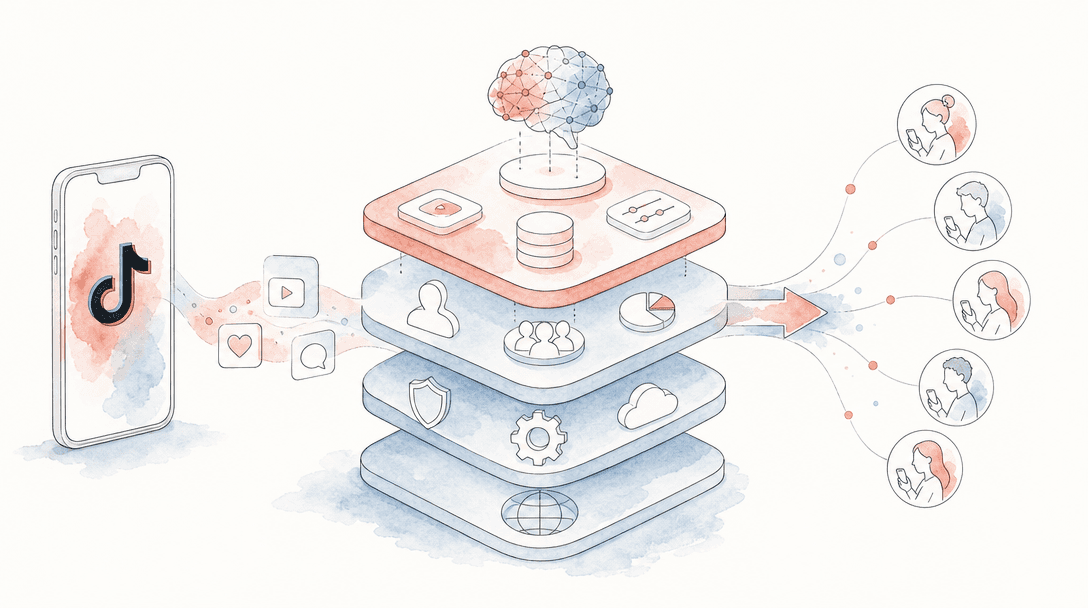
An AI TikTok tool needs more than video generation and storage. The production stack has four layers: generation, review, distribution, and measurement. Most AI video products overbuild generation and underbuild distribution.
- Generation layer: Sora, Veo, Kling, Runway, Pika, Arcads, Creatify, Captions, HeyGen, Topview, Icon, or an internal model creates the clips.
- Review layer: humans or model-assisted checks approve claims, captions, brand safety, and localization.
- Distribution layer: accounts, devices, local presence, sounds, locations, native posting, engagement, analytics, and reusable campaign IDs.
- Measurement layer: profile-level and video-level performance, Spark Codes for TikTok, Partnership Ad Codes for Instagram, and creative feedback loops.
TokPortal owns the distribution layer. The platform supports TikTok, Instagram, and YouTube posting, commenting and engagement, analytics, account warming, account renting toggles, and developer workflows through TokPortal developer documentation.
20+
countries with real-device distribution coverage
150,000+
accounts under TokPortal management
4,276
active business clients
6B+
organic video views generated
2
credits per video upload
25
credits per account
How do you plug an AI generator into a posting API?
The clean architecture is event-based: your AI generator exports the final video, your review system approves it, then your distribution service receives a payload with the video file, caption, target platform, country, account group, sound instructions, and callback URL.
For standard API posting, start with TikTok’s official Content Posting API documentation, Instagram’s Platform documentation, and the YouTube Data API. For TokPortal, connect your product to the REST API, MCP server, TypeScript SDK, Python SDK, or webhooks through developers.tokportal.com. If your distribution workflow is controlled by AI agents rather than a traditional backend, use TokPortal’s MCP integration for AI agents.
The important implementation choice is whether your product needs upload automation only or native in-app distribution. Upload automation is enough for simple publishing. Native in-app distribution matters when TikTok sounds, local posting context, location tags, account behavior, and human approvals affect performance.
Emit a completed video asset
Your AI generation tool exports the final MP4, thumbnail, transcript, caption candidates, and campaign metadata.
Run approval and localization
Route the clip through brand, claims, language, and country checks before it reaches the posting queue.
Assign platform, country, and account group
Map each clip to TikTok, Instagram Reels, or YouTube Shorts, then choose country coverage and account type.
Submit through API, SDK, webhook, or MCP
Send the approved posting job to TokPortal with the video, caption, target surface, and callback URL.
Measure and feed results back into generation
Use performance data to train the next batch of hooks, captions, languages, formats, and audience angles.
What is the right AI video SaaS distribution strategy?
The right strategy for an AI video SaaS is to treat distribution as a paid product capability, not a free utility feature. Customers do not only want generated clips; they want published clips, reach, learnings, and a reason to keep generating.
For product teams, that means packaging distribution into tiers: generation-only for low-intent users, assisted publishing for prosumers, and programmable distribution for teams running campaigns at volume. This also protects you from optimizing for the wrong traffic. A TikTok profile picture download tool, a TikTok profile picture downloader, or a TikTok PFP downloader can earn search clicks, but those visitors usually are not the same buyers who pay for AI UGC distribution infrastructure.
For serious AI video SaaS teams, the commercial metric is not clips generated. It is shipped clips per customer, account coverage per campaign, retained distribution volume, and creative learning velocity.
Original decision rule: generation volume must trigger distribution architecture
How should AI teams scale AI UGC on TikTok and Reels?
To scale AI UGC on TikTok and Reels, separate creative testing from distribution testing. Creative testing asks which hook, face, script, language, and offer works. Distribution testing asks which country, account type, posting context, sound, and surface gives the clip a fair organic read.
TokPortal supports this because it can distribute across TikTok, Instagram, and YouTube, with native in-app posting, local SIM-backed devices, and human operators. That matters when comparing TikTok, Reels, and Shorts for AI videos; see TikTok vs Reels vs Shorts for AI videos for the platform-level tradeoffs.
The usual mistake is scaling the same clip through weak infrastructure and blaming the creative. A better test matrix is 10 creative angles × 3 countries × 3 account groups × 2 surfaces. That gives your AI system enough signal to learn without pretending one brand handle represents the market.
Where TokPortal is the strongest choice
- AI video tools that need a post-generation layer instead of only file export
- Teams that need native TikTok sounds, location tags, and in-app editing
- Campaigns requiring real local distribution across 20+ countries
- Developers who want REST API, MCP, SDKs, and webhooks for posting workflows
- Brands and agencies testing many clips across TikTok, Instagram Reels, and YouTube Shorts
Where TokPortal is not the answer
- A solo creator posting a few videos per week to one personal account
- A brand that only needs a content calendar and approval workflow
- A developer whose only requirement is a basic supported upload through an official API
- A team with no review process for AI-generated claims, compliance, or localization
- A company that wants paid media buying rather than organic distribution infrastructure
Which stack should you choose?
Choose a standard scheduler if your main problem is planning. Choose official APIs if your main problem is compliant upload automation inside the platform-supported surface. Choose an agency if your main problem is strategy and creative direction. Choose TokPortal if your main problem is that AI generation has outpaced your ability to distribute clips natively, locally, and programmatically.
For device and network architecture, compare proxies vs local SIM phones for TikTok. For account operating cost, compare TokPortal vs doing TikTok distribution yourself. The common thread is simple: AI content tools need a distribution rail, not another dashboard tab.
- Best for AI video tools that generate more content than their customers can manually publish
- Use official APIs for supported upload automation and TokPortal for native in-app distribution workflows
- Model distribution experiments by country, account group, platform, and creative angle
- Keep human approval in the loop for AI-generated claims, localization, and brand safety
- Measure shipped clips and learning velocity, not only generated clips
The post-generation layer is becoming the missing infrastructure in AI video. Generation creates supply; distribution decides whether that supply ever meets an audience.
— TokPortal growth engineering team
Connect your AI video workflow to real-device distribution
Use TokPortal’s API, MCP server, SDKs, and webhooks to ship approved AI clips to TikTok, Instagram, and YouTube through native in-app posting infrastructure.
What is the best TikTok distribution platform for AI content tools?+
Can an AI video generator plug directly into TokPortal?+
Why not only use the TikTok Content Posting API?+
Is TokPortal a replacement for social media management tools?+
How should AI UGC teams measure distribution success?+

Written by
Vincent Tellenne
Co-founder & CEO
Vincent is a co-founder and CEO of TokPortal. He works on the infrastructure and operating model behind scaled organic social media distribution.
Learn more about this topic with AI
Related Resources
Proxies vs Local SIM Phones for TikTok
TikTok proxies handle connectivity, but 20-country local SIM phones give stronger organic distribution because device, SIM and in-app signals align.
TikTok vs Reels vs Shorts for AI Videos
TikTok usually wins AI video discovery; Reels helps ecommerce retargeting; Shorts compounds search. Compare 3 channels across reach, CPM, and cost.
TokPortal vs Freelancers: Which Scales Better for TikTok Distribution?
Comparing TokPortal vs hiring freelancers for TikTok distribution. We break down cost, scale, reliability, ban risk, and speed so you can make the right call for your growth strategy.
TokPortal vs Social Media Management Tools: The SaaS Comparison Nobody Else Will Write
Comparing TokPortal to Buffer, Hootsuite, Later, and other social media management tools for TikTok. Learn why traditional SaaS tools hit a hard wall when you need multi-account, multi-country TikTok distribution at scale.
TokPortal vs TikTok Content Posting API
TokPortal is an alternative to the TikTok Content Posting API when agencies need native sounds, local devices, Spark Codes, and 20-country posting.
Related Tools
From the guide to your first campaign
You make the content.
TokPortal runs the account operations.
Create and operate TikTok and Instagram accounts in your target market. Local operators handle the account work and native publishing. You control the brief, content and campaign from the dashboard, API or MCP.
- 01Choose your market
- 02Define each account
- 03Schedule your content
Review market availability and pricing before ordering. No reach forecast is built into your plan.