
On this page
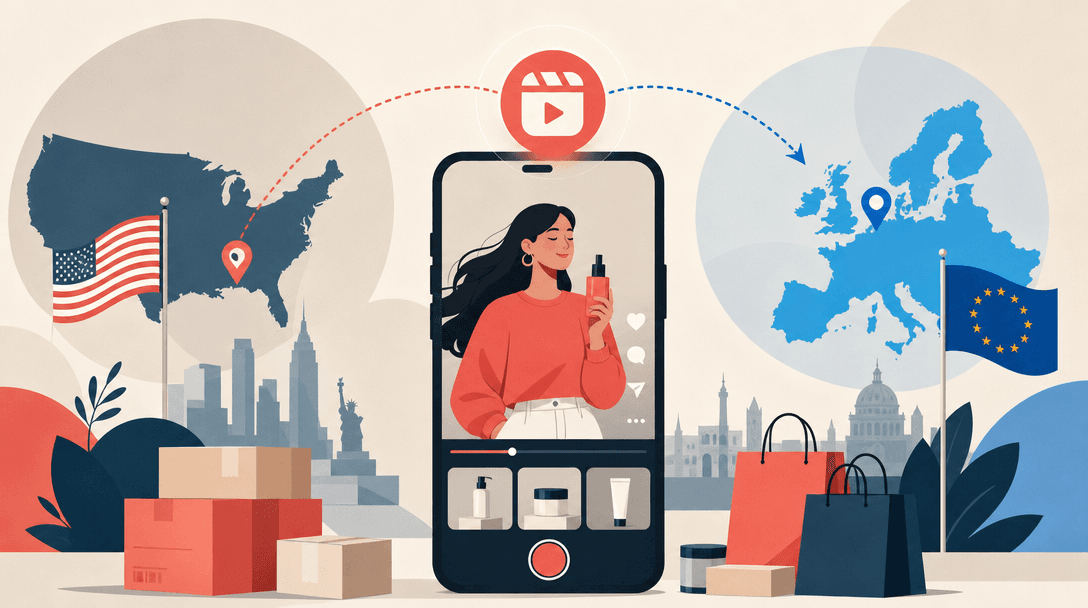
TokPortal is organic Reels distribution infrastructure for DTC brands that need Instagram videos posted across real accounts, real phones, and local markets. It helps ecommerce teams run US and European Reels campaigns without relying on one brand account or paid ads alone.
Instagram Reels distribution for DTC brands is the operating layer between finished video assets and market-level reach. Most ecommerce teams can now produce dozens of product videos with creators, AI-UGC tools, editors, and affiliates. The harder problem is getting those Reels published through enough credible, local surfaces to test hooks, offers, countries, and product angles without forcing every test through one brand handle.
TokPortal is programmable, organic social-media distribution infrastructure — The Human API. For Reels, DTC teams use TokPortal to coordinate real-account posting from real physical smartphones with local SIM cards, human operators, scheduling, account warming, analytics, and API workflows. If your team also runs TikTok, this pairs naturally with TokPortal’s ecommerce TikTok distribution playbook and the broader social distribution API for TikTok, Reels, and Shorts.
4,276
active business clients using TokPortal distribution infrastructure
150,000+
social accounts under TokPortal management
6B+
organic video views generated across TokPortal campaigns
20+
countries available through real devices and local SIM-based posting
How to scale Reels for DTC products
To scale Reels for DTC products, separate the campaign into four jobs: creative production, account preparation, market routing, and measurement. A single brand account is useful for owned proof, but it is a weak testing surface for a launch because one account cannot reliably test 20 hooks, 10 creators, 5 offers, and multiple countries in the same week.
A practical DTC Reels system starts with a product-angle matrix. For example: problem-aware hook, founder demo, unboxing, objection handling, comparison, social proof, routine integration, and offer-led urgency. Each angle gets 3–5 edits. Those edits are then posted across warmed accounts matched to niche and geography, not dumped onto the same profile at the same time.
TokPortal supports account warming before campaign volume starts: niche warming costs 7 credits and deep warming costs 40 credits for Instagram, handled manually over three days. DTC teams use this before pushing higher-volume Reels campaigns so the account history matches the product category before launch week.
Build a product-angle matrix
Map each SKU to hooks such as demo, unboxing, problem-solution, comparison, objection handling, testimonial-style, bundle offer, and seasonal use case.
Create Reels variants before distribution
Produce multiple cuts per angle with different first frames, captions, voiceovers, text overlays, and calls to action. Distribution cannot rescue one weak creative.
Warm accounts by niche and country
Prepare accounts around the product category and region before publishing campaign volume. For Instagram, TokPortal offers deep warming as a three-day manual process.
Route videos by market
Send US creatives to US accounts and European variants to country-matched accounts such as France, Germany, Italy, Spain, Portugal, Romania, and Finland where available.
Measure by creative cell, not by post alone
Track hook, product, offer, country, account type, publish time, and resulting reach so winning cells can be repeated.
Original operating rule: scale cells, not clips
Instagram Reels for US and EU launches
US and European Reels launches need different distribution logic because DTC demand is shaped by shipping promises, currency, language, privacy expectations, and local creative norms. A US skincare Reel can lead with speed, social proof, and bundle economics. A France or Germany variant may need clearer product education, localized captions, and a softer conversion path before the offer.
TokPortal’s device network covers the USA plus multiple European markets, including France, Germany, Italy, Portugal, Romania, Spain, Finland, Switzerland, and the UK. For DTC launches, that means Reels can be published through country-matched operators using real physical devices and local SIM cards rather than routing every market through one centralized workflow.
The operational win is not just language. It is market-native posting context: local account activity, local device signals, local scheduling, and region-specific creative routing. This is the same logic behind multi-country TikTok launch strategy, adapted for ecommerce Reels campaigns.
- USA launch cells for national shipping offers and broad English creative
- UK launch cells for English creative with local pricing and delivery language
- France launch cells with French captions, local references, and localized checkout promises
- Germany launch cells with clearer product claims, delivery details, and trust-building copy
- Italy, Spain, Portugal, Romania, and Finland cells for localized category tests where inventory and fulfillment support the market
- European expansion cells that separate brand awareness from immediate conversion when a market is new
How do DTC brands run Reels campaigns on many accounts?
DTC brands run Reels campaigns on many accounts by treating social posting like distribution infrastructure, not community management. The brand or agency supplies the video assets, metadata, campaign rules, posting calendar, and target markets. TokPortal handles account inventory, human-in-the-loop posting, device routing, warming, analytics, and campaign execution through the dashboard or API.
The economics are credit-based: 25 credits per account, 2 credits per video upload, 7 credits for niche warming, 40 credits for Instagram deep warming, 3 credits for video editing, and 1 credit for sound-volume control where applicable. For developers and technical growth teams, the REST API, webhooks, TypeScript SDK, Python SDK, and MCP server are available at TokPortal developer documentation.
This matters when a DTC team already has a content engine. If your creative team or AI-UGC stack produces 100 Reels-ready assets, the bottleneck becomes scheduling, local posting, and account operations. TokPortal is the post-generation layer for that workflow, similar to how UGC-at-scale campaigns distribute many creative variants without relying on one profile.
Feature
Single brand account
Multi-account Reels distribution
Creative testing
Market routing
Operational load
Brand safety
Best use
What does a multi-region Reels strategy look like?
A multi-region Reels strategy starts with the markets where the DTC brand can actually fulfill demand. Do not distribute in Germany if checkout, shipping, returns, and customer support are not ready for German buyers. Organic reach is useful only when the landing path can convert.
For a US and EU launch, build three campaign tiers. Tier 1 is the core revenue market: usually the US for American DTC brands. Tier 2 is proven expansion: UK, Germany, France, Italy, or Spain depending on shipping and category. Tier 3 is learning: smaller creative tests in markets where the brand wants early signal before committing paid media or retail partnerships.
Each region should have its own creative rules: captions, currency, delivery promise, claim language, landing page, and influencer style. Meta’s Instagram publishing and Reels advertising documentation define the official ad and publishing surfaces, but organic multi-account distribution still requires human operating discipline: asset naming, posting windows, local account history, and analytics hygiene.
Where multi-region Reels distribution helps
- Testing DTC product-market fit across countries before increasing paid spend
- Launching multiple SKU angles without overloading the owned brand account
- Localizing Reels by country, language, offer, and shipping promise
- Giving agencies a repeatable operating layer for client ecommerce campaigns
- Routing AI-UGC and creator-made assets into real publishing workflows
Where TokPortal is not the answer
- It will not fix weak creative, poor product-market fit, or a broken checkout flow
- It is not a replacement for owned community management on the brand handle
- It is not the right first step if the brand has no clear SKU, offer, margin, or fulfillment plan
- It should not be used to make product claims the brand cannot substantiate
What is a Reels posting network for ecommerce?
A Reels posting network for ecommerce is a managed set of real Instagram accounts, devices, operators, and workflows that publish product videos for a brand across markets. The goal is not to imitate a paid ad account. The goal is to create more organic distribution surfaces for product education, hook testing, and launch discovery.
TokPortal’s moat is physical execution: real smartphones, local SIM cards, human operators, and native in-app posting across supported countries. Platforms evaluate device context, carrier data, location context, WiFi patterns, and behavioral history. Publishing from real local devices gives DTC Reels campaigns a more natural operating environment than centralized duplicate posting workflows.
For ecommerce teams, the network should be used with a clear taxonomy: SKU, angle, creator type, market, account cluster, post time, and landing URL. The same principle applies if the brand is expanding beyond Instagram into TikTok, where account preparation and native posting are covered in TokPortal’s account warming guide and 100-account scaling guide.
Organic Reels vs paid ads for DTC brands
Organic Reels and paid ads solve different DTC problems. Paid ads are better for controlled spend, retargeting, attribution, and scaling a proven offer. Organic Reels are better for discovering hooks, testing creator angles, seeding product narratives, and learning what a market responds to before spend is locked into an ad set.
The strongest DTC teams use both. Run organic Reels distribution to find which creative cells earn attention without paid delivery. Then move winners into paid acquisition, whitelisting, creator licensing, email capture, or the owned brand account. Instagram Partnership Ads can extend eligible creator or partner content through Meta’s paid system, while TokPortal handles the organic distribution side before the paid decision.
Use paid ads when you need predictable volume on a validated funnel. Use organic Reels distribution when the unknown is creative, country, audience language, or product angle. If your media buyer is guessing which hook to fund, organic distribution gives them better inputs.
GSC lesson: volume is not the same as buyer intent
A worked example: 40 Reels for a US and EU DTC launch
Assume a DTC beauty brand has 40 Reels-ready assets: 8 product angles with 5 edits each. The launch markets are the US, UK, France, and Germany. Instead of posting all 40 assets on the brand handle, the team creates 16 creative cells: 4 markets × 4 priority angles. Each cell receives 2–3 edits in the first testing wave.
The brand account publishes the safest product story. The distribution accounts test sharper hooks: price objection, routine fit, before-after education where compliant, founder demo, ingredient explanation, and unboxing. Each post is tagged in the campaign sheet by market, hook, edit, landing page, and publish window. After the first wave, the team does not ask, 'Which Reel won?' It asks, 'Which angle-market pair deserves more distribution or paid spend?'
This is where Reels distribution for ecommerce becomes an operating advantage. The brand can learn whether German buyers respond to ingredient education, whether US buyers respond to bundle economics, and whether French buyers need a different first frame before committing the paid budget.
Plan a multi-account Reels campaign
Use TokPortal pricing to model accounts, uploads, warming, and Instagram distribution capacity for your next DTC launch.
How do DTC brands scale Instagram Reels without overposting on their own account?+
Can TokPortal distribute Reels in both the US and Europe?+
Is organic Reels distribution better than paid ads for ecommerce?+
Do DTC brands need different Reels for each country?+
Does TokPortal replace an agency or social media manager?+
Can this connect to our existing automation stack?+

Written by
Vincent Tellenne
Co-founder & CEO
Vincent is a co-founder and CEO of TokPortal. He works on the infrastructure and operating model behind scaled organic social media distribution.
Learn more about this topic with AI
Related Resources
TikTok Marketing for E-Commerce: Scale Product Distribution with TokPortal
TikTok marketing strategies for e-commerce brands in 2026. Learn how to scale product distribution with multi-account campaigns, UGC, and organic content using TokPortal.
Multi-Country TikTok App Launch Strategy
Launch a mobile app on TikTok across 10 countries with organic posting, local accounts, install tracking, creative tests, and a checklist for teams.
How to Scale TikTok Marketing with 100+ Accounts in 2026
Learn how to scale TikTok marketing with 100+ accounts using real devices, native posting, and account warming. Complete guide for brands and agencies running multi-account organic campaigns in 2026.
Social Distribution API for TikTok, Reels & Shorts
Post TikTok, Reels and Shorts from code with TokPortal’s real-device API, SDKs and webhooks across 20 countries—built for AI video tools and agencies.
The Complete Guide to TikTok Account Warming in 2026
Master TikTok account warming for maximum organic reach. Learn warming techniques, timelines, and how to automate the process with TokPortal's niche warming and deep warming features.
UGC at Scale: How Brands Run 50+ Account Campaigns on TikTok
Learn how brands run UGC campaigns at scale with 50+ TikTok accounts. Complete playbook covering account setup, content strategy, and distribution using TokPortal.