
On this page
Spark Ads vs organic Spark Codes: use Spark Ads when you already know a post converts and need paid reach through TikTok Ads Manager; use organic Spark Code seeding when you need to discover which UGC, account, sound, or country earns traction before spending. TokPortal makes seeding and per-video Spark handoffs scalable.
TokPortal is programmable, organic social-media distribution infrastructure — The Human API. For TikTok Spark strategy, that means brands can post UGC through real local devices, identify which posts earn organic traction, then request or receive Spark Codes on the exact videos worth amplifying.
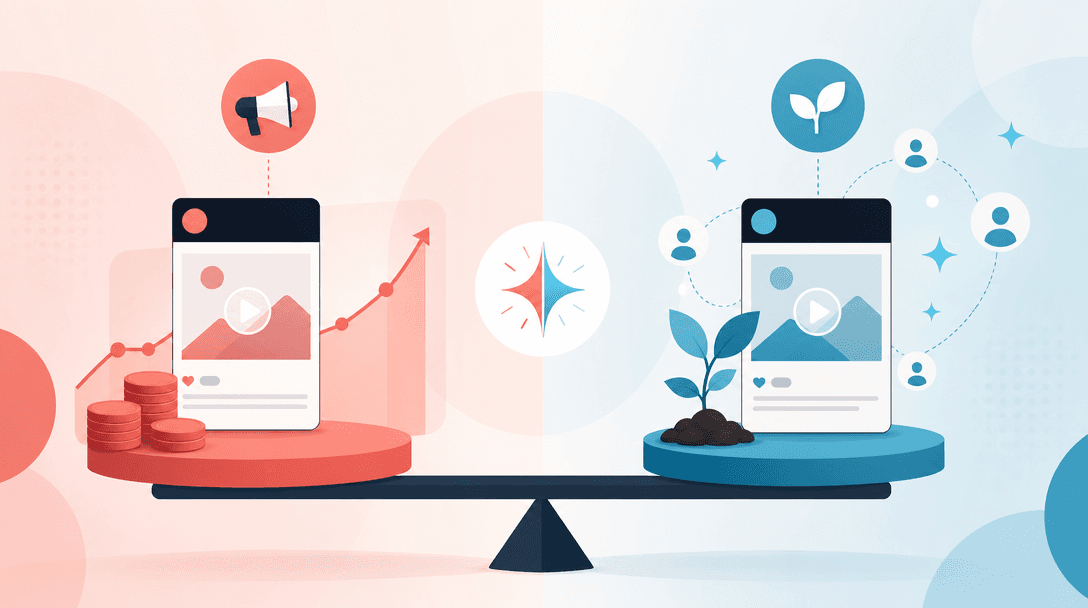
The mistake is treating Spark Ads and organic seeding as substitutes. They are different stages of the same campaign: organic distribution finds the creative-market fit; Spark Ads buy more exposure for the posts that already proved they deserve it. If you are building a UGC engine, start with UGC at Scale: how brands run 50+ account campaigns on TikTok and then layer Spark Codes into the winner-selection process.
20
countries with real local-device distribution
150,000+
accounts under management
4,276
active business clients
6B+
organic video views generated
When should you use Spark Ads vs organic TikTok?
Use organic TikTok first when the question is creative risk. If you do not know which hook, creator angle, account type, location, sound, or caption will earn attention, paying to distribute every asset is expensive learning. Seed the content organically, compare watch behavior and engagement, then collect Spark Codes only from the posts that show momentum.
Use Spark Ads when the question is scale. TikTok Spark Ads are a paid ad format that lets advertisers amplify eligible organic posts with authorization from the account or creator, according to TikTok Business Help Center documentation. That makes them strongest after an organic signal exists: a product demo that drives saves, a founder clip that earns comments, a local offer that performs in one city, or UGC that beats the rest of the batch.
The practical rule: organic seeding answers “which post deserves money?” Spark Ads answer “how much more distribution should this proven post receive?”
Feature
Spark Ads
Organic Spark Code seeding
Primary job
Best timing
Control surface
Budget exposure
Best for
Weakness
How do you scale Spark Code distribution?
Build the UGC batch before buying reach
Start with enough variation to learn: different hooks, first frames, creator styles, captions, product claims, and local references. Spark strategy fails when every post is the same asset with a different username.
Assign posts across real local accounts
Distribute the batch across accounts matched to country, niche, language, and audience context. TokPortal posts inside the native TikTok app on real physical smartphones with local SIM cards, so location tags, TikTok sounds, and in-app editing remain available.
Let organic performance rank the assets
Compare the seeded posts by engagement, comments, saves, profile actions, and qualified traffic. TokPortal’s internal TikTok benchmark index shows top-quartile engagement is above 5%, giving teams a practical threshold for shortlisting winners.
Request Spark Codes only from shortlist posts
Treat each Spark Code as a per-video handoff, not a blanket permission workflow. The goal is to collect codes from the posts that earned organic signal, not from every video in the campaign.
Move winners into paid amplification
Use TikTok Ads Manager for Spark Ads once the post has proof. Keep organic seeding running in parallel so the paid team always has new winners instead of waiting for one creative cycle at a time.
Automate the repeatable parts
For technical teams, TokPortal supports a REST API, MCP server, TypeScript SDK, Python SDK, and webhooks through https://developers.tokportal.com, so Spark Code workflows can plug into existing UGC and reporting systems.
Spark Ads cost vs organic reach: what should you compare?
Do not compare Spark Ads to organic reach as if one is always cheaper. Compare the cost of learning. Spark Ads spend is auction-based inside TikTok Ads Manager, while TokPortal organic seeding uses credits: 25 credits per account, 2 credits per video upload, 7 credits for niche warming, 3 credits for video editing, and 1 credit for sound-volume control.
A simple test plan: 10 accounts cost 250 account credits. Posting 5 UGC variations across those 10 accounts costs 100 upload credits. If the accounts need niche warming, add 70 credits. That gives you a 10-account, 50-post learning grid before you decide which videos deserve paid amplification.
The paid-media question is not “can Spark Ads buy reach?” They can. The better question is “which post should receive that spend?” Organic Spark Code seeding lowers the chance that the paid team funds the wrong creative.
Original decision rule: promote the top post per angle, not the top post overall
What is a Spark Code marketplace strategy?
- Treat Spark Codes as per-video rights, not as generic creator access.
- Classify every available code by niche, country, hook type, audience intent, and post performance.
- Separate discovery inventory from paid-amplification inventory.
- Prioritize codes from posts with strong organic comments and saves, not only view count.
- Keep a live shortlist of Spark-ready winners for the media buying team.
- Retire codes from posts whose angle no longer matches the offer, landing page, season, or inventory position.
- Use platform authorization flows and document which post, account, and campaign each code belongs to.
A marketplace strategy is useful when an agency, DTC team, app-growth team, or AI-UGC platform has more content than paid media can test. Instead of asking media buyers to review a folder of raw videos, create a live inventory of posts that already exist on TikTok and are eligible for Spark amplification.
This is where TokPortal’s per-video Spark Code surface matters. Teams can seed content organically, keep winners visible, and make the handoff to paid media cleaner: post URL, country, account context, creative angle, organic result, and Spark Code status. For creator-led distribution workflows, pair this with influencer seeding on TikTok for brands.
How should brands use TikTok Spark Ads for UGC?
UGC Spark Ads work best when the paid ad is not the first test. The strongest workflow is: generate or source UGC, seed it through multiple accounts, observe which posts earn attention, then amplify those exact posts with Spark Ads.
For DTC, the winner might be a product demo that earns saves. For apps, it might be a problem-solution clip that drives profile taps. For TikTok Shop, it might be an AI-assisted product video that outperforms the creator-shot version. See the DTC brand TikTok growth playbook and Creatify AI videos for TikTok Shop distribution for adjacent execution models.
TikTok’s official Content Posting API is useful for certain publishing workflows, but TikTok’s developer documentation does not provide the same native in-app surface as posting inside the real app. For Spark-ready UGC, native sounds, location tags, and account context can change the post’s organic signal before the paid team ever touches it.
How do you seed Spark Codes across multiple accounts?
Seed across multiple accounts by designing a matrix, not a blast. A useful matrix has four columns: account country, niche context, creative angle, and posting window. The goal is to learn whether the asset works because of the video itself, the local audience, the account context, or the timing.
TokPortal supports TikTok posting across 20 countries: USA, UK, Australia, Brazil, Canada, Colombia, Finland, France, Germany, Indonesia, Italy, Japan, Malaysia, Mexico, Pakistan, Philippines, Portugal, Romania, Spain, and Switzerland. That matters for Spark Code strategy because a post that wins in the UK may not be the best paid asset for Brazil, and a Spanish-language winner should not be buried inside an English-only ad workflow.
Agencies running this at client scale should document the operating model before the first seed. The closest playbooks are the UGC agency playbook for scaling campaigns and running UGC campaigns in 10 countries simultaneously. Developers can connect the workflow to reporting, approvals, and webhooks through TokPortal’s REST API and SDK documentation.
Where TokPortal fits
- You need organic TikTok proof before putting spend behind Spark Ads.
- You want to test the same UGC across accounts, countries, niches, or hooks.
- You need native in-app posting with TikTok sounds, location tags, and editing.
- You want per-video Spark Code handoffs as part of a repeatable campaign workflow.
- You are building a UGC, AI video, app launch, ecommerce, or agency distribution system.
Where TokPortal is not the answer
- You already have a single proven post and only need paid delivery inside TikTok Ads Manager.
- Your campaign requires guaranteed impressions by a fixed hour with no organic discovery phase.
- You have no permission to use the creative in paid media.
- Your offer, landing page, or tracking is not ready for paid amplification.
What about TikTok profile viewer and PFP downloader traffic?
Searches like “tiktok profile picture download,” “tiktok profile viewer,” “tiktok profile picture downloader,” “tiktok pfp downloader,” and “download pp tiktok” can produce traffic, but they do not prove Spark Ads buyer intent. They are creator-utility searches, not distribution-strategy searches.
Use that traffic for lightweight tools or education if it already exists, but do not let it drive your Spark Code roadmap. A brand deciding between Spark Ads and organic Spark Code seeding is buying a distribution outcome: validated UGC, cleaner paid-media handoff, and more confident budget allocation.
Build a Spark Code seeding campaign before you buy reach
Use TokPortal to seed UGC through real local TikTok accounts, identify organic winners, and hand the strongest posts to your paid team with Spark Codes.
Are Spark Ads better than organic TikTok?+
What is an organic Spark Code strategy?+
How many accounts should a brand use before running Spark Ads?+
Can TokPortal help with Spark Codes?+
Should AI-generated UGC go straight into Spark Ads?+
Does organic Spark Code seeding replace TikTok Ads Manager?+

Written by
Vincent Tellenne
Co-founder & CEO
Vincent is a co-founder and CEO of TokPortal. He works on the infrastructure and operating model behind scaled organic social media distribution.
Learn more about this topic with AI
Related Resources
Creatify AI Videos for TikTok Shop Distribution
Distribute Creatify AI product videos on TikTok Shop with 20-country posting, variant testing, affiliate clips, and API-triggered workflows.
DTC Brand TikTok: The Direct-to-Consumer Growth Playbook
The complete TikTok playbook for DTC brands. Learn how to build multi-account distribution, leverage native TikTok features, and scale organic customer acquisition across 30+ countries.
Influencer Seeding on TikTok: How Brands Distribute to Creators at Scale
Learn how brands run influencer seeding campaigns on TikTok at scale — what works, what fails, and how to build the multi-account distribution infrastructure behind successful creator programs.
Running UGC Campaigns in 10 Countries Simultaneously
Learn how to run international UGC campaigns across 10+ countries simultaneously on TikTok and Instagram — without bans, shadowbans, or operational chaos.
UGC Agency Playbook: From 5 to 50 Client Campaigns
How to scale a UGC agency from 5 to 50 client campaigns. The operational playbook covering account infrastructure, content workflows, multi-country distribution, and tools that prevent burnout and ban waves.
UGC at Scale: How Brands Run 50+ Account Campaigns on TikTok
Learn how brands run UGC campaigns at scale with 50+ TikTok accounts. Complete playbook covering account setup, content strategy, and distribution using TokPortal.