
On this page
TokPortal is programmable organic social-media distribution infrastructure for scaling TikTok UGC without influencer whitelisting. Brands supply the videos; TokPortal posts them natively through real human operators on real physical devices with local SIM cards, giving D2C and agency teams multi-account, geo-native reach without negotiating creator access.
Influencer whitelisting is useful when the creator is the media asset. It is a bad default when the asset is the UGC itself: product demos, founder clips, AI-assisted testimonials, comparison videos, unboxings, offer tests, and local-language variants. TokPortal separates UGC production from UGC distribution, so a brand can test many creatives across many TikTok accounts without waiting on creator access, creator posting windows, or one account's audience.
This page is for brands, agencies, and e-commerce teams that already have videos and need distribution. For a broader campaign operating model, read UGC at Scale: How Brands Run 50+ Account Campaigns on TikTok.
How to scale TikTok UGC without influencers
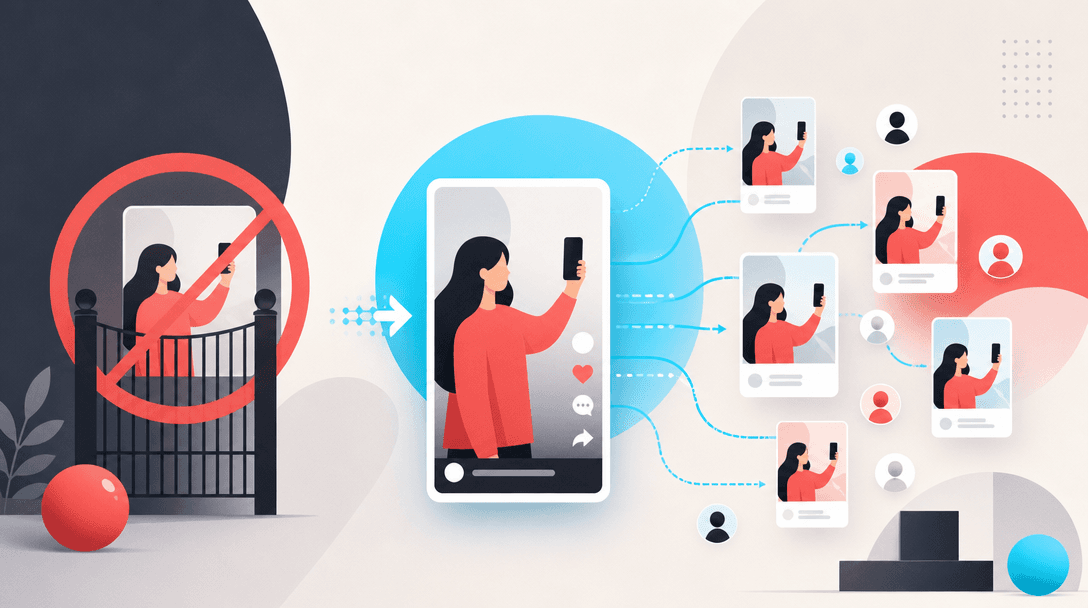
To scale TikTok UGC without influencers, treat creators as a content source, not the distribution channel. Buy, produce, or generate the videos; then distribute them through a controlled account network where each account has a niche, geography, posting cadence, and creative angle.
The practical shift is from one creator post to a campaign grid: 10 hooks, 10 accounts, 5 markets, then double down on the combinations that earn retention, saves, comments, clicks, or purchases. TokPortal supports this with native in-app posting on real physical smartphones, local SIM cards, location tags, TikTok sounds, and API-controlled scheduling through TokPortal developer docs.
Build a UGC creative grid
Create variants across hook, offer, format, product angle, language, and proof point. A D2C brand should test problem-led, comparison-led, demo-led, and objection-led cuts instead of posting the same video everywhere.
Assign accounts by niche and market
Map each account to a product category, local country, and content angle. TokPortal operates with real accounts on real devices and local SIM cards across 20+ countries.
Post natively inside TikTok
Native app posting preserves TikTok sounds, captions, location tags, and in-app editing options that are not available in the same way through the official Content Posting API.
Measure account-level and creative-level lift separately
Do not judge a campaign by total views alone. Track which hook-account-market combinations produce watch time, engagement rate, profile visits, click-through, and sales events.
Move winners into paid handoff only after proof
Use Spark Codes when a video earns organic proof first. This keeps paid media from subsidizing weak creative and gives the media buyer a stronger starting point.
TikTok UGC distribution network
A TikTok UGC distribution network is a managed set of real accounts used to publish brand-supplied videos across different niches, countries, and posting schedules. The goal is not to imitate influencer marketing. The goal is to create repeatable organic reach infrastructure for content that is already produced.
TokPortal's network uses real human operators, real physical devices, and local SIM cards in the USA, UK, Australia, Brazil, Canada, Colombia, Finland, France, Germany, Indonesia, Italy, Japan, Malaysia, Mexico, Pakistan, Philippines, Portugal, Romania, Spain, and Switzerland. That matters because TikTok distribution is shaped by device signals, location context, account history, sound usage, and in-app behavior.
20+
countries supported with local-device distribution
150,000+
accounts under TokPortal management
4,276
active business clients
6B+
organic video views generated
9,000+
TikTok profiles analyzed in internal benchmark indexes
Original campaign rule: distribution coverage beats creator dependency
UGC vs influencer marketing on TikTok
Feature
UGC distribution network
Influencer whitelisting
Primary asset
Best use case
Operational bottleneck
Posting method
When to use paid media
Where TokPortal is the better fit
- You have 20, 50, or 100 UGC videos and need systematic distribution.
- You want country-specific TikTok posting without building local account operations yourself.
- You need native sounds, location tags, and in-app publishing rather than a limited upload workflow.
- You want Spark Code handoffs only after a post has shown organic signal.
Where influencer whitelisting is still the better fit
- The creator's personal credibility is the core reason the buyer trusts the message.
- You are buying a celebrity partnership or long-term ambassador relationship.
- Your legal team requires content to stay on the creator's own profile only.
- You have only one hero video and no plan to test variants.
TikTok UGC distribution for D2C brands
D2C brands win TikTok UGC by matching product proof to the right account context. A skincare brand needs routine-led, problem-led, and comparison-led accounts. A supplement brand needs education-heavy accounts with careful claim control. A fashion brand needs try-on, styling, and trend-response accounts. One brand handle cannot carry all of those contexts at once.
The D2C playbook is simple: ship more angles than your paid team can safely test, let organic posting reveal which angles earn attention, then route the winners into retargeting, Spark Ads, TikTok Shop, landing-page tests, or creator follow-up. For vertical examples, see the DTC brand TikTok growth playbook, the e-commerce TikTok strategy guide, and the beauty brand TikTok playbook.
- Product demo videos posted from niche-relevant accounts
- Offer tests across different hooks and local markets
- TikTok sounds, location tags, and captions added inside the native app
- Account warming before campaign volume increases
- Per-video Spark Codes for paid amplification handoff
- REST API, MCP server, TypeScript SDK, Python SDK, webhooks, n8n, Make, and Zapier support
TikTok UGC posting across many accounts
Posting UGC across many TikTok accounts requires three controls: account readiness, creative differentiation, and scheduling discipline. Account readiness means the profile has niche context before the campaign starts. Creative differentiation means each post has a reason to exist, not a duplicated caption with a new upload time. Scheduling discipline means the brand can see what was posted, where, when, and under which campaign.
TokPortal prices the operational primitives in credits: 25 credits per account, 2 credits per video upload, 7 credits for niche warming, 40 credits for deep warming on Instagram, 3 credits for video editing, and 1 credit for sound-volume control. That lets an agency or growth team model the cost of a 10-account test before scaling to 50 or 200 accounts. Agencies can extend this into white-label operations with white-label TikTok distribution for clients or a larger UGC agency campaign system.
What to measure before you buy influencer access
Before paying for influencer whitelisting, measure whether the creative deserves paid distribution. The useful signals are hook retention, engagement rate, saves, comments with buying intent, profile visits, landing-page clicks, TikTok Shop activity, and country-level response. TokPortal's internal TikTok benchmark index classifies 3-5% engagement as good, 5-8% as strong, and above 8% as excellent across follower tiers.
Research tools have a place, but they are not a campaign engine. A TikTok profile picture download tool, TikTok profile picture downloader, TikTok profile viewer, TikTok pfp downloader, or 'download pp TikTok' utility can help a marketer inspect accounts during research. None of those tools posts UGC, controls schedules, preserves native TikTok features, or turns 50 videos into a measurable distribution system.
A practical 30-day UGC distribution plan
Week 1: produce or collect 30-50 UGC cuts, group them by hook type, and select the first 10 accounts by niche and country. Week 2: post the first creative grid and hold back paid spend until engagement and retention patterns appear. Week 3: refresh captions, sounds, and angles; remove weak combinations; increase posting on the strongest account-market matches. Week 4: request Spark Codes for the best posts and hand those videos to paid media with organic proof attached.
This is also the point to expand into adjacent channels. If your buyers respond to short-form UGC on both TikTok and Instagram, compare the dual-platform model in TikTok + Instagram Reels campaigns at scale.
Model your first multi-account UGC campaign
Use TokPortal pricing to plan the account count, upload volume, warming, native posting, and Spark Code handoff for your next TikTok UGC distribution test.
Can I scale TikTok UGC without hiring influencers?+
Is UGC distribution a replacement for influencer whitelisting?+
Why not just use the official TikTok Content Posting API?+
How many accounts should a D2C brand start with?+
Can TokPortal support agencies running client UGC campaigns?+

Written by
Vincent Tellenne
Co-founder & CEO
Vincent is a co-founder and CEO of TokPortal. He works on the infrastructure and operating model behind scaled organic social media distribution.
Learn more about this topic with AI
Related Resources
DTC Brand TikTok: The Direct-to-Consumer Growth Playbook
The complete TikTok playbook for DTC brands. Learn how to build multi-account distribution, leverage native TikTok features, and scale organic customer acquisition across 30+ countries.
Running UGC Campaigns in 10 Countries Simultaneously
Learn how to run international UGC campaigns across 10+ countries simultaneously on TikTok and Instagram — without bans, shadowbans, or operational chaos.
UGC Agency Playbook: From 5 to 50 Client Campaigns
How to scale a UGC agency from 5 to 50 client campaigns. The operational playbook covering account infrastructure, content workflows, multi-country distribution, and tools that prevent burnout and ban waves.
UGC at Scale: How Brands Run 50+ Account Campaigns on TikTok
Learn how brands run UGC campaigns at scale with 50+ TikTok accounts. Complete playbook covering account setup, content strategy, and distribution using TokPortal.
How to Build a UGC Machine That Produces 100 Videos a Week
Learn how to build a UGC machine that produces 100+ videos per week. Covers creator sourcing, editing pipelines, multi-account distribution, and the infrastructure to scale without burning out your team.
White-Label TikTok & Instagram Distribution: Become a Reseller
Build your agency or AI SaaS on TokPortal’s managed account and publishing operations. Keep your brand, scope a pilot and calculate your delivery margin.
From the guide to your first campaign
You make the content.
TokPortal runs the account operations.
Create and operate TikTok and Instagram accounts in your target market. Local operators handle the account work and native publishing. You control the brief, content and campaign from the dashboard, API or MCP.
- 01Choose your market
- 02Define each account
- 03Schedule your content
Review market availability and pricing before ordering. No reach forecast is built into your plan.