
On this page
TokPortal is programmable organic social-media distribution infrastructure that lets teams publish HeyGen talking-head videos across real TikTok accounts using real physical devices, local SIM cards, and human operators. Use HeyGen to generate avatar variants, then use TokPortal to localize, schedule, post, and measure them across 100+ pages.
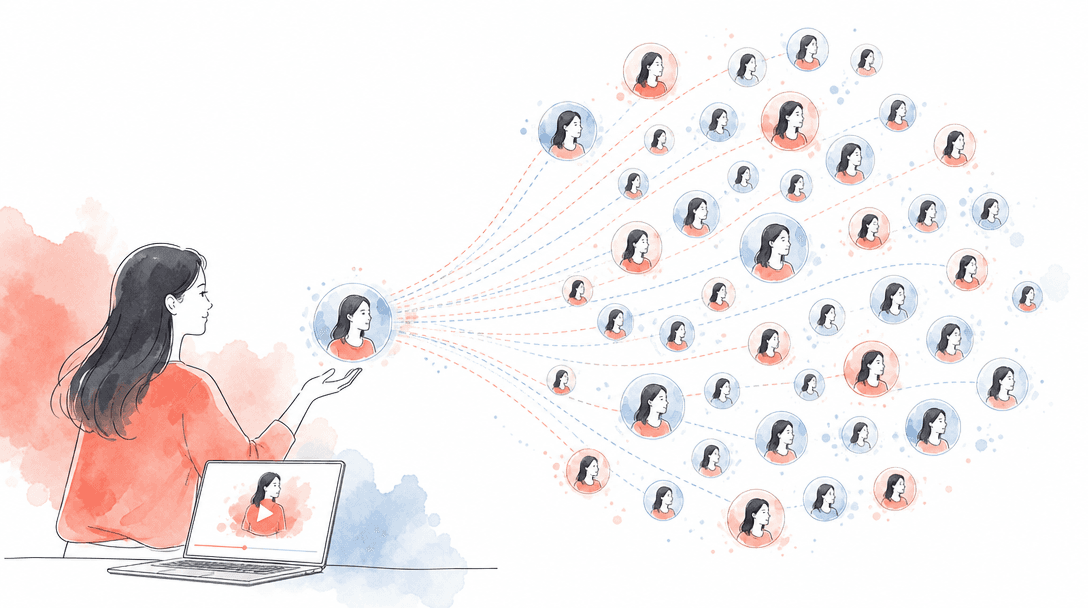
HeyGen solves production: one script can become 20 avatar videos in different languages, voices, and formats. The bottleneck is distribution. A single brand TikTok page is not enough signal for creative testing, country testing, or hook testing; you need many local pages posting natively and measuring which angles earn organic reach.
TokPortal is the post-generation layer for that workflow. Teams use it when they already have HeyGen output and need TikTok distribution across real local accounts, not just another folder of exported MP4s. If you are building a broader UGC engine, start with UGC at Scale: How Brands Run 50+ Account Campaigns on TikTok and pair it with the AI-specific workflow below.
How do you use HeyGen for Reels and TikToks?
Use HeyGen for the controlled parts of short-form creative: avatar presenter, script, voice, language, captions, framing, and repeated hook variants. Export each video in a vertical 9:16 format, keep the first spoken line under the opening visual, and write the first two seconds as a scroll-stop claim rather than a brand introduction.
For TikTok and Reels, treat HeyGen as a creative assembly line, not the publishing channel. The same base script can become a founder-style explainer, product demo, objection handler, feature launch, or local market offer. TokPortal then distributes those exports through native in-app posting across TikTok, Instagram, and YouTube, so the creative enters each platform through the real app experience.
If you are running the same campaign on both TikTok and Instagram, use the structure in running Instagram and TikTok campaigns simultaneously to separate platform-specific captions, sounds, and posting windows.
Can HeyGen avatar ads work as organic TikTok content?
Yes, but only when the creative behaves like TikTok content instead of a repurposed ad. A HeyGen avatar video should open with a problem, proof point, or contrarian statement before naming the product. Organic viewers do not owe the avatar attention; the first line has to earn it.
The strongest organic avatar formats are: “I tested this so you do not have to,” “Most people get this wrong,” “Here is the cost breakdown,” “Three reasons this fails,” and “If you are in [country], this matters.” These work because the avatar is delivering information, not pretending to be a lifestyle creator.
For regulated categories such as finance, health, crypto, or legal services, keep claims conservative and follow the platform and country advertising rules that apply to the content. The distribution system does not replace legal review; it makes approved creative travel farther.
How do you distribute HeyGen content globally?
Global HeyGen distribution works when production and posting are separated. HeyGen creates the localized video assets. TokPortal publishes them through local operators on real physical smartphones with local SIM cards in 20+ countries, including the USA, UK, Australia, Brazil, Canada, Colombia, Finland, France, Germany, Indonesia, Italy, Japan, Malaysia, Mexico, Pakistan, Philippines, Portugal, Romania, Spain, and Switzerland.
That matters because TikTok distribution is shaped by device context, local language, content behavior, and early audience signals. A Spanish-language avatar posted from Spain is a different market test from the same file posted from a generic brand account in another country. The goal is not to duplicate content everywhere; it is to give each market its own localized asset, caption, sound choice, and posting window.
For a 10-country campaign, pair this page with the 10-country UGC campaign playbook.
20+
countries with local posting coverage
150,000+
accounts under management
4,276
active business clients
6B+
organic video views generated
How do you localize HeyGen videos per country?
Localize the claim before you localize the language. A translated script is not enough. The UK version may need pricing in pounds, the Germany version may need a compliance-first explanation, the Brazil version may need a more direct entertainment hook, and the Japan version may need a softer credibility build before the pitch.
Use this country localization checklist before uploading HeyGen assets:
- Language: native phrasing, not literal translation.
- Avatar fit: presenter style that matches the category and market.
- Opening hook: country-specific pain point in the first two seconds.
- Caption: local spelling, currency, and product terms.
- Sound: native TikTok sound where the campaign allows it.
- Posting window: market-specific schedule rather than headquarters time.
- Landing page: country page, currency, or app-store route aligned with the viewer.
Native in-app posting is the difference-maker here: TikTok sounds, location tags, and app-native editing are available inside the real TikTok app, while the official TikTok Content Posting API has a narrower publishing surface according to TikTok’s developer documentation.
How do you test many hooks with HeyGen and TikTok?
HeyGen makes hook testing cheap; TokPortal makes it observable at distribution scale. A useful first test is 10 hooks × 5 markets × 2 avatar styles = 100 posts. Keep the product, landing page, and core offer constant so the opening angle is the main variable.
Do not judge the winner only by total views. Use early retention, engagement rate, comments with buying intent, profile taps, link clicks where available, and market-by-market response. TokPortal’s internal TikTok benchmark index of 9,000+ profiles shows top-quartile engagement above 5% across tiers, while average engagement drops as account size grows: about 6.2% for 1K–10K follower accounts, 4.8% for 10K–100K, 3.5% for 100K–1M, and 2.2% for 1M+.
That tier adjustment matters. A 4% engagement rate on a larger page can be stronger than a 7% engagement rate on a small niche page, depending on reach, country, and conversion intent.
Original testing rule: optimize for buyer signal, not utility traffic
What is the HeyGen to TokPortal workflow?
The practical workflow is simple: generate variants in HeyGen, name every file by hook and market, upload the campaign assets to TokPortal, assign them to accounts, and collect performance data. Technical teams can automate this through the TokPortal REST API, SDKs, webhooks, and developer documentation.
TokPortal charges in credits for the distribution layer: 25 credits per account, 2 credits per video upload, 7 credits for niche warming, 40 credits for Instagram deep warming, 3 credits for video editing, and 1 credit for sound-volume control. That makes a 100-page test easy to model before launch.
Generate the HeyGen source variants
Create the avatar videos by hook, market, language, and offer. Export vertical 9:16 assets with clean captions and filenames such as US_hook3_founder_v1.mp4.
Build the campaign matrix
Decide how many accounts, countries, hooks, and posting windows you want to test. A first serious test is 100 posts across 5 countries and 10 hooks.
Prepare local account coverage
Use TokPortal accounts by country and niche. For new accounts, use niche warming before the first campaign so the account context matches the content category.
Upload and assign videos
Upload each HeyGen asset, map it to the correct country and account group, and add localized captions, sound instructions, and posting windows.
Post natively through the real app
TokPortal operators publish inside TikTok on real devices, which enables native sounds, location tags, and in-app editing that standard upload-only workflows cannot fully reproduce.
Read the results by market and hook
Compare retention, engagement rate, comments, profile actions, and conversion signals. Keep the winning hook-country pairs and generate the next HeyGen batch from those learnings.
What is an AI avatar campaign distribution plan?
An AI avatar campaign distribution plan defines who sees each avatar, where it is posted, and how the next creative batch is chosen. The minimum viable plan has four layers: creative matrix, account matrix, country matrix, and decision rules.
Example: a SaaS company launching in the USA, UK, Canada, Germany, and Australia creates 20 HeyGen videos: 5 pain-point hooks, 5 comparison hooks, 5 objection handlers, and 5 founder-style explainers. TokPortal distributes them across 100 local pages over a controlled posting window. The team keeps any hook-country pair that clears its engagement and conversion threshold, then asks HeyGen to generate the second batch around those winners.
This is especially useful for categories where the same product needs different framing by market: DTC, apps, SaaS, gaming, beauty, education, and finance. For adjacent examples, see app launch distribution on TikTok, SaaS TikTok marketing for B2B pipeline, and AI product-video distribution for TikTok Shop.
Feature
Standard upload workflow
TokPortal native distribution
Best use case
Posting surface
TikTok sounds
Country testing
Scale model
TokPortal is not the right answer if you only need to post one HeyGen video to one brand account per week. Use a normal scheduler or publish manually. TokPortal becomes useful when the question changes from “can we publish this?” to “which market, hook, avatar, and account context can make this creative work?”
For agencies, that distinction is the difference between selling video production and selling distribution outcomes. The agency version of this workflow is covered in white-label TikTok distribution for growth agencies.
Price your 100-page HeyGen distribution test
Model the account credits, upload credits, warming, and native posting workflow before you generate the next batch of AI avatar videos.
Can I post HeyGen videos directly to TikTok without TokPortal?+
Why use native in-app posting for HeyGen videos?+
How many HeyGen videos should I test first?+
Can TokPortal distribute HeyGen content outside the US?+
Do I need developers to run the HeyGen to TokPortal workflow?+
What should I measure after posting HeyGen avatar videos?+

Written by
Vincent Tellenne
Co-founder & CEO
Vincent is a co-founder and CEO of TokPortal. He works on the infrastructure and operating model behind scaled organic social media distribution.
Learn more about this topic with AI
Related Resources
Creatify AI Videos for TikTok Shop Distribution
Distribute Creatify AI product videos on TikTok Shop with 20-country posting, variant testing, affiliate clips, and API-triggered workflows.
Running Instagram + TikTok Campaigns Simultaneously from One Dashboard
Learn how to run Instagram and TikTok campaigns simultaneously from a single dashboard — without account bans, without VPNs, and without doubling your operations team.
Running UGC Campaigns in 10 Countries Simultaneously
Learn how to run international UGC campaigns across 10+ countries simultaneously on TikTok and Instagram — without bans, shadowbans, or operational chaos.
UGC at Scale: How Brands Run 50+ Account Campaigns on TikTok
Learn how brands run UGC campaigns at scale with 50+ TikTok accounts. Complete playbook covering account setup, content strategy, and distribution using TokPortal.
How to Build a UGC Machine That Produces 100 Videos a Week
Learn how to build a UGC machine that produces 100+ videos per week. Covers creator sourcing, editing pipelines, multi-account distribution, and the infrastructure to scale without burning out your team.
White-Label TikTok & Instagram Distribution: Become a Reseller
Build your agency or AI SaaS on TokPortal’s managed account and publishing operations. Keep your brand, scope a pilot and calculate your delivery margin.
From the guide to your first campaign
You make the content.
TokPortal runs the account operations.
Create and operate TikTok and Instagram accounts in your target market. Local operators handle the account work and native publishing. You control the brief, content and campaign from the dashboard, API or MCP.
- 01Choose your market
- 02Define each account
- 03Schedule your content
Review market availability and pricing before ordering. No reach forecast is built into your plan.