
On this page
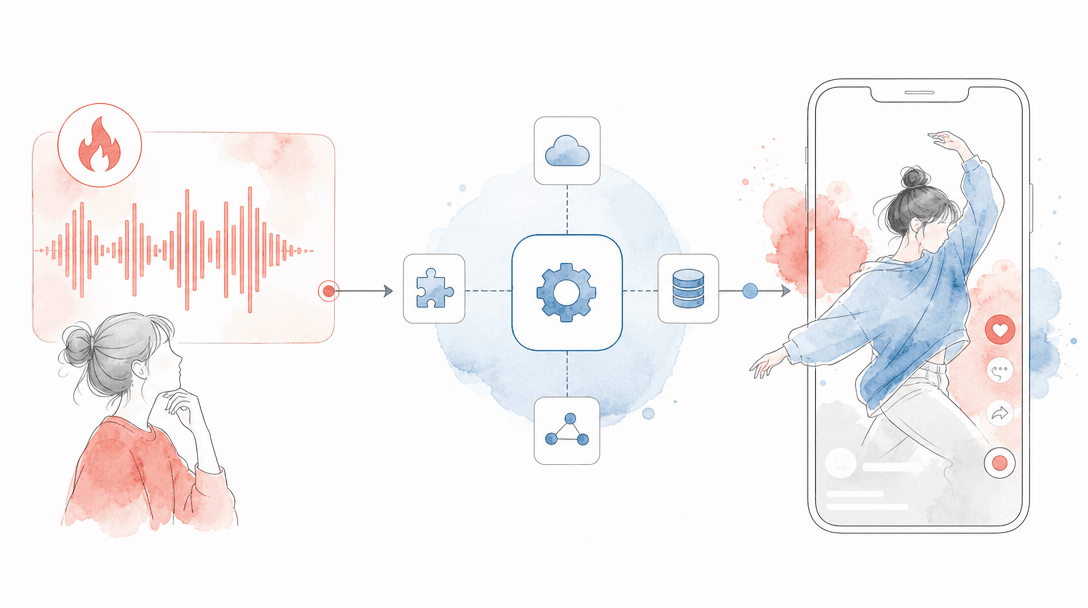
TokPortal lets teams post TikToks with trending sounds programmatically by combining API campaign control with native in-app publishing. Your system sends the video, caption, sound instructions, geo, and schedule; TokPortal’s real-device operator network publishes inside TikTok so native sounds, location tags, and editing work.
TokPortal is programmable organic social-media distribution infrastructure — The Human API. It gives growth teams an API-like way to publish TikTok campaigns while the actual post is made inside the real TikTok app on real physical smartphones with local SIM cards in 20+ countries. That matters because TikTok’s official Content Posting API is built for programmatic publishing, but native in-app posting is what supports sounds, location tags, edits, and the normal app-level posting flow.
This page is for teams that already generate content — AI video tools, UGC agencies, music marketers, app growth teams, and DTC brands — and need sound-led TikTok distribution without turning campaign operations into spreadsheets and phone handoffs. If your current workflow stops at video generation, read this alongside UGC at scale for 50+ account campaigns, Creatify AI video distribution for TikTok Shop, and music promotion on TikTok with organic distribution.
How do you add popular sounds when auto posting TikTok?
To add popular sounds while auto posting TikTok, separate campaign control from final publishing. Your system should automate the brief, asset upload, caption, account selection, country, posting window, and sound instruction. The final publish should happen inside TikTok’s native mobile app, where the operator can attach the approved sound before posting.
In TokPortal, the workflow looks like this: upload the video through API, define a sound rule such as “use this TikTok sound URL,” “use a currently popular beauty sound in France,” or “use the label-approved track variant,” then schedule publishing across selected accounts. The post is still controlled programmatically, but the sound is applied through the app UI rather than a limited posting endpoint.
For developer teams, the control layer lives in the TokPortal REST API, SDKs, webhooks, and MCP server. For campaign teams, the strategic question is not “Can we press publish automatically?” It is “Can we preserve the native TikTok post attributes that drive sound-led reach?”
How does TikTok sound seeding work at scale?
TikTok sound seeding at scale means distributing multiple creative variations that use the same sound, track, hook, or audio trend across a controlled set of accounts, countries, and posting windows. The goal is not one upload. The goal is repeated native exposure from accounts that match the audience and geography of the campaign.
A practical sound-seeding campaign has five parts: the audio asset or sound URL, the creative variants, the account pool, the geo plan, and the measurement window. For example, a label might seed 40 short clips using the same chorus across US, UK, Canada, France, and Germany accounts. A beauty brand might test one trending audio against 12 product demos before scaling the winning combination.
This is where TokPortal differs from a normal scheduler. The platform combines programmatic orchestration with real in-app execution, so a campaign can use local accounts, native sounds, location tags, and human review instead of treating every post as the same generic file upload.
Is there an API workaround for TikTok sounds?
The honest answer: there is no clean public TikTok endpoint that gives brands full native trending-sound selection the same way the mobile app does. TikTok’s Content Posting API is useful for approved programmatic publishing, but native sound selection is not the same as attaching audio inside the app during a normal mobile post. TikTok also separates commercial-use music, trend discovery, and developer publishing into different product surfaces.
The workable architecture is an API-like workflow with native final-mile publishing. Your system still behaves like software: it sends JSON, receives statuses, triggers webhooks, assigns accounts, and logs results. The final-mile action happens on a real device in the real app so the sound can be selected natively.
That distinction matters for AI video teams. If you generate 100 Sora, Veo, Kling, Runway, Pika, HeyGen, Arcads, Creatify, or Captions videos, you do not need a human coordinator manually chasing every file. You need a programmable distribution layer that preserves the native TikTok actions the official API does not expose.
How are brands using trending audio programmatically?
Brands use trending audio programmatically by treating sound as a campaign variable, not an afterthought. Each post is defined by a structured payload: video asset, caption, target country, account niche, posting window, sound rule, and measurement tag. That lets the growth team test sound-led concepts across many accounts without losing reporting discipline.
For a DTC launch, the payload might group 20 product videos by hook, price angle, and sound. For an app launch, it might localize the same gameplay clip into different countries with different audio trends. For a SaaS campaign, it might test founder clips, customer objection clips, and problem-solution clips under separate sound categories. See app launch TikTok strategy from day one and SaaS TikTok marketing for B2B growth for adjacent campaign models.
The trap is chasing generic utility traffic instead of buyer intent. Queries like “tiktok profile picture download,” “tiktok profile picture downloader,” “tiktok pfp downloader,” “download pp tiktok,” and “download profil tiktok” can bring impressions, but they usually attract users looking for a free asset tool. Sound-led programmatic posting is a buyer-intent workflow: the searcher has content, budget, and a distribution bottleneck.
How do you scale sound-based TikTok campaigns?
To scale sound-based TikTok campaigns, stop thinking in single-post automation and start thinking in account portfolios. A campaign needs enough accounts to test creative angles, enough countries to match demand, and enough scheduling control to avoid every post landing in the same narrow window.
A useful starting structure is 10 accounts, 3 sound hypotheses, and 5 creative variants per sound. That creates 150 distribution opportunities without producing 150 unique concepts from scratch. The same logic scales to a UGC machine producing 100 videos per week or UGC campaigns running across 10 countries simultaneously.
TokPortal supports this with real accounts on physical smartphones, local SIM cards, native in-app posting, account warming, analytics, Spark Codes for TikTok, and webhooks for status reporting. The growth team keeps the software control plane. The TikTok post keeps the native surface.
How should music marketers run sound seeding on TikTok?
Music marketers should treat TikTok sound seeding as controlled distribution around a specific track moment: the chorus, drop, lyric, transition, or memeable line. The best campaigns do not simply upload the full song. They pair a repeatable audio moment with many native-feeling videos that give creators and viewers a reason to reuse the sound.
A label or artist team can use TokPortal to brief multiple clip types: lyric overlays, street-style edits, reaction clips, outfit changes, dance prompts, product tie-ins, or location-specific cuts. The campaign can then publish those variants through local accounts in target markets such as the USA, UK, Canada, France, Germany, Australia, Brazil, Japan, Mexico, and the Philippines.
For reporting, track more than views. Track sound uses, saves, comment language, country-level response, and which creative format causes viewers to identify the track. The point is to create distribution pressure around the sound while keeping the posting flow authentic and native to TikTok.
20+
countries with real-device TokPortal distribution coverage
150,000+
accounts under TokPortal management
4,276
active business clients using TokPortal infrastructure
6B+
organic video views generated through TokPortal campaigns
Define the sound rule before uploading videos
Choose whether each post must use a specific TikTok sound URL, a pre-approved commercial track, or a trend category such as beauty, gaming, fitness, finance, or local culture.
Upload assets through the control layer
Send the video file, caption, account criteria, target country, schedule, and tracking tag through TokPortal’s API, SDKs, dashboard, or automation stack.
Assign local accounts and posting windows
Match the campaign to accounts by country and niche. Use local accounts when the sound trend or product market is country-specific.
Publish inside the native TikTok app
TokPortal’s real-device operator network posts from physical smartphones using the TikTok app, applying the sound and any approved native options before publishing.
Capture status and performance
Use webhooks and analytics to confirm scheduled, published, or failed states, then compare performance by sound, country, account group, and creative variant.
Scale the winning sound-creative pair
Move budget and posting volume toward the sound and creative format with the strongest early response, rather than scaling every variant equally.
Feature
Official posting API only
TokPortal API-like native workflow
Campaign control
Native TikTok sounds
Location and local context
Best fit
Original campaign rule: treat sound as a distribution variable
- Use native in-app posting when TikTok sounds are central to the campaign
- Send sound instructions as structured campaign metadata
- Test one sound across multiple creative variants before scaling
- Separate commercial-use music from organic trend exploration
- Match sound-led campaigns to local accounts when the trend is country-specific
- Measure sound performance by creative format, country, and account group
- Use Spark Codes when a winning TikTok needs a paid-media handoff
Where TokPortal is the right fit
- You need native TikTok sounds, location tags, and in-app posting behavior.
- You generate many AI or UGC videos and need distribution after production.
- You run campaigns across multiple accounts, countries, or client brands.
- You need API, MCP, SDKs, webhooks, and human-in-the-loop publishing in one workflow.
Where TokPortal is not the answer
- You only need to publish one video from one owned account.
- Your legal or brand team only allows official API publishing with no native app step.
- You are looking for a free profile utility such as a TikTok profile picture downloader rather than distribution infrastructure.
- Your campaign does not need sounds, local context, account portfolios, or scale.
Build your native TikTok sound workflow
Use TokPortal’s API-like control layer to schedule videos, assign local accounts, and publish with native TikTok sounds through real-device operators.
Can the TikTok Content Posting API add trending sounds?+
How does TokPortal post with sounds programmatically?+
Can brands use any trending TikTok sound?+
Is this useful for AI video tools?+
How many accounts do I need for a sound-seeding campaign?+
Can TokPortal support music marketing campaigns?+

Written by
Vincent Tellenne
Co-founder & CEO
Vincent is a co-founder and CEO of TokPortal. He works on the infrastructure and operating model behind scaled organic social media distribution.
Learn more about this topic with AI
Related Resources
App Launch TikTok Strategy: Get Downloads from Day One with TokPortal
TikTok marketing strategy for app launches. Create authentic buzz with multi-account campaigns, UGC content, and organic distribution using TokPortal. Complete launch playbook.
Creatify AI Videos for TikTok Shop Distribution
Distribute Creatify AI product videos on TikTok Shop with 20-country posting, variant testing, affiliate clips, and API-triggered workflows.
Running UGC Campaigns in 10 Countries Simultaneously
Learn how to run international UGC campaigns across 10+ countries simultaneously on TikTok and Instagram — without bans, shadowbans, or operational chaos.
UGC at Scale: How Brands Run 50+ Account Campaigns on TikTok
Learn how brands run UGC campaigns at scale with 50+ TikTok accounts. Complete playbook covering account setup, content strategy, and distribution using TokPortal.
How to Build a UGC Machine That Produces 100 Videos a Week
Learn how to build a UGC machine that produces 100+ videos per week. Covers creator sourcing, editing pipelines, multi-account distribution, and the infrastructure to scale without burning out your team.
From the guide to your first campaign
You make the content.
TokPortal runs the account operations.
Create and operate TikTok and Instagram accounts in your target market. Local operators handle the account work and native publishing. You control the brief, content and campaign from the dashboard, API or MCP.
- 01Choose your market
- 02Define each account
- 03Schedule your content
Review market availability and pricing before ordering. No reach forecast is built into your plan.