
On this page
TokPortal is programmable organic social-media distribution infrastructure for taking Sora videos from generation to TikTok, Instagram Reels and YouTube Shorts at scale. It posts through real human operators on real physical devices, so AI video teams can run native, geo-specific distribution via API, MCP, SDKs and webhooks.
Sora solves video creation; it does not solve distribution. The teams that win with AI video in 2026 are not the teams generating the most clips. They are the teams that can publish, localize, test and measure those clips across TikTok, Instagram Reels and YouTube Shorts without turning the growth team into a manual upload desk.
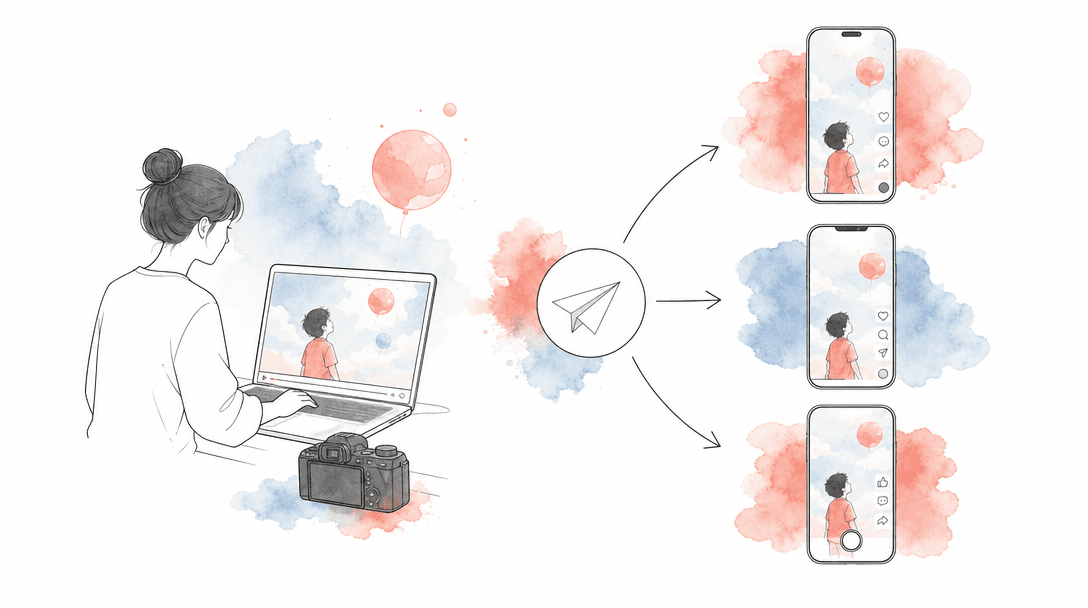
TokPortal sits after Sora in the workflow. Your team generates the video, sends the asset, caption, market, schedule and account instructions to TokPortal, and the post is published natively through real devices in the target country. That matters because vertical platforms reward context: sound, location, language, account history and local posting behavior all shape performance.
How do you use Sora for TikTok content?
Use Sora as the creative engine, not the whole TikTok strategy. The practical workflow is to generate many short-form concepts, select the ones with a clear hook in the first seconds, format them for vertical viewing, then distribute variants across multiple real accounts instead of betting the campaign on one brand handle.
A strong Sora-for-TikTok prompt usually specifies the platform context before the scene: vertical composition, mobile-first framing, one clear subject, fast visual payoff, and room for captions or on-screen text. If the video depends on subtle detail, it will often underperform on TikTok and Reels because most users are scrolling on phones, not watching like a film trailer.
For teams already building an AI UGC engine, Sora belongs beside tools such as Creatify, HeyGen, Runway, Kling or Pika. The distribution question is the same: once you have 50 or 100 clips, where do they go? See the broader operating model in how to build a UGC machine that produces 100 videos a week.
What is the pipeline from Sora to TikTok, Reels and Shorts?
Generate platform-native Sora concepts
Create vertical-first clips with a visible hook, a single message and a format that can survive being watched without sound. Store each render with prompt, concept, product, language and market metadata.
Score and QA the outputs
Remove clips with visual artifacts, unclear product claims, unreadable text or weak first-frame appeal. Keep a simple creative score so the analytics loop can connect performance back to prompt patterns.
Prepare captions, sounds and posting instructions
Write platform-specific captions, hashtags, location tags and native app instructions. TikTok, Reels and Shorts should not receive the exact same metadata if the campaign is serious.
Send assets to TokPortal by API, SDK or MCP
Use the TokPortal REST API, TypeScript SDK, Python SDK or MCP server to submit the video asset, target platform, account, country, schedule and any native in-app requirements.
Publish through real devices in the target market
TokPortal routes the mission to human operators using real physical smartphones and local SIM cards, so posts are published inside the actual TikTok, Instagram or YouTube app.
Measure, prune and scale winning variants
Pull analytics through TokPortal, compare watch and engagement signals by concept and country, then increase posting volume behind the prompts, hooks and markets that show traction.
How do you post Sora videos at scale with an API?
Posting Sora videos at scale requires a distribution layer that accepts structured campaign instructions, not just video files. At minimum, your workflow should pass: asset URL, platform, country, account, caption, schedule, sound instruction, location instruction, approval state and webhook callback.
TokPortal exposes a full REST API at developers.tokportal.com, plus TypeScript and Python SDKs, webhooks and an MCP server for Claude, ChatGPT and agent-based workflows. A developer can connect Sora output storage, a QA queue, a caption generator and TokPortal into one post-generation pipeline.
The credit model is predictable: 25 credits per account, 2 credits per video upload, 7 credits for niche warming, 40 credits for deep warming on Instagram, 3 credits for video editing and 1 credit for sound-volume control. That lets teams model distribution cost before increasing generation volume.
Feature
Official publishing APIs
TokPortal distribution infrastructure
Best use case
TikTok native sounds
Location and market context
Workflow control
When not to use it
How should you optimize Sora outputs for vertical video platforms?
- Render in vertical 9:16 unless the concept has a specific reason to use another format
- Make the first frame readable without caption context
- Keep one visual idea per clip instead of compressing a full ad script into one render
- Leave safe space for TikTok, Reels and Shorts interface overlays
- Avoid tiny text, fine detail and low-contrast product shots
- Create three hook variants before creating three endings
- Localize captions and on-screen language by market instead of translating only the final caption
- Track the Sora prompt, model settings and edit notes alongside each posted asset
The highest-leverage optimization is not prettier generation. It is making the video testable. A Sora clip should carry enough metadata that your team can answer: which prompt style created it, which opening visual was used, which platform received it, which country saw it, and which account posted it.
This is where many AI video teams confuse creative volume with distribution learning. Publishing 100 Sora clips from one account gives you a narrow read. Publishing 100 structured variants across markets gives you a learning system. The same principle applies to AI product video workflows such as Creatify AI videos for TikTok Shop distribution.
How do you measure performance of Sora videos on social?
4,276
active business clients using TokPortal
150,000+
accounts under management
6B+
organic video views generated
9,000+
TikTok profiles analyzed in TokPortal benchmark indexes
Measure Sora distribution at three levels: creative, account and market. Creative metrics tell you which prompt pattern, hook, offer and edit style worked. Account metrics tell you whether a profile is warming correctly and whether the audience fit is improving. Market metrics tell you where the same concept deserves more localized variants.
Do not over-weight vanity traffic from utility searches such as “TikTok profile picture download,” “TikTok profile viewer,” “TikTok profile picture downloader,” “TikTok pfp downloader” or “download pp TikTok.” Those searches can create impressions, but they rarely indicate a business buyer for AI video distribution. For Sora teams, the useful metrics are posted-video performance, account-level learning and conversion events downstream of social traffic.
TokPortal’s internal TikTok benchmark index across 9,000+ profiles shows average engagement rates of about 6.2% for 1K–10K follower accounts, 4.8% for 10K–100K, 3.5% for 100K–1M and 2.2% for 1M+. Use those ranges as context, not as a promise. A new Sora concept should be judged against the account tier, niche and market where it was posted.
How do you geo test Sora creative variants?
Geo testing Sora videos means changing the market context, not just changing the upload location. The same AI-generated clip can perform differently when posted from a US lifestyle account, a French beauty account, a German app-review account or a Brazilian entertainment account. Language, captions, posting time, account niche and local cultural cues all affect the read.
TokPortal supports distribution across USA, UK, Australia, Brazil, Canada, Colombia, Finland, France, Germany, Indonesia, Italy, Japan, Malaysia, Mexico, Pakistan, Philippines, Portugal, Romania, Spain and Switzerland. For a serious Sora test, pick 3–5 markets, keep the core visual concept constant, localize the caption and first-frame text, then compare early engagement and retention signals before scaling.
If the campaign depends on regional adoption, study the operating model in running UGC campaigns in 10 countries simultaneously.
Original operating rule: test markets before you test prompts endlessly
How do you stack Sora with distribution infrastructure?
The clean stack is: Sora for generation, cloud storage for rendered assets, a review queue for approvals, an LLM or editor for captions, TokPortal for native distribution, and analytics/webhooks for the learning loop. The stack works because each layer does one job. Sora creates. Your team approves. TokPortal distributes. Analytics decides what gets more volume.
For agencies, the same stack can run client campaigns without rebuilding operations per client. See how growth agencies white-label TikTok distribution. For brands testing TikTok and Instagram together, see TikTok + Instagram Reels dual-platform campaign operations.
TokPortal is strongest when Sora output has already passed creative QA and the business question is distribution: where to post, when to post, which accounts to use, which countries to test, and how quickly to scale winners.
Where TokPortal fits Sora teams
- You generate more AI video than your team can manually publish
- You need TikTok, Reels and Shorts distribution from one workflow
- You need native in-app features such as TikTok sounds, location tags and editing
- You want geo-specific tests using real local devices and human operators
- You need API, MCP, SDK and webhook control instead of spreadsheet-based posting
Where TokPortal is not the answer
- You only publish one or two videos a week from a single owned account
- Your Sora videos have not passed brand, legal or creative review
- You are looking for paid media buying rather than organic distribution
- You do not have a measurement plan for creative, account and market performance
Build your Sora-to-social distribution pipeline
Connect Sora output to TokPortal’s API, MCP server, SDKs and webhooks, then publish AI video campaigns natively across TikTok, Reels and Shorts.
Can I post Sora videos directly to TikTok, Instagram Reels and YouTube Shorts?+
Why not just use the official posting APIs?+
Do Sora videos need to be edited before distribution?+
Can TokPortal distribute the same Sora video to TikTok, Reels and Shorts?+
How many countries can I test Sora videos in?+
How should I budget for Sora video distribution?+

Written by
Vincent Tellenne
Co-founder & CEO
Vincent is a co-founder and CEO of TokPortal. He works on the infrastructure and operating model behind scaled organic social media distribution.
Learn more about this topic with AI
Related Resources
App Launch TikTok Strategy: Get Downloads from Day One with TokPortal
TikTok marketing strategy for app launches. Create authentic buzz with multi-account campaigns, UGC content, and organic distribution using TokPortal. Complete launch playbook.
Creatify AI Videos for TikTok Shop Distribution
Distribute Creatify AI product videos on TikTok Shop with 20-country posting, variant testing, affiliate clips, and API-triggered workflows.
Running UGC Campaigns in 10 Countries Simultaneously
Learn how to run international UGC campaigns across 10+ countries simultaneously on TikTok and Instagram — without bans, shadowbans, or operational chaos.
TikTok + Instagram Reels: Running Dual-Platform Campaigns at Scale
Learn how to run TikTok and Instagram Reels campaigns simultaneously at scale. Real strategies, account structures, and infrastructure for dual-platform organic growth.
UGC at Scale: How Brands Run 50+ Account Campaigns on TikTok
Learn how brands run UGC campaigns at scale with 50+ TikTok accounts. Complete playbook covering account setup, content strategy, and distribution using TokPortal.
How to Build a UGC Machine That Produces 100 Videos a Week
Learn how to build a UGC machine that produces 100+ videos per week. Covers creator sourcing, editing pipelines, multi-account distribution, and the infrastructure to scale without burning out your team.
From the guide to your first campaign
You make the content.
TokPortal runs the account operations.
Create and operate TikTok and Instagram accounts in your target market. Local operators handle the account work and native publishing. You control the brief, content and campaign from the dashboard, API or MCP.
- 01Choose your market
- 02Define each account
- 03Schedule your content
Review market availability and pricing before ordering. No reach forecast is built into your plan.