
On this page
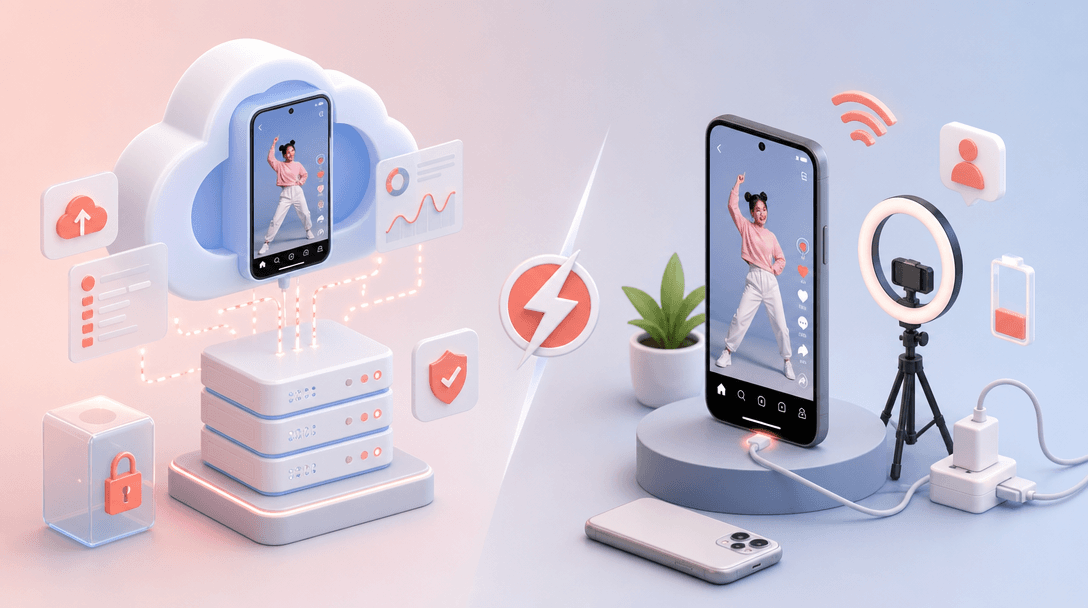
Cloud phones are remote virtual phones; real-phone TikTok marketing uses physical smartphones, local SIM cards, and native in-app posting. For growth teams, real devices are the safer operating model when reach matters because TikTok can evaluate device, network, location, and behavior context, not just the uploaded video.
TokPortal is programmable organic social-media distribution infrastructure — The Human API. It posts and engages across TikTok, Instagram, and YouTube at scale through real human operators using real physical devices and local SIM cards in 20+ countries, controlled via API, MCP, SDKs, and webhooks.
This page is for growth teams, agencies, app marketers, and AI video operators comparing cloud phone TikTok workflows with real-device operations. Do not confuse this with top-of-funnel utility searches like TikTok profile picture download, TikTok profile picture downloader, TikTok pfp downloader, download pp TikTok, or TikTok profile viewer. Those users want a quick free tool; you need a distribution layer that preserves reach when you post at scale.
Are cloud phones safe for TikTok marketing?
Cloud phones are not automatically unsafe, but they are a weak fit for serious TikTok marketing because they compress many accounts into remote, repeatable infrastructure. TikTok can evaluate more than the video file: device signals, app behavior, location consistency, network context, and posting patterns all contribute to whether distribution looks organic.
A real-phone operation is closer to normal user behavior: a real TikTok app, on a real smartphone, using a local SIM card, with a human operator publishing inside the app. That matters when campaigns need native sounds, location tags, edits, and country-specific distribution. TikTok’s own Content Posting API documentation is useful for approved publishing workflows, but it is not the same as native in-app posting with every consumer app feature available.
Why are cloud phone TikTok views low?
Cloud phone TikTok views are usually low because the account context is thinner than the creative. The video may be good, but the operating environment can look repetitive: similar devices, similar remote networks, inconsistent geography, and publishing behavior that does not match a normal local user.
Reach problems often get misdiagnosed as a content issue. In practice, teams should audit four layers before rewriting the creative: device type, network origin, account history, and posting behavior. If all four are artificial-looking or inconsistent, stronger hooks will not fully fix distribution.
Feature
Cloud phone TikTok workflow
Real-phone TikTok workflow
Device context
Network context
Posting surface
Operational control
Best use
What is the alternative to device farms for TikTok?
The practical alternative is a human-operated real-device fleet: physical smartphones, local SIM cards, native apps, warmed accounts, and a central control layer for briefs, approvals, scheduling, analytics, and webhooks. TokPortal gives teams that operating model without asking them to recruit, train, and manage device operators country by country.
This is the right model for agencies running client campaigns, AI video teams distributing hundreds of generated assets, and D2C brands that need multiple credible posting surfaces. If your team is building a UGC engine, pair this page with UGC at Scale: how brands run 50+ account campaigns on TikTok and how to build a UGC machine that produces 100 videos a week.
How does organic TikTok distribution with real devices work?
Organic TikTok distribution with real devices works by separating content production from local publishing. Your team supplies the videos, captions, routing rules, target countries, and posting schedule. TokPortal routes the work to real phones in the right geography, and operators publish inside the native app.
The advantage is not just scale; it is native context. TikTok sounds, location tags, and in-app edits remain available because the post is created inside the real TikTok app rather than only through a remote uploader. This is especially valuable for app launches, local commerce, music seeding, TikTok Shop creatives, and multi-market campaigns. See App Launch TikTok Strategy: get downloads from day one and Creatify AI videos for TikTok Shop distribution for concrete campaign patterns.
20
countries with real-device social distribution coverage
150,000+
accounts under TokPortal management
4,276
active business clients using TokPortal infrastructure
6B+
organic video views generated through TokPortal campaigns
9,000+
TikTok profiles analyzed in TokPortal benchmark indexes
How do you scale TikTok posting without cloud phones?
Map the campaign by country, niche, and account role
Decide which accounts are for testing hooks, which are for regional localization, and which are for proven creative rollouts. Do not push every asset to every account.
Warm accounts before volume
Use niche warming before campaign traffic. TokPortal supports niche warming at 7 credits and deep warming for Instagram at 40 credits over a 3-day manual process.
Publish inside the native app
Use real devices so the operator can add TikTok sounds, location tags, and app-native edits that are not available in the same way through a generic cloud-phone workflow.
Control operations through API, SDKs, or no-code tools
Route videos, metadata, schedules, and status events through TokPortal’s REST API, MCP server, TypeScript SDK, Python SDK, webhooks, n8n, Make, or Zapier. Developer docs are available at https://developers.tokportal.com.
Measure account-level reach before scaling
Track early view velocity, completion behavior, niche fit, and country performance. Scale the account-video combinations that show real distribution, not just the creatives your team likes.
What should mobile device fleets for social media include?
A social-media device fleet is not just phones on a shelf. For TikTok, Instagram, and YouTube Shorts campaigns, the fleet needs account custody, local network context, human operators, quality checks, publishing logs, and analytics. Without those layers, the fleet becomes a hardware problem instead of a distribution system.
Agencies also need client separation, approvals, reporting, and repeatable delivery. If you are selling this as a service, compare the operating model in how growth agencies white-label TikTok distribution for clients and managing 200+ accounts across 15 clients.
- Physical smartphones assigned to real operating locations
- Local SIM cards matched to the campaign country
- Native TikTok, Instagram, and YouTube app publishing
- Human-in-the-loop posting and quality control
- Account warming before campaign volume
- Per-video analytics and campaign-level reporting
- API, MCP, SDK, webhook, n8n, Make, and Zapier control options
- Clear pricing units for accounts, uploads, warming, editing, and sound-volume control
Why does TikTok reach collapse on emulator setups?
TikTok reach can collapse on emulator setups because the publishing environment does not resemble normal consumer usage. Emulators are useful for software QA, but they are a poor foundation for reach-sensitive marketing because the device layer, sensor context, app behavior, and network pattern can be too uniform.
The fix is not to keep swapping proxies or rewriting captions. The fix is to move the publishing layer closer to how TikTok is actually used: real phones, local mobile networks, native app posting, and human operators. This is why TikTok marketing with real phones consistently outperforms remote virtual workflows for serious organic distribution.
Original operating rule: diagnose reach by context before creative
Price a real-device TikTok campaign
See the credit model for accounts, uploads, warming, editing, and native posting before you move another campaign through cloud phones.
Is a cloud phone enough for TikTok marketing?+
Why do my TikTok videos get low views when posted from cloud phones?+
Can TokPortal post inside the TikTok app?+
Can I control real-device posting through an API?+
When is TokPortal not the right answer?+
How many countries does TokPortal support for real-device distribution?+

Written by
Vincent Tellenne
Co-founder & CEO
Vincent is a co-founder and CEO of TokPortal. He works on the infrastructure and operating model behind scaled organic social media distribution.
Learn more about this topic with AI
Related Resources
Managing 200+ Accounts Across 15 Clients: Agency Operations Guide
Learn how growth agencies manage 200+ TikTok and Instagram accounts across multiple clients. Operational frameworks, tooling, and automation strategies that prevent burnout and account bans.
App Launch TikTok Strategy: Get Downloads from Day One with TokPortal
TikTok marketing strategy for app launches. Create authentic buzz with multi-account campaigns, UGC content, and organic distribution using TokPortal. Complete launch playbook.
Creatify AI Videos for TikTok Shop Distribution
Distribute Creatify AI product videos on TikTok Shop with 20-country posting, variant testing, affiliate clips, and API-triggered workflows.
UGC at Scale: How Brands Run 50+ Account Campaigns on TikTok
Learn how brands run UGC campaigns at scale with 50+ TikTok accounts. Complete playbook covering account setup, content strategy, and distribution using TokPortal.
White-Label TikTok & Instagram Distribution: Become a Reseller
Build your agency or AI SaaS on TokPortal’s managed account and publishing operations. Keep your brand, scope a pilot and calculate your delivery margin.
From the guide to your first campaign
You make the content.
TokPortal runs the account operations.
Create and operate TikTok and Instagram accounts in your target market. Local operators handle the account work and native publishing. You control the brief, content and campaign from the dashboard, API or MCP.
- 01Choose your market
- 02Define each account
- 03Schedule your content
Review market availability and pricing before ordering. No reach forecast is built into your plan.