
On this page
TikTok device farms lose reach because the pattern stops looking like normal local usage: repeated device signals, thin account history, duplicate uploads, and non-native posting compress distribution. The fix is not more devices; it is real-user infrastructure with aged accounts, local SIMs, native in-app posting, and human-in-the-loop operations.
TokPortal is programmable organic social-media distribution infrastructure: real accounts, real physical smartphones, local SIM cards, and human operators in 20+ countries, controlled through API, MCP, SDKs and webhooks. If your TikTok device farm worked for two weeks and then views collapsed, the useful question is not how to add more hardware. The useful question is which signals stopped matching normal local usage.
This page is for agencies, AI-video teams, affiliate operators and growth teams that already have content and need reliable distribution. For the deeper mechanics behind ranking signals, read TikTok Algorithm 2026: How Organic Distribution Really Works.
How long do TikTok farms stay effective?
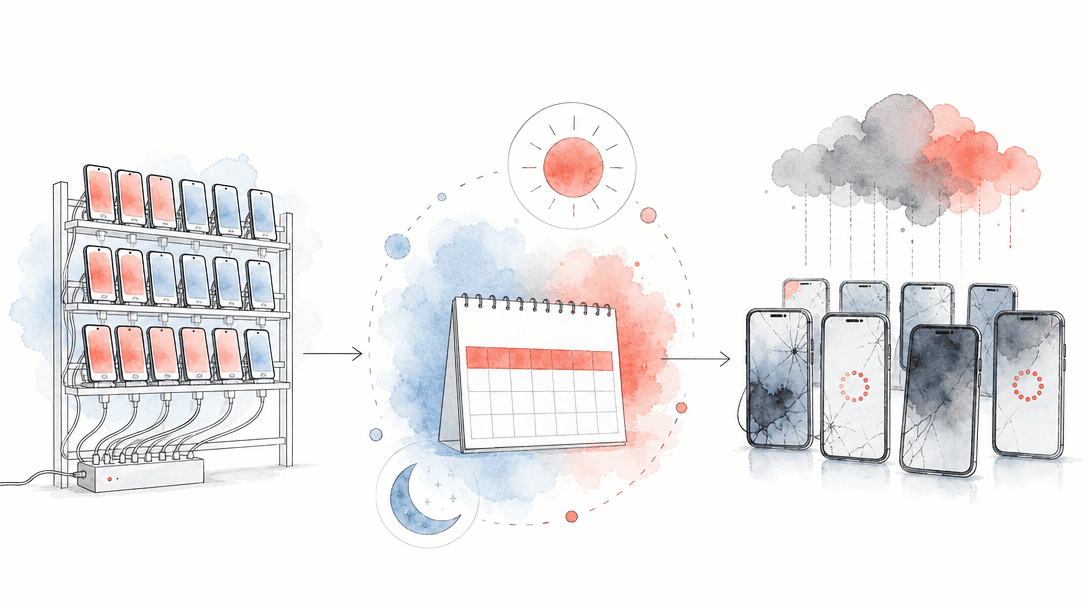
There is no official 30-day TikTok limit. The common 30-day failure pattern happens because early accounts have little history, then repeated behavior becomes easier to classify: same upload cadence, same asset reuse, similar device handling, thin viewing history, and weak local engagement.
A device setup can look productive in week one because each account is still being tested by the recommendation system. By week four, the platform has enough behavioral history to decide whether the account behaves like a real local participant or a distribution node. TikTok’s own explanation of the For You system says recommendations use signals such as user interactions, video information and device/account settings; those signals compound over time.
Operational rule: if median views per account fall for three consecutive posting cycles while creative quality and topic remain constant, treat it as an infrastructure problem before blaming the editor.
What are the signs your TikTok device setup is flagged?
The first sign is not a total stop. It is compression: posts publish, but the first distribution test is smaller, the video gets fewer non-follower impressions, and comments or saves no longer arrive in proportion to watch time.
- Account-level compression: every post from one account opens weak, even when the same creative works elsewhere.
- Cluster-level compression: multiple accounts on the same setup drop during the same week.
- Geo mismatch: the audience drifts away from the intended country despite country-specific content.
- Feature gaps: native sounds, location tags or in-app edits are missing because posting happens outside the normal app workflow.
- Warming gap: the account posts before it has a credible niche viewing and interaction history.
If the problem is new-account behavior rather than creative decay, start with The Complete Guide to TikTok Account Warming in 2026.
How does TikTok throttle device-farm traffic?
Throttling is usually visible as reduced initial distribution, not as a public warning. The platform does not need to block publishing to reduce reach. It can simply send the post to a smaller test audience, wait for stronger proof, or limit distribution when account and device signals do not line up with normal usage.
The important distinction is publishing versus distribution. A post can publish successfully through an official or unofficial workflow and still fail to earn organic reach. TikTok’s Content Posting API documentation explains how publishing access works, but API publishing is not the same thing as native in-app posting with the full consumer-app context. For example, native sound selection and location behavior are fundamentally app-side experiences, which is why we break down the difference in How to Add TikTok Sounds via API: Native In-App Posting Explained.
What is the alternative to a TikTok device farm?
The alternative is real-user distribution infrastructure: real people operating real smartphones on local SIM cards, using the native TikTok app, with accounts that are warmed into the right niche and country before campaign volume starts.
TokPortal was built for this use case. Brands and agencies upload creative, route it by country and account, and control posting through the TokPortal app, REST API, MCP server, TypeScript SDK, Python SDK and webhooks. The distribution still happens inside the real app, which preserves native TikTok features such as sounds, location tags and in-app editing.
If you are posting one or two videos a week from a single brand-owned account, TokPortal is probably not necessary. Use TikTok’s own scheduling and learn the API boundaries in How to Post on TikTok via API in 2026. If you are distributing dozens or hundreds of UGC or AI-generated videos across markets, you need infrastructure, not a phone pile.
How do you scale TikTok without farms?
Scale by separating content production from distribution operations. Your creative team should decide angles, hooks and offers. Your distribution layer should handle account readiness, country matching, posting windows, native app execution, analytics and per-video handoffs such as TikTok Spark Codes.
A practical stack looks like this: generate or edit content, assign each asset to a country and niche, warm accounts before volume, publish through native in-app workflows, then measure account-level and creative-level performance separately. That is the system described in How to Scale TikTok Marketing with 100+ Accounts in 2026 and the broader TikTok Distribution at Scale Infrastructure Guide.
Technical teams can connect campaign logic directly through TokPortal developer documentation, including REST API, MCP, SDKs and webhooks.
Why do cheap TikTok views stop working?
Cheap views stop working because they optimize the wrong metric. A view count without country fit, retention, comments, saves, shares and account-level trust does not create durable distribution. It can make a dashboard look better while the next upload opens to a smaller audience.
This is also why high-impression utility traffic does not equal growth. Queries such as TikTok profile picture download, TikTok profile picture downloader, TikTok profile viewer, TikTok pfp downloader, download profil TikTok and download pp TikTok can earn clicks for a tool site, but they do not prove a brand can distribute campaign content. Buyers care about qualified reach, country coverage and repeatable posting operations.
Use the TokPortal benchmark frame instead: in our internal index of 9,000+ TikTok profiles, engagement above 5% is top-quartile across tiers. If a campaign buys surface-level views but cannot generate meaningful engagement, the algorithm has little reason to expand distribution.
Organic vs farmed TikTok distribution: what changes reach?
Organic distribution compounds when the account, device, location, content and viewer response tell the same story. Farmed distribution decays when those signals drift apart: the account claims one country, the device pattern suggests another, the content is duplicated, and the account has no believable niche history.
The practical difference is not morality; it is signal quality. TikTok does not need your internal label for the setup. It reads behavior. Real-user infrastructure gives the platform a coherent pattern: local SIM, local app use, native posting, realistic account activity, and content matched to the country and niche.
20+
countries with TokPortal real-device distribution coverage
150,000+
accounts under TokPortal management
4,276
active business clients using TokPortal infrastructure
6B+
organic video views generated through TokPortal
9,000+
TikTok profiles analyzed in TokPortal benchmark indexes
Feature
Device-farm setup
Real-user distribution infrastructure
Device signal
Country signal
Posting method
Account history
Creative features
Scaling risk
Compare week-one and week-four median views by account
Export the last 30 days of posts. Do not average across all accounts; one strong account can hide a cluster problem. Look for accounts where median opening views fall across three posting cycles while creative type stays constant.
Separate creative failure from account failure
Post the same creative family across different account groups. If only one group compresses, the problem is likely distribution infrastructure. If every group compresses, the hook, topic or offer needs work.
Check country consistency
Review where viewers actually come from versus where the campaign is intended to run. Country drift is a strong sign that device, account and content signals are not aligned.
Audit native app features
List which posts used native TikTok sounds, location tags, captions and in-app edits. Missing native context often explains why a technically published post does not perform like a normal TikTok upload.
Warm before increasing volume
Do not add more uploads to an account with thin niche history. Build a relevant viewing and interaction pattern first, then increase cadence gradually.
Move campaign logic into an infrastructure layer
Route content by country, niche, account readiness and posting window. Use APIs and webhooks for control, but keep the final publish action inside the native app through real operators.
Original audit rule: do not buy more phones until you isolate the failure layer
Replace the phone pile with real-user distribution
See TokPortal pricing for native in-app posting, account warming, country routing, analytics, Spark Codes and API-controlled campaign operations across 20+ countries.
Why did my TikTok device farm work at first and then lose reach?+
Is a real phone enough to protect TikTok reach?+
Can VPNs or emulators fix a TikTok reach drop?+
Should I switch to the TikTok Content Posting API instead?+
What should an agency do after client TikTok views collapse?+

Written by
Vincent Tellenne
Co-founder & CEO
Vincent is a co-founder and CEO of TokPortal. He works on the infrastructure and operating model behind scaled organic social media distribution.
Learn more about this topic with AI
Related Resources
How to Post on TikTok via API in 2026 (Step-by-Step Working Guide)
Post videos to TikTok automatically with the official Content Posting API. Working examples, auth setup, sounds, scheduling — everything that works in 2026.
How to Scale TikTok Marketing with 100+ Accounts in 2026
Learn how to scale TikTok marketing with 100+ accounts using real devices, native posting, and account warming. Complete guide for brands and agencies running multi-account organic campaigns in 2026.
The Complete Guide to TikTok Account Warming in 2026
Master TikTok account warming for maximum organic reach. Learn warming techniques, timelines, and how to automate the process with TokPortal's niche warming and deep warming features.
TikTok Algorithm 2026: How Organic Distribution Really Works
Deep dive into the TikTok algorithm in 2026. Understand how organic distribution works, why some videos go viral, and how to optimize multi-account campaigns for maximum reach.
TikTok Distribution at Scale: The Infrastructure Guide
Learn how to build a scalable TikTok distribution infrastructure. From account farms to geo-targeting, this guide covers everything marketing pros need to grow at scale.
How to Add TikTok Sounds via API: Native In-App Posting Explained
Learn how to add TikTok sounds via API using TokPortal's native in-app posting. Add trending sounds, control volume levels, and use carousels — all programmatically.
From the guide to your first campaign
You make the content.
TokPortal runs the account operations.
Create and operate TikTok and Instagram accounts in your target market. Local operators handle the account work and native publishing. You control the brief, content and campaign from the dashboard, API or MCP.
- 01Choose your market
- 02Define each account
- 03Schedule your content
Review market availability and pricing before ordering. No reach forecast is built into your plan.