
On this page
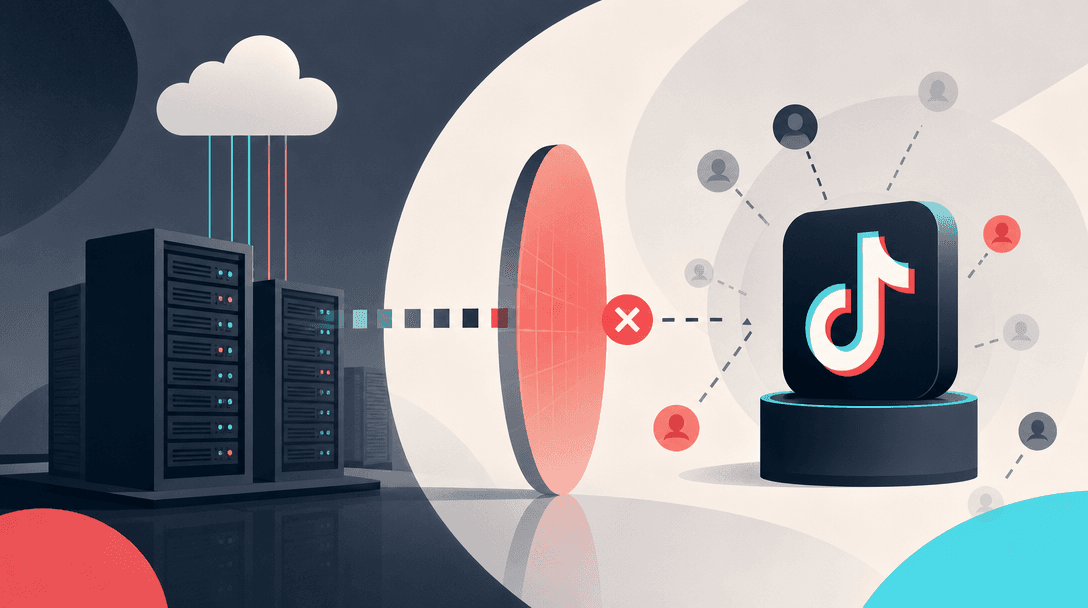
Datacenter IP social posting often loses TikTok reach because the network signal does not match normal mobile app usage: server ASN, repeated sessions, missing carrier/GPS/device context, and non-native publishing patterns. TokPortal avoids that by posting inside the real TikTok app through human-in-the-loop operators on physical smartphones with local SIMs.
TokPortal is programmable, organic social-media distribution infrastructure — The Human API. It posts and engages across TikTok, Instagram, and YouTube at scale through real human operators using physical smartphones and local SIM cards in 20+ countries, controlled via API, MCP, SDKs, and webhooks.
When teams ask why a TikTok datacenter IP loses reach, they usually expect a single network answer. The real issue is signal mismatch: TikTok sees a publishing session that behaves less like a local phone and more like a server workflow. If you are scaling client campaigns, AI video output, UGC variants, or multi-country posting, the infrastructure layer matters as much as the content calendar. For the broader mechanics, see TokPortal’s TikTok distribution infrastructure guide and how TikTok organic distribution works in 2026.
Does TikTok detect datacenter IP?
Yes, TikTok can collect and evaluate network and device context, including IP address, device identifiers, app activity, approximate location, and connection signals, as described in TikTok’s privacy and developer documentation. TikTok does not publish its full ranking or integrity models, but the public documentation is clear that platform sessions are not judged by upload success alone.
A datacenter IP is usually attached to a hosting provider or cloud server ASN, not a mobile carrier. That matters because normal TikTok publishing happens from consumer phones, mobile networks, home WiFi, GPS/cell-tower context, and in-app behavior. When posting infrastructure replaces those signals with server-like sessions, the account can publish while distribution quality still deteriorates.
Why do TikTok views drop on automation tools?
TikTok views often drop on automation tools because the publishing path changes: server uploads, repeated session patterns, limited native app context, and weaker local device signals. The post may be accepted, but it lacks the same environmental signals as a video posted inside the TikTok app from a real phone in the target country.
This is also why simple web utilities are not a useful comparison. Queries such as “tiktok profile picture download,” “tiktok profile picture downloader,” “tiktok profile viewer,” “tiktok pfp downloader,” “download profil tiktok,” and “download pp tiktok” describe browser-side viewing or downloading behavior. They do not test the harder problem: publishing brand content into a platform-native feed with durable reach.
The official TikTok Content Posting API is useful for compliant publishing workflows, but it does not expose every native in-app action that marketers care about. If your campaign depends on sounds, location context, in-app editing, or country-specific posting behavior, read how TikTok sounds work with native in-app posting and the practical guide to posting to TikTok via API.
What TikTok reach problems come from server IPs?
Server IP reach problems usually show up as a clean upload followed by poor early distribution. The team sees the post live, the scheduler reports success, and the content looks fine — but the first testing pool is smaller or weaker than expected. That is the dangerous version of the problem because nothing appears broken in the publishing dashboard.
The common pattern is a mismatch between account country, posting location, device history, network type, content cadence, and session behavior. A TikTok account intended to reach UK buyers, for example, should not repeatedly publish from infrastructure that looks unrelated to UK mobile usage. For multi-country teams, the more durable model is local account operation, local device context, and local publishing cadence. See the multi-country TikTok strategy guide for how country-specific distribution changes the operating model.
How does TikTok detect non-mobile traffic?
At a high level, TikTok can use IP, device, app, location, carrier, session, and behavioral signals to understand whether activity resembles normal mobile app usage. Public TikTok documentation confirms collection of device and network information; the exact weighting is not public and should not be treated as a checklist to manipulate.
The practical takeaway is simple: user agent strings and proxies are not the same as a phone. A real phone has a device fingerprint, installed app environment, SIM or carrier context, GPS and cell-tower context, camera roll behavior, local time zone, and a history of human interaction. Server-side posting strips away much of that context and compresses many accounts into infrastructure patterns that are easy to distinguish from local mobile operation.
Mobile IP vs datacenter IP for TikTok posting
Feature
Datacenter or server IP posting
Real mobile device with local SIM
Network identity
Device context
Country fit
Native TikTok features
Operational fit
How do you fix TikTok reach after proxy use?
Stop changing infrastructure before you diagnose
Pause experiments with server IPs, proxies, and new tools for a short audit window. If every post uses a different network path, you cannot isolate whether the problem is creative, account history, or publishing context.
Separate content quality from delivery signals
Compare the same creative type across accounts with different posting paths. If native mobile posts hold reach while server-posted variants drop, the publishing layer is a likely constraint.
Return to native in-app posting
Use the TikTok app on a physical smartphone where possible. Native posting restores app environment, device state, local context, and access to in-app features that server workflows often miss.
Warm accounts before scaling volume
Do not move from zero history to high-volume campaigns overnight. Build niche-consistent behavior, posting cadence, and account history before using the account for important distribution.
Map each country to local infrastructure
For geo-specific campaigns, match account country, phone context, SIM, language, posting times, and operator location. A global campaign should be a set of local campaigns, not one server workflow with many outputs.
Track recovery by account cohort
Measure reach by account age, country, niche, posting path, and creative format. Do not average everything together; weak infrastructure hides inside blended campaign reporting.
Account recovery is not a magic reset button. The safest operating move is to reduce inconsistent network signals, return to real app behavior, and rebuild account trust through normal posting cadence. For a deeper operating checklist, use the TikTok account warming guide before pushing volume again.
What is the best infrastructure for TikTok posting?
- Physical smartphones instead of server-only upload sessions
- Local SIM cards and country-matched operators for geo-native posting
- Native TikTok app publishing rather than browser-only or server-only workflows
- Human-in-the-loop review for captions, sounds, timing, and account context
- Account warming before campaign volume increases
- API, SDK, webhook, and MCP controls for campaign orchestration without removing the mobile publishing layer
- Per-account analytics so weak reach is diagnosed by cohort, not hidden in campaign averages
20+
countries with TokPortal local-device distribution coverage
150,000+
accounts under management
4,276
active business clients
6B+
organic video views generated
Original insight: high-ranking TikTok utility traffic is not distribution intent
When TokPortal is the right answer
- You need to distribute AI-generated or UGC videos across many TikTok accounts.
- You need country-specific posting from the USA, UK, Canada, France, Germany, Australia, or other supported markets.
- You need native in-app features such as TikTok sounds, location tags, edits, and normal app publishing behavior.
- You want API, MCP, SDK, webhook, n8n, Make, or Zapier control without relying on server-only posting.
When TokPortal is not the answer
- You post once a week from one brand-owned phone and do not need scale.
- Your core problem is weak creative rather than distribution infrastructure.
- You only need paid ads management, not organic social distribution.
- You are not ready to manage account cohorts, country strategy, and content volume.
Build TikTok posting on real-device infrastructure
Use TokPortal’s REST API, MCP server, SDKs, and webhooks to orchestrate organic distribution while real operators publish inside the native app on local devices.
Is a datacenter IP the reason my TikTok views dropped?+
What is the best IP type for TikTok posting?+
Can the official TikTok Content Posting API replace native app posting?+
How long does it take to recover reach after proxy-heavy posting?+
Does TokPortal use real phones for TikTok posting?+

Written by
Vincent Tellenne
Co-founder & CEO
Vincent is a co-founder and CEO of TokPortal. He works on the infrastructure and operating model behind scaled organic social media distribution.
Learn more about this topic with AI
Related Resources
How to Post on TikTok via API in 2026 (Step-by-Step Working Guide)
Post videos to TikTok automatically with the official Content Posting API. Working examples, auth setup, sounds, scheduling — everything that works in 2026.
How to Scale TikTok Marketing with 100+ Accounts in 2026
Learn how to scale TikTok marketing with 100+ accounts using real devices, native posting, and account warming. Complete guide for brands and agencies running multi-account organic campaigns in 2026.
The Complete Guide to TikTok Account Warming in 2026
Master TikTok account warming for maximum organic reach. Learn warming techniques, timelines, and how to automate the process with TokPortal's niche warming and deep warming features.
TikTok Algorithm 2026: How Organic Distribution Really Works
Deep dive into the TikTok algorithm in 2026. Understand how organic distribution works, why some videos go viral, and how to optimize multi-account campaigns for maximum reach.
TikTok Distribution at Scale: The Infrastructure Guide
Learn how to build a scalable TikTok distribution infrastructure. From account farms to geo-targeting, this guide covers everything marketing pros need to grow at scale.
How to Add TikTok Sounds via API: Native In-App Posting Explained
Learn how to add TikTok sounds via API using TokPortal's native in-app posting. Add trending sounds, control volume levels, and use carousels — all programmatically.
From the guide to your first campaign
You make the content.
TokPortal runs the account operations.
Create and operate TikTok and Instagram accounts in your target market. Local operators handle the account work and native publishing. You control the brief, content and campaign from the dashboard, API or MCP.
- 01Choose your market
- 02Define each account
- 03Schedule your content
Review market availability and pricing before ordering. No reach forecast is built into your plan.