
On this page
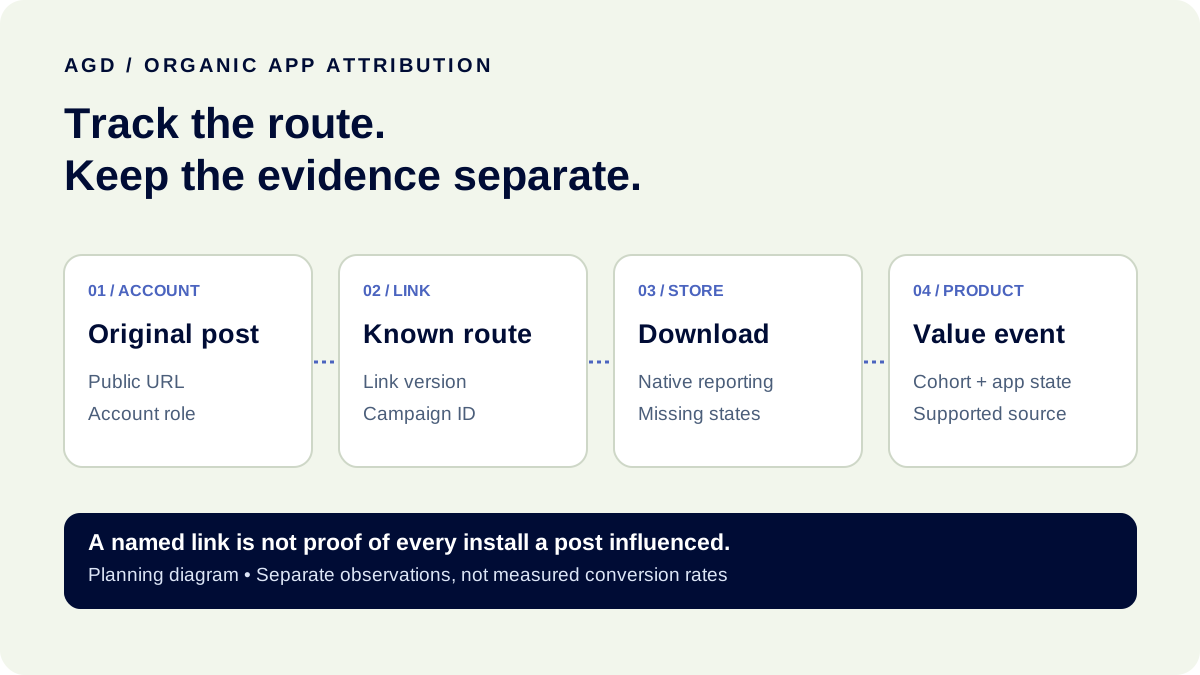
To track organic TikTok app installs, give each eligible account a stable, identifiable destination, connect that destination to the measurement your app store supports, and compare it with clearly defined product events. Keep profile visits, link clicks, attributed downloads and activated users separate. A recorded link visit identifies an observed route; it does not identify everyone who watched a video and later searched for your app.
Account-Generated Distribution (AGD) is an organic growth model where content is distributed through a network of purpose-built social accounts instead of relying on a single brand account or external creators for reach. For an app team, that means different account roles can attract different needs. Measurement should preserve those differences so you can decide which original content and product journey deserve more work.
This guide gives you an account-link ledger, separate iOS and Android implementation briefs, and a device-check worksheet. The public examples illustrate measurement problems, not customer results. The proposed IDs and numbers are hypothetical. For choosing creative formats and account roles first, use the broader AGD marketing strategy for mobile apps guide.
Sources & real examples
Public accounts, original posts and primary references. Each example is linked where it is discussed.
View all 6 sources and review notes
- Apple campaign links ↗
Official setup, attribution window and reporting thresholds read 9 September 2026. Campaign tokens are not user-level product joins. Publication freshness check: official source re-read 10 September 2026.
- Google Play Install Referrer ↗
Official API overview read 9 September 2026. App-side integration required; no device test of a customer app was performed. Publication freshness check: official source re-read 10 September 2026.
- TikTok profile links ↗
Current official help read in the browser 9 September 2026: eligibility and in-app browser routing. Publication freshness check: official source re-read 10 September 2026.
- Public iOS developer attribution question ↗
Original exchange read and captured 9 September 2026. Self-reported uncertainty, not a validated conversion result. Publication freshness check: official source re-read 10 September 2026.
- Duolingo Japan public skit ↗
Original post rechecked 9 September; 8 September capture retained. Outside example; no private app analytics or AGD adoption claim.
- Google Analytics app attribution ↗
Official help read 9 September 2026: Play listing referrer syntax and first_open versus store download. Placeholder link is not a tested app. Publication freshness check: official source re-read 10 September 2026.
Why an install spike does not identify the TikTok source
In a public iOS developer discussion about TikTok app marketing, one participant asks another how they calculated downloads and conversions. The reply acknowledges that there is no reliable method: the developer assumes an increase above a normally steady install baseline came from the promotional video. That is an honest description of an inference. It is not a measured path from a particular viewer to a purchase.
The distinction becomes expensive when you operate several accounts. A tutorial, a founder story and a local-language series may publish during the same week. A store feature, product update or newsletter can also change downloads. If you credit the entire increase to whichever post you noticed first, the next production decision rests on a story about the data rather than an identified source.
Keep the spike in your review. Label it as a timing observation and list concurrent changes. Then ask a narrower question your instrumentation can answer: which account-specific links were used, which store campaigns reported downloads, and which identified cohorts reached the product milestone? You can act on incomplete evidence without pretending that the missing connections have been observed.
Build an account-link ledger before changing the bio
Create a permanent internal account ID that survives a handle change. Pair it with the account’s editorial role and intended audience. A hypothetical language app might use ja_story_01 for a Japanese-language character series and en_demo_01 for English beginner lessons. Those labels organize your own campaign; they are not real profiles, and they do not establish the country of a viewer.
Give every destination change a version and an effective time. Store the exact outgoing URL, platform, campaign identifier, destination owner and verification status. If you replace a link on Thursday, preserve Wednesday’s record. Otherwise someone reviewing an older post will find the current profile link and accidentally assign its current campaign token to historical traffic.
Choose a reporting unit you can defend. An account-specific bio link generally supports analysis of that account’s link route during a known period. It does not tell you which of the account’s older posts prompted a profile visit. Even a token named after a video remains only a name unless that video has an exclusive, observable path. Keep post URLs for creative review, but leave the install-to-post connection unknown where the evidence stops.
Use the same identifiers in the publishing brief and measurement ledger. A caption author should not need to guess which destination belongs to an account. Before publishing, the operator can check the approved account, asset, CTA and current link version together. This connects the distribution work to the report without requiring the person posting to interpret a mobile analytics SDK.
Check whether the account can actually link to the app
TikTok’s profile-link help currently says website links require at least 1,000 followers or a Verified Business Account. It also explains that profile links open in its in-app browser and that some external link chains can prompt a move to the device browser. A generic business-account label is not the same eligibility condition.
Inspect the actual account before writing a “link in bio” CTA. If a website field is unavailable, mark that route unavailable in the ledger and change the creative’s next step accordingly. Do not report absent link tracking as zero interest. An app-name search may still happen, but a subsequent store search does not automatically reveal which account prompted it.
Prefer a short route that you can maintain. A landing page can explain the app and offer an operating-system choice, but each additional destination becomes another thing to test. Document who controls it, what it records and where it sends the visitor. Do not add a redirect merely to make the campaign look more sophisticated; add it only when it solves a specific routing or measurement need.
Set up iOS campaign links in App Store Connect
Apple’s campaign-link documentation explains the native setup. Select the app in App Store Connect, open Analytics, then Acquisition → Campaigns, and use the add control to generate a link. The feature requires existing app analytics data. Copy the generated URL; its pt identifies the developer account, ct identifies your campaign and mt identifies the media type. Do not invent a provider token. Campaign names can contain up to 30 characters.
Apple counts a first-time download within 24 hours of use of a campaign link or token. Campaign visibility requires at least 24 hours and first-time downloads from at least five individual users; displayed metrics also require a threshold of five in the selected date range. Detailed exports can withhold or combine small groups. These rules mean that a missing row cannot simply be entered as zero.
For your ledger, choose a short campaign name such as agd_en_demo01_v1 and record the actual URL copied from your own app’s campaign screen. That example name is a proposed convention, not a configured campaign. Keep app-store reporting beside product analytics as separate evidence unless your implemented measurement system establishes a valid connection. Matching dates and similar totals are not a user-level join.
Assign someone to review reporting availability after launch. Their first job is to check the saved campaign URL and observation period, then record whether the requested report is available. If a report remains unavailable, preserve that state and investigate the setup. Increasing production does not repair a mistyped destination, and silently converting missing data to zero makes a working but small campaign appear to have failed.
Give Android developers a specific Install Referrer brief
Google Play’s Install Referrer API can return referral content for the installed package, referrer-click and installation-start timestamps, and the app version at first installation. Google documents a client library for Kotlin or Java and an API interface for other implementations. Retrieving that information requires app-side integration; adding ordinary web UTM parameters alone does not create an install event in your product analytics.
Ask the developer to show a verified example from your actual release path: the outgoing destination, referral value received after installation, parsing result and stored attribution field. Use a test marker such as agd_en_demo01_v1 that the team can recognize without putting a person’s identity in the URL. Record an explicit missing or failed state when referral information is unavailable.
The useful handoff is a contract for what will be observed. Specify the campaign field name, allowed values, when it is written, how duplicate callbacks are handled, and which product event will read it. Ask the developer to check encoding through the complete destination chain. A referrer value that appears readable in a spreadsheet can be altered by a redirect or parsed into the wrong field.
Do not turn that contract into a claim that this guide has tested your Android app. The worksheet below is a test plan for your team. Run it against your store-distributed app on the relevant devices, retain the observed result, and fix the implementation before using its labels to choose between accounts. Keep Android results separate from Apple’s campaign report because the two sources describe different measurement systems.
For a concrete link brief, Google’s app attribution help shows a Play listing URL with a referrer parameter. A placeholder for the marker above is https://play.google.com/store/apps/details?id=com.example.app&referrer=agd_en_demo01_v1. Replace the package ID with your actual listing. This is an illustrative URL, not a live app or a tested integration. The receiving implementation must read and map the marker to your campaign record; the name alone does not configure reporting.
If you use Google Analytics for Firebase, label its first_open correctly: Google explains that the SDK starts when the app opens, so that event is not the same observation as a store download. Keep the event name in the report. For a compound referral value, ask the developer to verify the decoded value after installation against the original brief, including separators and any escaping.
Read a real TikTok post without inventing private installs
The public Duolingo Japan account offers a useful boundary example. In this apology skit, the captured frame shows the owl character facing a sequence of bowing figures. The visible account and post identify the creative object. They do not reveal store campaign configuration, first-time downloads, paid subscriptions or whether a viewer already uses the app.
Our interpretation is that the joke could address both a curious newcomer and someone who has skipped an existing routine. That is a reason to ask about acquisition and returning-user behavior separately. It is not evidence about the actual composition of this post’s audience. No private Duolingo analytics were inspected, and the example does not establish that Duolingo uses the AGD label.
Apply the boundary to your own network. When an account publishes a reminder, compare the intended outcome with the measurement you have. A returning user opening an existing installation may be useful, but it is not a new install. Give the creative review its own fields for account role, story and response; give the conversion review fields for supported source, user state and product outcome.
Test the whole route on a device, then record what happened
Start each test by writing the intended route and initial app state. “Opened the right store page” is a different acceptance criterion from “referral marker received after a first installation.” Someone with the app already installed is not a substitute for the fresh-install test. A reinstall also needs its own row and interpretation. Avoid merging those cases into one green checkmark.
Test the actual TikTok profile entry point, any intermediate page, the store destination and the first meaningful product action. Note where the browser changes and whether the visitor has to choose an operating system. Compare the final destination with the exact approved URL. If a step fails, attach the observed screen or event to the row rather than replacing the result with what the team expected.
Repeat after a destination or app implementation changes. A link can still open while the campaign field is lost, or a product event can still fire while its account label is absent. Choose one owner for closing the discrepancy and preserve the previous link version. This creates a practical release check for measurement, instead of discovering broken attribution during a weekly content review.
Organic TikTok app attribution: ledger and device checks
ACCOUNT AND LINK RECORD
Permanent account ID / current public profile URL:
Editorial role / intended audience:
Approved CTA / link placement available:
Link version / effective from / effective until / timezone:
Exact outgoing URL / destination owner:
iOS generated campaign URL / campaign token:
Android referral field / expected test marker:
Product value event / definition / measurement owner:

DEVICE CHECKS (one result per row; never assume a pass)
iOS / app not installed:
iOS / app already installed:
iOS / reinstall:
Android / app not installed:
Android / app already installed:
Android / reinstall:
For EACH row record: device and OS, date, entry point,
redirects, final destination, observed campaign/referral,
product event, missing state, evidence, owner and fix.

REPORTING LEDGER
Account ID / link version / report source:
Window start / end / timezone / report retrieved at:
Metric name / definition / value OR missing state:
Attribution unit: account route / campaign / other:
User state: first-time / returning / unknown:
Activation definition / cohort age:
Concurrent launches, paid activity or store changes:
What is directly observed? What remains an inference?
Next decision / owner / date to recheck:
Compare account results without forcing the totals to match
Suppose a hypothetical weekly review shows 120 recorded link clicks and 18 attributed store downloads for one account. Another account shows 80 clicks and no available campaign row. Those are invented numbers for this example. Do not enter zero downloads for the second account, subtract its clicks from the first account or call the difference proof of a weaker creative. First establish why the report is missing and whether the observations cover comparable windows.
Even the first account’s two numbers should not automatically become a conversion rate. Check whether clicks count visits or people, which downloads are included, how attribution works, and whether the time windows align. If those populations are not compatible, display the numbers separately. A precise percentage can hide a mismatch more effectively than a blank cell.
Pick one product value event before ranking cohorts: completing a first lesson or exporting a first usable design, for example. Those are proposed definitions, not universal activation standards. Compare cohorts at the same age and retain the unknown-source group. If you can connect only some users to a source, say which subset the activation result describes; do not imply it covers every person influenced by the account.
End the review with the smallest supported decision. Fix a broken destination, investigate a missing referral field, improve an onboarding step, or commission another original episode for a promising account role. Expanding AGD should preserve distinct editorial promises and a measurement trail you can still inspect. The account and content isolation guide helps with those role boundaries.
When your account briefs, original assets and destinations are ready, plan your account network in TokPortal. Keep app attribution in the same operating brief so distribution activity and product outcomes can be reviewed together. The objective is a better-informed next campaign decision, with the gaps in your evidence still visible.

Written by
Vincent Tellenne
Co-founder & CEO
Vincent is a co-founder and CEO of TokPortal. He works on the infrastructure and operating model behind scaled organic social media distribution.
Learn more about this topic with AI
Related Resources
Related Tools
Put your AGD strategy to work
You make the content.
TokPortal runs the account operations.
Create and operate TikTok and Instagram accounts in your target market. Local operators handle the account work and native publishing. You control the brief, content and campaign from the dashboard, API or MCP.
- 01Choose your market
- 02Define each account
- 03Schedule your content
Review market availability and pricing before ordering. No reach forecast is built into your plan.