
On this page
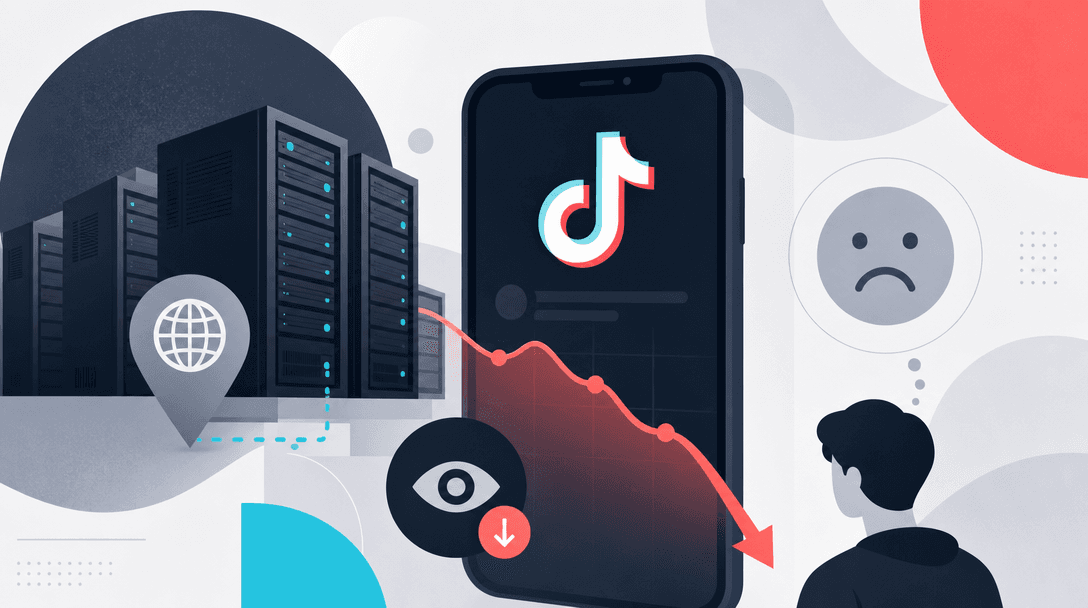
TokPortal is programmable organic social-media distribution infrastructure for teams that need TikTok reach without cloud-posting fingerprints. If views collapse after posting from a server IP, the issue is usually not the video; it is the environment signal: datacenter IP, missing device context, repeated upload path, and account history all look different from normal in-app posting.
Low TikTok views after server-side posting are usually an infrastructure problem before they are a creative problem. TikTok receives more than the video file: it can evaluate the upload path, app environment, device consistency, account history, location signals, and whether the post behaves like native use. If your first 50 videos posted manually reached normal test pools and the next 50 posted from a cloud workflow flatlined, diagnose the posting environment before rewriting the content strategy.
For brands, agencies, and AI video tools, the fix is not “post less.” The fix is to move distribution back into a credible native environment: real accounts, real devices, local connectivity, warmed account history, and a controlled schedule. Read the broader infrastructure model in TokPortal’s TikTok distribution at scale guide.
Does TikTok detect datacenter IP addresses?
Yes, large consumer platforms can distinguish normal residential or mobile connectivity from datacenter hosting patterns. The important point for growth teams is not whether TikTok has a single “datacenter IP” switch; it is that a cloud upload path lacks many signals that normal app posting includes.
A native TikTok post from a phone carries a coherent environment: device model, app session, OS behavior, local network, language, approximate region, watch behavior, editing flow, and account history. A server-side workflow often concentrates many posts through the same hosting ranges, repeated upload pattern, and stripped-down context. That mismatch can reduce how aggressively the post is tested with real viewers.
The official TikTok Content Posting API documentation is useful for approved publishing workflows, but it is not the same as opening the TikTok app on a real local smartphone, selecting a native sound, using app-native editing, and posting from the local market.
TikTok automation views suddenly dropped: what changed?
When TikTok automation views suddenly drop, the most common change is not the caption or hashtag set. It is one of five operational shifts: a new scheduler, a new proxy provider, a move from phone posting to cloud posting, a sudden increase in volume, or a mismatch between account country and network country.
Audit the timeline in hours, not weeks. Find the first post where reach collapsed, then compare it with the last normal post:
- Was it uploaded through the same app path?
- Was the account accessed from the same country?
- Did the device or browser session change?
- Did the posting cadence jump from human-paced to batch-paced?
- Did the account start posting duplicate creative across many profiles?
If the answer is yes to two or more, treat it as a distribution-path problem. Use this TikTok API posting guide to separate what the official API can do from what native in-app posting can do.
TikTok shadowban from using proxies: how should brands think about it?
Most teams use “shadowban” as shorthand for a reach ceiling they cannot explain. A more useful diagnosis is signal mismatch. If a US account posts from a low-quality proxy one day, a different country the next, and a cloud host after that, the account history stops looking like a stable creator or brand presence.
Proxies also solve the wrong problem. They change the visible network route, but they do not create the full native environment: physical device continuity, SIM carrier context, normal app behavior, local sound availability, editing flow, and human-paced account activity. For country-specific campaigns, those signals matter more than hiding an IP address.
If country routing is the core issue, read the multi-country TikTok strategy guide instead of trying to patch global distribution with rotating network shortcuts.
How to restore TikTok reach after using API or server posting
Freeze the broken upload path
Stop posting new videos through the server, proxy, or scheduler that correlates with the drop. Do not keep testing at full volume while the account is sending the same weak environment signals.
Benchmark the account manually
Publish one native in-app post from a real phone in the account’s target country. Use normal editing, a relevant sound if appropriate, and a standard posting time. Compare early distribution to the last healthy manual post.
Warm the account back into a niche
Rebuild normal account behavior before pushing volume. TokPortal uses niche warming for 7 credits per account; the goal is to make account history coherent around a topic and geography before scaling posts.
Separate creative quality from delivery quality
Post the same creative through two controlled paths: one native real-device path and one previous automation path. If the native post receives a normal test pool and the server post does not, the creative is not the main constraint.
Scale only after the account shows stable early reach
Increase volume gradually across multiple warmed accounts, not one overloaded profile. Use webhooks and analytics to monitor post-level reach before adding more daily uploads.
TokPortal’s distribution platform is built for this recovery path: real accounts on physical smartphones, local SIM cards in 20+ countries, and human operators posting inside TikTok, Instagram, and YouTube. Developers can connect through the TokPortal REST API, SDKs, webhooks, and MCP server while the actual publishing still happens in the native app environment.
For a deeper operational playbook, use the TikTok account warming guide before sending high-volume campaigns back into production.
Why TikTok posts from a cloud server get no views
Feature
Cloud/server posting path
Native real-device posting path
Upload environment
TikTok sounds
Location consistency
Posting behavior
Best use case
A cloud server can upload a file, but it cannot fully reproduce the app-native posting context that TikTok users create every day. That matters most when you are distributing AI-generated videos, UGC variants, music clips, app promos, or affiliate creatives at scale.
The native sound limitation is especially important. TikTok’s Content Posting API supports approved publishing flows, but native app posting is the path that lets an operator add TikTok sounds inside the real app. If sounds are part of your distribution strategy, read how TikTok sounds work with native in-app posting.
20+
countries with TokPortal real-device distribution coverage
150,000+
accounts under management
4,276
active business clients
6B+
organic video views generated
Original diagnostic: do not confuse website utility traffic with TikTok distribution health
When is the official TikTok API still the right answer?
Use the official API when
- You need an approved publishing workflow for a small number of owned accounts
- Native sounds, location nuance, and in-app editing are not critical to the campaign
- Your primary requirement is a clean developer workflow documented by TikTok
- You can accept the feature limits described in TikTok’s developer documentation
Use native real-device distribution when
- You need to distribute many creative variants across markets
- Your reach fell after moving from phone posting to server-side posting
- You need TikTok sounds, local posting behavior, or geo-native account history
- Your agency or AI tool needs a post-generation distribution layer
- Use one account country, one local device environment, and one niche per account cluster
- Warm accounts before volume instead of testing new infrastructure at full campaign scale
- Track reach by upload path, not only by creative, hook, or caption
- Keep AI-generated variants separated enough that each account has a coherent content lane
- Use native in-app posting when TikTok sounds, location tags, or app editing affect performance
- Route developer workflows through an API while keeping the final publish action inside the real app
The 10-minute audit for a TikTok reach collapse
Run this before changing creative direction. Pull the last 10 normal posts and the first 10 collapsed posts. Put them in a sheet with six columns: posting method, country, device, account age, time posted, and first-hour views. If the drop lines up with a new scheduler, proxy, API workflow, or cloud uploader, you have enough evidence to test a native posting path.
For teams scaling beyond a few profiles, the operational solution is account architecture. Split markets by country, warm accounts by niche, and scale with device-backed distribution instead of pushing every asset through one server workflow. Here is the 100-account TikTok scaling playbook.
Price a real-device TikTok distribution test
If your server-posted videos are flatlining, run a controlled test through native in-app posting across real devices, local SIMs, and warmed accounts.
Why did my TikTok views drop after automation?+
Can a datacenter IP reduce TikTok reach?+
Will switching back to phone posting restore reach immediately?+
Is the TikTok Content Posting API bad for reach?+
Should brands use proxies for country-specific TikTok campaigns?+
What is the fastest test to prove whether the server IP is the problem?+

Written by
Vincent Tellenne
Co-founder & CEO
Vincent is a co-founder and CEO of TokPortal. He works on the infrastructure and operating model behind scaled organic social media distribution.
Learn more about this topic with AI
Related Resources
How to Post on TikTok via API in 2026 (Step-by-Step Working Guide)
Post videos to TikTok automatically with the official Content Posting API. Working examples, auth setup, sounds, scheduling — everything that works in 2026.
How to Scale TikTok Marketing with 100+ Accounts in 2026
Learn how to scale TikTok marketing with 100+ accounts using real devices, native posting, and account warming. Complete guide for brands and agencies running multi-account organic campaigns in 2026.
The Complete Guide to TikTok Account Warming in 2026
Master TikTok account warming for maximum organic reach. Learn warming techniques, timelines, and how to automate the process with TokPortal's niche warming and deep warming features.
TikTok API Alternatives: When the Official API Isn't Enough
Explore the best TikTok API alternatives for content posting, account management, and automation. Learn when the official API falls short and what to use instead.
TikTok Distribution at Scale: The Infrastructure Guide
Learn how to build a scalable TikTok distribution infrastructure. From account farms to geo-targeting, this guide covers everything marketing pros need to grow at scale.
How to Add TikTok Sounds via API: Native In-App Posting Explained
Learn how to add TikTok sounds via API using TokPortal's native in-app posting. Add trending sounds, control volume levels, and use carousels — all programmatically.
From the guide to your first campaign
You make the content.
TokPortal runs the account operations.
Create and operate TikTok and Instagram accounts in your target market. Local operators handle the account work and native publishing. You control the brief, content and campaign from the dashboard, API or MCP.
- 01Choose your market
- 02Define each account
- 03Schedule your content
Review market availability and pricing before ordering. No reach forecast is built into your plan.