
On this page
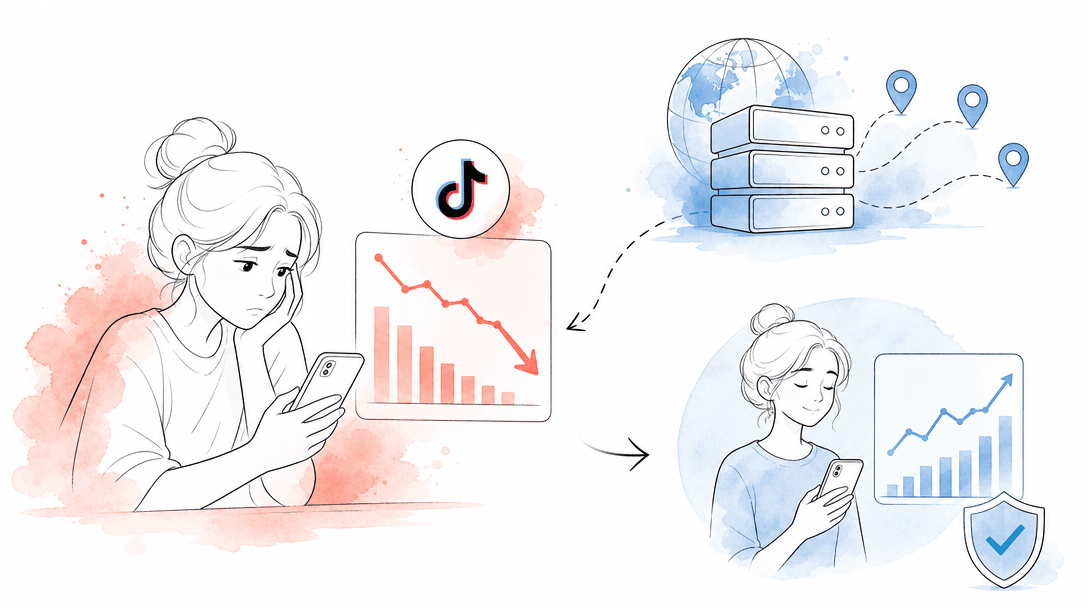
TikTok views often drop after datacenter proxies because the account no longer looks geo-native: IP, device signals, SIM/location context and in-app behavior diverge. TokPortal is organic social-media distribution infrastructure that posts through real human operators on real physical devices with local SIM cards in 20+ countries.
If your TikTok views dropped after using a proxy, stop changing creative first. The more likely issue is that the account’s posting environment changed faster than the account’s history can justify. TikTok says it processes device information, IP address, location data and app activity in its privacy documentation, and its recommendation system uses behavioral signals to decide early distribution. A datacenter proxy can make those signals inconsistent.
This page is for brands, agencies, AI video teams and technical marketers who need to scale posting without breaking organic distribution. If you only need a TikTok profile picture download, a TikTok profile picture downloader or a TikTok PFP downloader, that will not diagnose reach. Reach comes from account history, content response and the infrastructure used to publish.
Does using proxies affect TikTok reach?
Yes, proxies can affect TikTok reach when they create an unnatural gap between account history and posting context. The common failure pattern is simple: an account is created, watched and warmed in one country or device environment, then suddenly posts from a datacenter IP, new device signature or mismatched location. Even if the video is strong, the initial distribution test can be conservative because the account context is noisy.
Not every view drop is proxy-related. Creative fatigue, repeated hooks, low completion rate, weak first three seconds, unsuitable sounds and posting into the wrong language market can all reduce distribution. The proxy signal matters most when the drop happens immediately after infrastructure changes: new IP provider, new browser profile, emulator stack, remote session, country switch or scheduled upload path.
For how TikTok evaluates content after publishing, read TikTok Algorithm 2026: How Organic Distribution Really Works. The core point: the algorithm can only expand reach after the first test audience responds, and inconsistent account signals can make that first test smaller or less relevant.
Why datacenter proxies are a weak base for organic TikTok distribution
- The IP address does not match a normal local mobile usage pattern.
- The device environment can change faster than a real person’s device would.
- The account may post from one country while its historical watch behavior points to another.
- Browser-based or remote-upload workflows can miss native in-app context.
- Duplicate posting patterns across many accounts create operational sameness.
- Location tags, sounds and edits may not match the intended local audience.
What is the best way to scale TikTok without proxies?
The best way to scale TikTok without proxies is to separate content production from distribution infrastructure. Your creative team, AI video pipeline or agency workflow can generate the assets centrally. Publishing should happen through real accounts, real devices, native app sessions, local SIM cards and human-in-the-loop operations in the countries you want to reach.
TokPortal exists for this layer. It lets brands and developers post and engage across TikTok, Instagram and YouTube through real physical smartphones with local SIM cards in 20+ countries. Instead of building a fragile proxy stack, you program the campaign through API, MCP, SDKs, webhooks or no-code tools while the actual posting happens inside the native app.
If you are planning volume, start with the operating model in How to Scale TikTok Marketing with 100+ Accounts in 2026 and the infrastructure view in TikTok Distribution at Scale: The Infrastructure Guide.
Feature
Proxy-led scaling
Real-device distribution
Posting environment
Country signal
TikTok sounds
Operational control
Best fit
How do TikTok device fingerprinting and views connect?
TikTok views are not determined by device signals alone, but device context helps the platform understand whether an account’s activity is coherent. TikTok’s privacy documentation states that it may process device model, operating system, IP address, mobile carrier, app activity and approximate location. Those signals sit beside content-level performance signals such as watch time, rewatches, shares, comments and follows.
The practical issue is not one isolated signal. It is the bundle. A profile that watched local Brazilian content for weeks, then posts from a new environment that resembles a remote datacenter, with no local SIM context and a different device pattern, creates uncertainty. That uncertainty can reduce the quality of the first audience match, which is where many posts either expand or stall.
Account age and history matter here. A mature account with consistent local behavior can absorb more operational variance than a new account. For the warming side, use The Complete Guide to TikTok Account Warming in 2026 before pushing production volume.
Original operating rule: stabilize the account before judging the creative
What is the difference between residential and mobile proxies for TikTok?
Residential and mobile proxies are both IP workarounds; neither gives you the full context of a real phone being used locally. A residential proxy may provide an IP associated with a household network. A mobile proxy may provide carrier-like IP routing. But TikTok can still observe broader device, app and behavior signals beyond the visible IP.
That is why “mobile proxy” is not the same thing as “mobile device.” A real mobile device has installed app history, physical hardware, operating system state, mobile carrier context, GPS/cell/WiFi environment and human usage patterns. For organic distribution, that full bundle is the stronger foundation.
Feature
Residential or mobile proxy
Real phone with local SIM
Core function
Device signal
Locality
Creative features
Scaling risk
How do you recover TikTok reach after proxy use?
Stop switching environments
Pick one country, one device path and one posting method for the account. Do not rotate IP providers, upload tools or regions while diagnosing reach.
Return to native in-app behavior
Use the TikTok mobile app on a real device. Watch, search, save and engage with content in the niche and country you want the account to serve.
Pause high-volume publishing
Reduce posting pressure for several days. Let the account rebuild consistent session history before testing multiple uploads.
Post one clean test video
Upload a fresh video manually or through a native-device workflow. Use a relevant sound, local caption language and a clear first-three-second hook.
Compare performance to account baseline
Do not compare a recovered account to your best-ever viral post. Compare first-hour and first-day performance to the account’s normal median.
Warm before scaling again
If the account is new or recently moved countries, run niche warming before returning to campaign volume.
Recovery is not a cosmetic checklist. Changing the profile photo, username or bio will not fix an infrastructure mismatch. A TikTok profile picture downloader can help with asset QA, but a profile picture download has no direct relationship to distribution quality. Focus on the posting environment, the account’s niche history and whether the content is being shown to the right local audience.
If your team posts through API workflows, understand the tradeoff: TikTok’s official Content Posting API is useful for compliant publishing flows, but it does not provide every native in-app feature, including adding TikTok sounds inside the app. For the native sound workflow, read How to Add TikTok Sounds via API: Native In-App Posting Explained or review TokPortal’s developer resources at developers.tokportal.com.
What does TikTok organic reach infrastructure look like?
TikTok organic reach infrastructure is the operating layer that connects content supply to credible local distribution. For a modern brand, that usually means: content generation, creative QA, account selection, account warming, native-app publishing, comment engagement, analytics, Spark Code handoff and country-by-country learning loops.
TokPortal is built for that layer. It supports TikTok, Instagram and YouTube posting through real accounts on real physical smartphones with local SIM cards in 20+ countries. Campaigns can be controlled through REST API, MCP, TypeScript SDK, Python SDK, webhooks, n8n, Make and Zapier. Posting happens inside the app, so TikTok sounds, location tags and native editing remain available.
For technical teams, compare native-device workflows with official API limits in How to Post on TikTok via API in 2026.
20+
countries with local device coverage
150,000+
accounts under management
4,276
active business clients
6B+
organic video views generated
9,000+
profiles analyzed in TokPortal benchmark indexes
When TokPortal is not the answer
TokPortal fits when
- You already have a repeatable content engine and need more distribution capacity.
- You need native in-app TikTok posting with sounds, locations or editing.
- You run agency, brand, affiliate, app, music or AI-video campaigns across multiple accounts.
- You want API, MCP, SDK or webhook control over human-in-the-loop social distribution.
- You need country-specific posting in markets such as the USA, UK, Brazil, Germany, France, Japan, Mexico or Indonesia.
Use something simpler when
- You only post once per week from one founder account.
- Your creative has not yet found any signal on a single account.
- You need only a basic scheduler for one brand profile.
- You are trying to repair reach without changing the unstable posting environment.
- You need a free consumer utility such as a TikTok PFP downloader rather than business distribution.
Plan a real-device TikTok distribution campaign
See the credit model for accounts, uploads, warming and native in-app posting before you rebuild your TikTok stack.
Why did my TikTok views drop after using a proxy?+
Does TikTok know if I use a datacenter proxy?+
Are mobile proxies enough for TikTok growth?+
How long does it take to recover TikTok reach after proxy use?+
Can I scale TikTok posting without proxies?+
Does changing my TikTok profile picture fix low views?+

Written by
Vincent Tellenne
Co-founder & CEO
Vincent is a co-founder and CEO of TokPortal. He works on the infrastructure and operating model behind scaled organic social media distribution.
Learn more about this topic with AI
Related Resources
How to Post on TikTok via API in 2026 (Step-by-Step Working Guide)
Post videos to TikTok automatically with the official Content Posting API. Working examples, auth setup, sounds, scheduling — everything that works in 2026.
How to Scale TikTok Marketing with 100+ Accounts in 2026
Learn how to scale TikTok marketing with 100+ accounts using real devices, native posting, and account warming. Complete guide for brands and agencies running multi-account organic campaigns in 2026.
The Complete Guide to TikTok Account Warming in 2026
Master TikTok account warming for maximum organic reach. Learn warming techniques, timelines, and how to automate the process with TokPortal's niche warming and deep warming features.
TikTok Algorithm 2026: How Organic Distribution Really Works
Deep dive into the TikTok algorithm in 2026. Understand how organic distribution works, why some videos go viral, and how to optimize multi-account campaigns for maximum reach.
TikTok Distribution at Scale: The Infrastructure Guide
Learn how to build a scalable TikTok distribution infrastructure. From account farms to geo-targeting, this guide covers everything marketing pros need to grow at scale.
How to Add TikTok Sounds via API: Native In-App Posting Explained
Learn how to add TikTok sounds via API using TokPortal's native in-app posting. Add trending sounds, control volume levels, and use carousels — all programmatically.
From the guide to your first campaign
You make the content.
TokPortal runs the account operations.
Create and operate TikTok and Instagram accounts in your target market. Local operators handle the account work and native publishing. You control the brief, content and campaign from the dashboard, API or MCP.
- 01Choose your market
- 02Define each account
- 03Schedule your content
Review market availability and pricing before ordering. No reach forecast is built into your plan.