
On this page
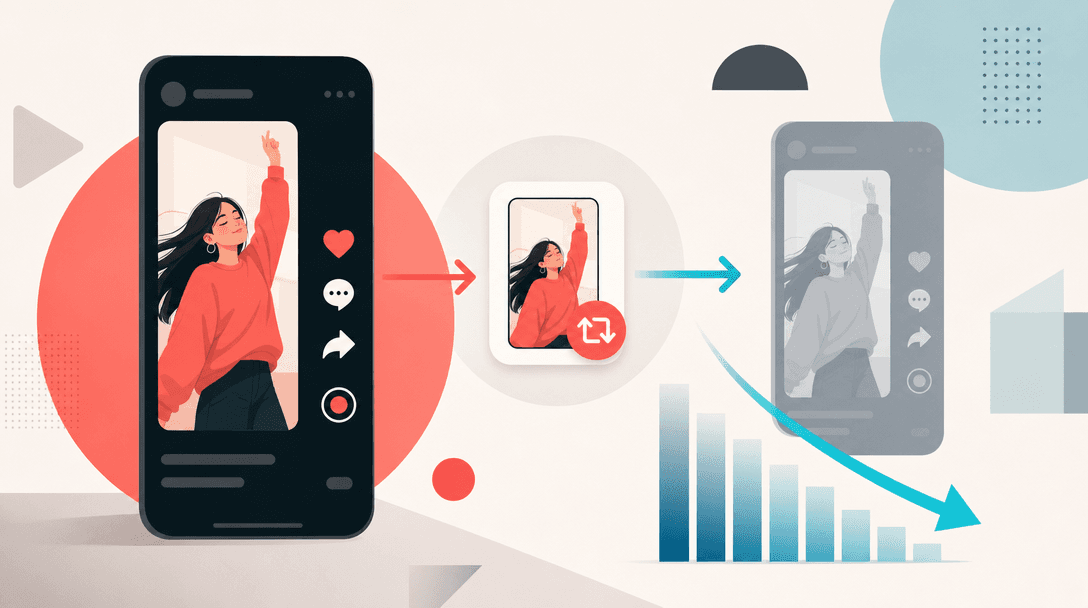
TikTok reach often drops after reposting because the second upload is too similar to an asset TikTok has already evaluated. Reposting is not automatically harmful, but identical files, captions, sounds, covers, timing and audience overlap can make the new post look less useful than the original.
Your repost strategy kills reach when it treats TikTok like a file uploader instead of a recommendation system. TikTok has already tested the first version of the clip with a seed audience. If the next upload gives the system the same video, same sound, same caption, same cover and similar audience context, there is little new reason to expand it.
TokPortal is programmable, organic social-media distribution infrastructure — The Human API. It posts across TikTok, Instagram and YouTube at scale through real human operators using real physical devices and local SIM cards in 20+ countries, controlled via API, MCP and SDKs. For brands, agencies and AI video teams, the fix is not “repost harder”; it is building a distribution stack where every repost has a distinct account, geo, sound, hook, caption and timing plan.
Does reposting TikToks hurt your account?
Reposting does not automatically hurt a TikTok account. The problem starts when an account repeatedly publishes near-identical assets with no new creative angle, no new audience context and no reason for the For You system to retest the clip. TikTok’s own explanation of recommendations says the system weighs user interactions, video information and account or device settings; a repost changes very little if the asset and context are unchanged.
The practical rule: a repost should be treated as a new distribution experiment, not a duplicate upload. Change the opening frame, caption angle, on-screen text, sound, location, publish window or target country. If you are running multiple brand accounts, warm them properly before pushing high-volume clips; the TikTok account warming guide explains why early account behavior affects distribution quality.
A clean repost strategy is normal for brands. A lazy repost strategy is what collapses reach.
How does TikTok duplicate video detection work?
TikTok does not publish a public duplicate-score formula. What it does publish is that recommendations use video information such as captions, sounds and hashtags, plus user behavior and device or account settings. In practice, duplicate risk is best understood as a stack of similarity signals: visual frames, audio track, file metadata, caption, cover, account history, publish cadence and audience overlap.
That matters because most teams only edit one layer. They trim two seconds, keep the same hook, reuse the same caption and post to a similar audience from a similar account. That is not a meaningful test; it is a near-repeat.
The official TikTok Content Posting API is useful for approved publishing workflows, but it is limited compared with native in-app posting. For example, native TikTok sounds and some in-app editing behaviors are not available the same way through official posting endpoints. If sounds are part of your variant strategy, read how TikTok sounds work with native in-app posting before designing the workflow.
How do you slightly edit reposts for reach?
Change the first 1.5 seconds
The opening frame and hook carry the first audience decision. Replace the first visual, add a new pattern interrupt, or start at a different moment in the clip.
Rewrite the caption for a different intent
Do not swap only hashtags. Turn the caption from curiosity to proof, from problem to comparison, or from product claim to user scenario.
Use a new sound or volume mix where relevant
If the account posts natively in the TikTok app, test a different native sound, original audio treatment, or sound-volume balance.
Change the cover and on-screen text
A new cover changes profile-grid context; new on-screen text changes how the clip is understood before the viewer hears anything.
Move the repost to a different audience cell
Change country, language, niche account, posting time or creator persona. A repost aimed at the same viewers is a weaker experiment.
Measure by account-level cohort, not one upload
Compare variants by account age, country, niche and publish window. One high or low post is noise; a 10-post cohort shows whether the strategy works.
The edit does not need to be cinematic. It needs to be meaningful. A better version is: same raw customer clip, new first frame, new caption promise, new native sound, new cover text, posted from a warmed beauty account in France at a French viewing window. That is a new distribution test.
A weak version is: same exported MP4, same opening, same caption, same hashtags, posted five times in one day. That is why teams think “TikTok killed reposting” when the real issue is that the experiment had no new variable.
Can you repost to theme pages without a reach downgrade?
Feature
Weak theme-page reposting
Distribution-grade theme-page reposting
Account fit
Creative treatment
Posting cadence
Geo context
Measurement
Theme pages work when they are treated as audience-specific publishers. They fail when they become dumping grounds for the same clip. If your product is skincare, a beauty tips page, a dermatology explainer page and a budget self-care page should not post the same version. Each one needs a different promise.
This is where account age and account behavior matter. A warmed account with a clear niche gives TikTok more context than a newly created, empty profile. For a deeper operating model, see how to scale TikTok marketing with 100+ accounts.
How do you distribute clips without TikTok downgrade?
Distribute clips by building variant groups, not by spraying identical uploads. A practical structure is 10 raw clips, 3 hooks per clip, 2 caption angles per hook and 3 country or niche cells. That produces 180 tests from the same raw creative base without pretending every post is the same asset.
The key is to preserve the idea while changing the packaging. TikTok is testing whether viewers respond to a piece of content in context. Context includes the account, country, sound, caption, posting time and early engagement pattern. The TikTok Algorithm 2026 guide breaks down why distribution is a sequence of audience tests, not a single global score.
Do not let vanity traffic confuse this diagnosis. Queries such as “tiktok profile picture download”, “tiktok pfp downloader” and “tiktok profile picture downloader” can bring large search impressions to a site, but they do not indicate buying intent or distribution quality. A brand diagnosing a duplicate TikTok content reach problem needs cohort data: which clip, which account, which variant, which country, which publish window and which outcome.
What should an organic TikTok distribution stack include?
- A library of raw clips with variant-ready hooks, covers and captions
- Warmed niche accounts with clear audience histories
- Native in-app posting for sounds, location tags and editing features
- Country-specific devices, SIM context and posting windows
- A scheduling layer that spaces tests instead of clustering repeats
- Analytics by account, country, hook, caption angle and creative source
- Spark Code handoff for clips that deserve paid amplification
- A weekly kill, iterate or scale decision process
The stack matters because TikTok reach is not only a content problem. It is a distribution problem. A strong creator clip can underperform if it is pushed through the wrong account, wrong country, wrong sound or wrong posting rhythm.
TokPortal handles this layer through real human operators using real physical smartphones and local SIM cards in 20+ countries. Brands can post natively to TikTok, Instagram and YouTube, use Spark Codes for per-video handoff, and control campaigns through REST API, MCP, TypeScript and Python SDKs. Technical teams should start with the TokPortal developer docs or read the TikTok API posting guide.
4,276
active business clients using TokPortal distribution infrastructure
150,000+
accounts under management across social platforms
6B+
organic video views generated through TokPortal
9,000+
TikTok profiles analyzed in internal benchmark indexes
Original operating rule: change at least 4 of 6 layers
When reposting is worth doing
- The original clip had strong watch time, saves or comments but reached the wrong country
- The raw asset can support a new hook, caption or audience promise
- You have warmed accounts in different niches or countries
- You can measure variants as cohorts instead of guessing from one upload
When reposting is the wrong move
- The same account already posted the clip recently
- You cannot change the first frame, caption, sound or audience context
- The account has no niche history yet
- The original idea failed because the offer, product or creative angle was weak
Build a repost-safe TikTok distribution plan
Use TokPortal to launch native, human-in-the-loop TikTok distribution across warmed accounts, local devices and country-specific posting windows.
Why did my TikTok reach drop after reposting the same video?+
Does deleting and reposting a TikTok help reach?+
How much do I need to edit a repost?+
Can brands repost UGC clips across many TikTok accounts?+
Is the official TikTok Content Posting API enough for repost distribution?+
What should I measure after reposting?+

Written by
Vincent Tellenne
Co-founder & CEO
Vincent is a co-founder and CEO of TokPortal. He works on the infrastructure and operating model behind scaled organic social media distribution.
Learn more about this topic with AI
Related Resources
How to Post on TikTok via API in 2026 (Step-by-Step Working Guide)
Post videos to TikTok automatically with the official Content Posting API. Working examples, auth setup, sounds, scheduling — everything that works in 2026.
How to Scale TikTok Marketing with 100+ Accounts in 2026
Learn how to scale TikTok marketing with 100+ accounts using real devices, native posting, and account warming. Complete guide for brands and agencies running multi-account organic campaigns in 2026.
The Complete Guide to TikTok Account Warming in 2026
Master TikTok account warming for maximum organic reach. Learn warming techniques, timelines, and how to automate the process with TokPortal's niche warming and deep warming features.
TikTok Algorithm 2026: How Organic Distribution Really Works
Deep dive into the TikTok algorithm in 2026. Understand how organic distribution works, why some videos go viral, and how to optimize multi-account campaigns for maximum reach.
TikTok Distribution at Scale: The Infrastructure Guide
Learn how to build a scalable TikTok distribution infrastructure. From account farms to geo-targeting, this guide covers everything marketing pros need to grow at scale.
How to Add TikTok Sounds via API: Native In-App Posting Explained
Learn how to add TikTok sounds via API using TokPortal's native in-app posting. Add trending sounds, control volume levels, and use carousels — all programmatically.
From the guide to your first campaign
You make the content.
TokPortal runs the account operations.
Create and operate TikTok and Instagram accounts in your target market. Local operators handle the account work and native publishing. You control the brief, content and campaign from the dashboard, API or MCP.
- 01Choose your market
- 02Define each account
- 03Schedule your content
Review market availability and pricing before ordering. No reach forecast is built into your plan.