
On this page
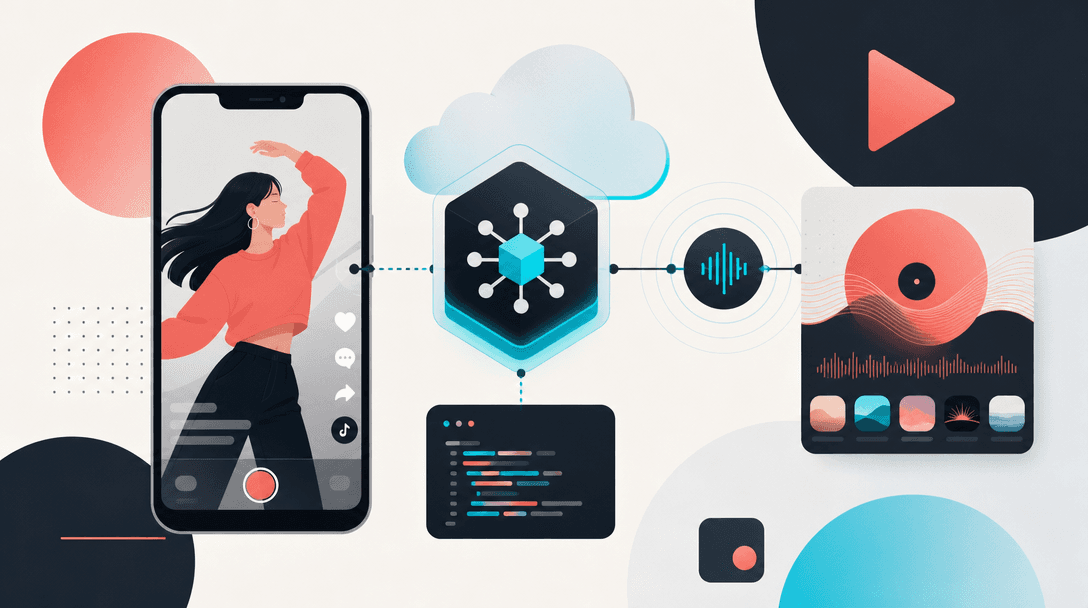
TokPortal is a social posting API that publishes TikToks through real devices running the native TikTok app, so posts can use native sounds, location tags, and in-app editing. The official TikTok Content Posting API supports upload and publish flows, but it does not expose full native sound selection.
TokPortal is programmable, organic social-media distribution infrastructure — The Human API. For TikTok posting with sounds, the key difference is execution layer: official APIs publish through approved upload flows, while TokPortal coordinates real human operators on real physical smartphones with local SIM cards in 20+ countries.
That matters because TikTok sounds, location tags, and app-native editing are not just decorative features. For sound-led creative, trend participation, music marketing, local launches, and AI video distribution, they are part of the post context. If you are building a scheduler, AI video pipeline, agency dashboard, or content operations system, start with the TokPortal developer documentation and compare it against the official TikTok Content Posting API before choosing the execution path.
Limits of official TikTok Content Posting API
The official TikTok Content Posting API is useful when your product needs a compliant upload or direct-post workflow for authorized TikTok users. TikTok’s developer docs describe flows for uploading media, checking creator info, and publishing through approved endpoints.
The practical limitation for sound-led distribution is narrower: TikTok’s public Content Posting API does not give developers the same creative surface as the native app. Native sound selection, location tagging, and some in-app editing behaviors are app experiences, not generic media-upload parameters. If the creative depends on a trending sound or geo-native context, a normal upload endpoint is not enough.
Use the official API when you need standard user-authorized publishing. Use a real-device posting layer when the post must be composed inside TikTok’s native app. For a fuller API comparison, read TikTok API alternatives when the official API is not enough.
Feature
Official TikTok Content Posting API
TokPortal real-device posting API
Publishing path
Native sounds
Location tags
Best use case
Automation model
How to programmatically post TikToks with native audio
Create or connect TikTok accounts
Add the TikTok accounts you own or manage in TokPortal. Accounts run on real physical devices, with local SIM cards available across 20+ countries.
Warm accounts before volume
Use niche warming when an account needs category context before posting. TokPortal niche warming costs 7 credits per account.
Upload the video asset
Send the video file, caption, campaign metadata, account selection, and target publish window through the API or SDK.
Specify native execution requirements
Pass instructions for native TikTok sound use, location tagging, basic in-app editing, sound-volume control, or review requirements.
Schedule the publish job
Queue the post immediately or schedule it by timezone. For country-specific timing, match the device geography and local audience window.
Receive status webhooks
Listen for queued, assigned, in-progress, published, failed, and analytics-ready events so your own system stays synchronized.
Pull analytics and iterate
Use post-level results to route winning formats into more accounts, countries, or creative variants instead of treating posting as a one-way upload.
Original engineering rule: separate generation from native execution
API design for large scale TikTok posting
Large-scale TikTok posting should be designed like distribution infrastructure, not like a single-account scheduler. The core objects are accounts, devices, videos, sounds, locations, publish jobs, approvals, webhooks, and analytics events.
A practical schema has four layers:
- Creative layer: video URL, caption, cover frame, native sound instruction, edit notes, product or campaign ID.
- Account layer: account ID, country, niche, language, readiness state, owner approval state if required.
- Execution layer: publish window, priority, native app requirements, device assignment, operator notes.
- Feedback layer: publish status, post URL, view count, engagement, Spark Code availability, analytics timestamp.
If you are scaling beyond a few scheduled posts, read TikTok distribution at scale: the infrastructure guide and how to scale TikTok marketing with 100+ accounts.
20+
countries with real-device TokPortal coverage
150,000+
accounts under TokPortal management
4,276
active business clients using TokPortal
6B+
organic video views generated through TokPortal
- Idempotency keys for every publish job
- Account readiness checks before scheduling
- Country-aware queues for local posting windows
- Webhook retries with signed payloads
- Creative metadata preserved from generation to analytics
- Per-video Spark Code and Partnership Ad Code handoff when available
- Credit tracking by account, upload, warming, editing, and sound-volume control
Webhooks and scheduling for TikTok posts
Scheduling is not just a timestamp. For TikTok, schedule quality depends on account readiness, country, local audience behavior, content freshness, and whether the post requires native sound selection. A developer-grade TikTok posting API should expose both pre-publish validation and post-publish events.
Recommended webhook events:
- post.queued: the job was accepted and has a stable ID.
- post.assigned: a device and operator workflow were assigned.
- post.in_progress: native app execution has started.
- post.published: the live TikTok URL is available.
- post.needs_review: operator or owner approval is required before publishing.
- analytics.ready: post-level performance data can be pulled.
For timing strategy, pair API scheduling with best time to post on TikTok by country in 2026. For account preparation, use the TikTok account warming guide.
Combining MCP servers and posting APIs
MCP changes the operator model for growth teams. Instead of a marketer manually exporting videos from an AI tool, an agent can inspect the campaign brief, select approved creatives, choose accounts, queue publish jobs, and summarize results back into Slack, Notion, or a BI dashboard.
The safe pattern is agent proposes, API executes, human workflow verifies native requirements. For example, an AI agent can identify that a Sora or Veo clip should use a specific TikTok sound, but the final native sound selection happens through TokPortal’s real-device execution layer. That keeps the API programmable while preserving the native TikTok app surface.
Developers can connect TokPortal through the TokPortal REST API, SDKs, and MCP resources. If your workflow is no-code or low-code, compare it with the auto social media posting guide.
Developers guide to TokPortal TikTok API
TokPortal’s TikTok API is built for teams that need native distribution after content generation. Typical users include AI video platforms, UGC engines, agencies, affiliate operators, music marketers, app growth teams, and technical growth teams with internal tooling.
Core surfaces include:
- Content posting: TikTok, Instagram, and YouTube publishing through real app workflows.
- Commenting and engagement: structured engagement actions through human-in-the-loop execution.
- Analytics: post and account performance feedback for routing decisions.
- Spark Codes and Partnership Ad Codes: monetizable handoffs for post-level amplification when available.
- Account warming: niche warming at 7 credits and deep warming for Instagram at 40 credits.
- Native options: TikTok sounds, location tags, editing, video editing at 3 credits, and sound-volume control at 1 credit.
Credit anchors are simple: 25 credits per account and 2 credits per video upload. Start with the TokPortal API docs, then model your queue around account readiness, country, and creative metadata.
When TokPortal is the right API layer
- You need native TikTok sounds or location tags, not just file upload.
- You publish AI-generated video at volume and need a post-generation distribution layer.
- You manage multiple countries and want local SIM, device, and app context.
- You need webhooks, SDKs, MCP support, and analytics in one workflow.
When TokPortal is not the answer
- You only need a simple one-account scheduler.
- You do not need native sounds, location tags, or in-app editing.
- Your users require only TikTok’s standard authorized upload flow.
- You are not ready to manage account strategy, creative testing, or publishing calendars.
Examples in TypeScript and Python for TikTok posting
These examples show the shape of a TokPortal posting request. Use the official SDK examples in the developer docs for exact package names, authentication, and response types.
TypeScript example:
const job = await tokportal.posts.create({ platform: 'tiktok', accountId: 'acct_usa_01', videoUrl: 'https://cdn.example.com/video.mp4', caption: 'Launch clip for Austin test market', nativeSound: { instruction: 'Use approved trending sound from campaign brief', volume: 0.35 }, location: { country: 'USA', city: 'Austin' }, publishAt: '2026-03-18T19:30:00-05:00', webhookUrl: 'https://app.example.com/webhooks/tokportal' })
Python example:
job = client.posts.create(platform='tiktok', account_id='acct_fr_02', video_url='https://cdn.example.com/clip.mp4', caption='Paris launch variant', native_sound={'instruction': 'Use approved sound from brief', 'volume': 0.4}, location={'country': 'France', 'city': 'Paris'}, publish_at='2026-03-18T20:00:00+01:00', webhook_url='https://app.example.com/webhooks/tokportal')
If your current organic workflow starts with account research, profile enrichment, or a TikTok profile picture download step, keep that utility outside the publish path. Search traffic for terms like TikTok profile picture downloader and TikTok PFP downloader is useful for research tools, but buyers usually convert when that data feeds a real posting and analytics workflow.
Build your TikTok posting pipeline on real devices
Use TokPortal’s REST API, SDKs, webhooks, and MCP support to publish TikToks with native sounds, location tags, and analytics feedback.
Can the official TikTok API add native sounds to a post?+
How does TokPortal post TikToks with sounds programmatically?+
Is TokPortal a replacement for TikTok’s Content Posting API?+
Does TokPortal support webhooks for TikTok posts?+
Can I use TokPortal with MCP servers or AI agents?+
What does TokPortal cost for TikTok posting?+

Written by
Vincent Tellenne
Co-founder & CEO
Vincent is a co-founder and CEO of TokPortal. He works on the infrastructure and operating model behind scaled organic social media distribution.
Learn more about this topic with AI
Related Resources
7 Best Tools to Schedule TikTok Posts in 2026
Discover the 7 best tools to schedule TikTok posts in 2026. Compare top TikTok schedulers by features, pricing, and scale to grow your organic reach.
How to Post on TikTok via API in 2026 (Step-by-Step Working Guide)
Post videos to TikTok automatically with the official Content Posting API. Working examples, auth setup, sounds, scheduling — everything that works in 2026.
How to Scale TikTok Marketing with 100+ Accounts in 2026
Learn how to scale TikTok marketing with 100+ accounts using real devices, native posting, and account warming. Complete guide for brands and agencies running multi-account organic campaigns in 2026.
TikTok API Alternatives: When the Official API Isn't Enough
Explore the best TikTok API alternatives for content posting, account management, and automation. Learn when the official API falls short and what to use instead.
TikTok Distribution at Scale: The Infrastructure Guide
Learn how to build a scalable TikTok distribution infrastructure. From account farms to geo-targeting, this guide covers everything marketing pros need to grow at scale.
How to Add TikTok Sounds via API: Native In-App Posting Explained
Learn how to add TikTok sounds via API using TokPortal's native in-app posting. Add trending sounds, control volume levels, and use carousels — all programmatically.
Related Tools
From the guide to your first campaign
You make the content.
TokPortal runs the account operations.
Create and operate TikTok and Instagram accounts in your target market. Local operators handle the account work and native publishing. You control the brief, content and campaign from the dashboard, API or MCP.
- 01Choose your market
- 02Define each account
- 03Schedule your content
Review market availability and pricing before ordering. No reach forecast is built into your plan.