
On this page
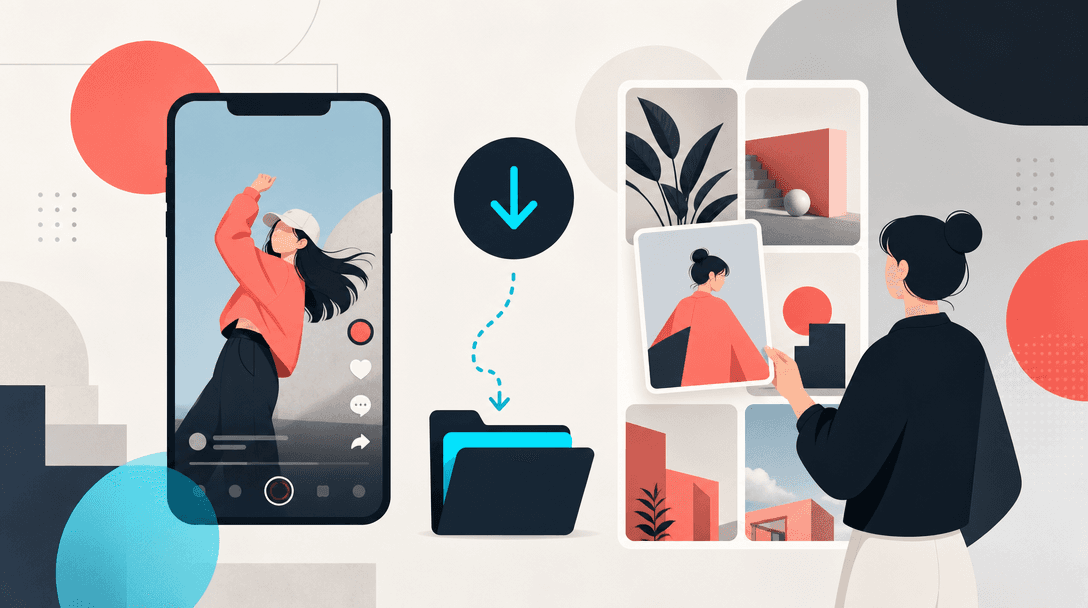
A TikTok picture downloader is a visual research tool for saving public TikTok images, profile pictures, thumbnails, and carousel references into a structured swipe file. For brands, the value is not the download itself; it is turning visual patterns into UGC briefs and controlled distribution tests.
TikTok picture downloader searches often start with small tasks: tiktok profile picture download, tiktok pfp downloader, download pp tiktok, save TikTok thumbnails, or view public profile assets before building a pitch deck. For a brand or agency, the stronger use case is building a searchable creative library: hooks, cover frames, product angles, creator archetypes, carousel formats, and country-specific visual patterns.
TokPortal is programmable, organic social-media distribution infrastructure — The Human API. Once a swipe file reveals which visual patterns are worth testing, TokPortal helps brands publish supplied videos through real human operators on real physical devices with local SIM cards in 20+ countries, controlled via API, MCP, SDKs, or the web app.
How do you use a TikTok picture downloader for swipe files?
Use a TikTok picture downloader as the capture layer, not the strategy. Save only public visual references that help your team understand why a post caught attention: the first frame, profile positioning, thumbnail text, product placement, creator styling, carousel order, background, caption framing, and niche signal.
A useful swipe file has four columns: visual asset, why it matters, testable hypothesis, and market/account to test on. “Blue skincare bottle on bathroom sink” is a weak note. “Close-up product shot with clean white tile background; test as first frame for beauty accounts in France and Germany” is operational.
If you are doing broader competitive research, pair this workflow with TikTok competitor analysis for brands so the picture file is connected to posting frequency, hook style, engagement, and offer mechanics.
How do agencies store TikTok creative references?
Capture the public reference
Save the public profile picture, thumbnail, carousel frame, or cover image with the source URL, creator handle, date captured, and market. Do not store it as an orphaned image with no context.
Tag the creative pattern
Tag by niche, product category, geo, language, hook type, creator archetype, thumbnail style, and offer angle. A swipe file only becomes useful when it can be filtered.
Rewrite the insight in your own words
Document the principle rather than copying the execution. Example: 'use a hand-held product close-up as the opening frame' is usable; duplicating another creator’s image composition line-for-line is not.
Map references to test briefs
Turn each saved pattern into a production brief: opening shot, caption direction, sound category, country, account type, and success metric.
Archive the outcome
After distribution, attach view rate, engagement rate, saves, comments, watch-time proxy, and qualitative notes back to the original reference. This creates a learning loop instead of a folder of screenshots.
How do you respect creator rights when downloading TikTok pictures?
Use downloaded TikTok pictures for internal research, mood boards, and creative analysis unless you have permission or a licensed right to republish. TikTok’s Intellectual Property Policy covers copyright and trademark complaints, and brands should treat creator visuals as protected creative work even when the image is publicly visible.
The clean operating rule: save for analysis, do not reuse as an asset. Your team can learn from a thumbnail structure, profile positioning, photo-mode sequence, or creator framing without reposting the image. If you want creator content in an ad, landing page, email, or brand account, get written usage rights.
This is especially important for UGC teams. A swipe file should produce original briefs, not copied posts. For carousel-specific references, use TokPortal’s guide to TikTok carousel posts and Photo Mode to separate format mechanics from creator-owned execution.
How should brands organize TikTok images by niche and geo?
- Niche: beauty, finance, gaming, fitness, food, fashion, app, education, home, pets, travel, local services
- Geo: country, language, city cue, visible location context, currency, retail environment, cultural reference
- Asset type: profile picture, video thumbnail, carousel frame, product still, text overlay, creator shot, comparison frame
- Creative job: stop-scroll, credibility, product proof, tutorial, transformation, objection handling, offer reveal
- Creator archetype: expert, student, parent, founder, reviewer, hobbyist, professional, local guide
- Distribution note: account age, niche match, sound category, posting window, and market priority
How do you turn a swipe file into a test plan across accounts?
Feature
Static swipe file
Distribution test plan
Output
Decision level
Geo handling
Account strategy
Learning loop
Which tools help with visual research on TikTok?
Useful research tools
- TikTok Creative Center helps identify trending formats, sounds, ads, and commercial examples from TikTok’s own discovery surfaces.
- A TikTok profile viewer can help teams review public profile presentation, bio positioning, pinned videos, and profile imagery before outreach or competitive mapping.
- A TikTok profile picture downloader or TikTok pfp downloader is useful for saving visible profile references when building creator archetype boards.
- Manual review inside the TikTok app remains important because native context, sound usage, comments, and profile behavior are part of the creative signal.
Common limits
- Download tools do not tell you whether a creative pattern will travel across accounts, niches, or countries.
- A thumbnail that works in one country can fail in another because language, retail cues, creator styling, and posting windows differ.
- The official TikTok Content Posting API is useful for some publishing workflows, but TikTok’s developer documentation does not support every native in-app creative feature brands use for organic testing.
- Visual research without distribution infrastructure becomes a deck, not a growth system.
How do you run distribution tests based on swipe insights?
Turn each swipe insight into a test cell. A test cell should include one creative variable, one market, one account type, one posting window, and one success metric. Example: “First-frame product close-up versus creator face opener, skincare niche, France, evening posting window, measured by early engagement rate and save behavior.”
TokPortal is built for this step. Brands produce the videos; TokPortal distributes them through real accounts on real physical smartphones with local SIM cards in 20+ countries. Native in-app posting means teams can use TikTok sounds, location tags, and editing flows that are not available through every official API path.
For the operating model, read TikTok distribution at scale infrastructure, how to scale TikTok marketing with 100+ accounts, and multi-country TikTok strategy for global brands.
20+
countries available for geo-native TokPortal distribution
150,000+
accounts under TokPortal management
4,276
active business clients using TokPortal
6B+
organic video views generated through TokPortal
9,000+
TikTok profiles analyzed in TokPortal benchmark indexes
Original operating insight: tag images by distribution risk, not just design taste
A simple agency framework is 50-10-3: collect 50 public visual references, reduce them to 10 original creative briefs, then test 3 variations across different accounts or countries. The aim is not to copy 50 pictures. The aim is to detect which visual ideas deserve production budget and distribution capacity.
When your team moves from research to publishing, TikTok account quality and posting context matter. Review TikTok account warming for 2026, best times to post on TikTok by country, and how native TikTok sounds work through in-app posting before treating a swipe insight as proven or disproven.
Turn your TikTok swipe file into a distribution test
Use TokPortal to publish supplied brand videos across real accounts, real devices, and local markets instead of leaving creative research in a folder.
What is a TikTok picture downloader used for by brands?+
Is a TikTok profile picture downloader the same as a TikTok profile viewer?+
Can we reuse downloaded TikTok pictures in brand ads or posts?+
How should an agency organize TikTok thumbnails and profile images?+
How do we test insights from a TikTok swipe file?+
Where does TokPortal fit after TikTok visual research?+

Written by
Vincent Tellenne
Co-founder & CEO
Vincent is a co-founder and CEO of TokPortal. He works on the infrastructure and operating model behind scaled organic social media distribution.
Learn more about this topic with AI
Related Resources
Multi-Country TikTok Strategy for Global Brands
Learn how global brands execute a multi-country TikTok strategy to reach local audiences, drive engagement, and scale international growth across 30+ markets.
How to Scale TikTok Marketing with 100+ Accounts in 2026
Learn how to scale TikTok marketing with 100+ accounts using real devices, native posting, and account warming. Complete guide for brands and agencies running multi-account organic campaigns in 2026.
TikTok Carousel Posts: Complete Guide to Photo Mode
Learn everything about TikTok carousel posts and photo mode — how they work, best practices, and how to scale your strategy across multiple accounts.
TikTok Competitor Analysis: How to Spy on Competition
Learn how to run a full TikTok competitor analysis. Discover tools, frameworks, and strategies to spy on TikTok competitors and dominate your niche with data-driven content.
TikTok Distribution at Scale: The Infrastructure Guide
Learn how to build a scalable TikTok distribution infrastructure. From account farms to geo-targeting, this guide covers everything marketing pros need to grow at scale.
TikTok for Business: Complete Marketing Guide 2026
Master TikTok for business in 2026 with our complete marketing guide. Learn strategies, content tips, ad formats, and how to scale globally with real accounts.
From the guide to your first campaign
You make the content.
TokPortal runs the account operations.
Create and operate TikTok and Instagram accounts in your target market. Local operators handle the account work and native publishing. You control the brief, content and campaign from the dashboard, API or MCP.
- 01Choose your market
- 02Define each account
- 03Schedule your content
Review market availability and pricing before ordering. No reach forecast is built into your plan.