
On this page
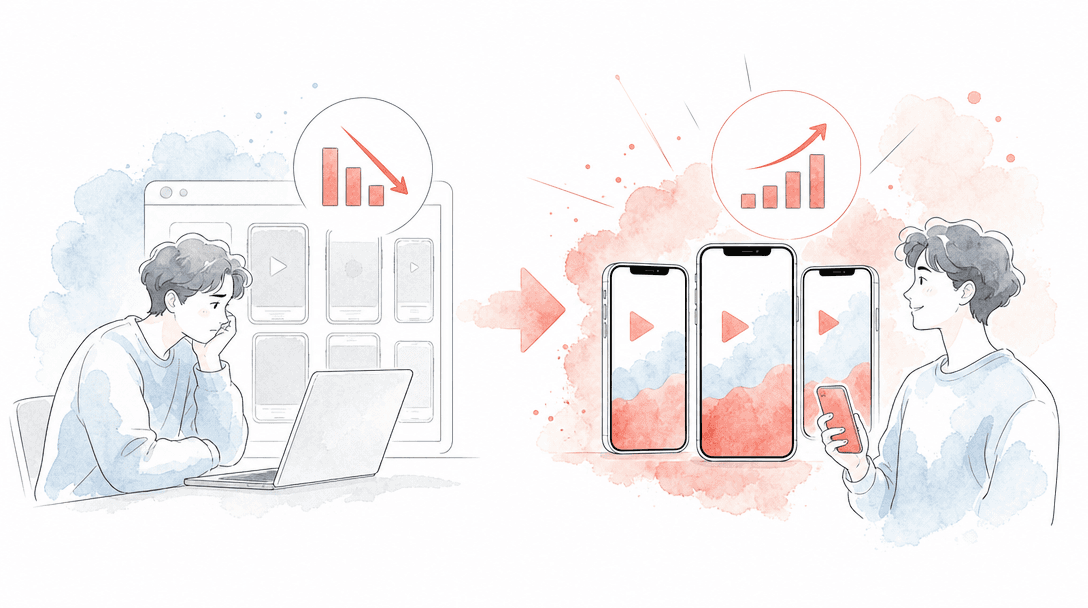
TikTok views are often low on emulators and cloud phones because the device, network, location, and in-app behavior signals do not look like normal mobile use. Real phones with local SIM cards and human-in-the-loop posting give TikTok a cleaner organic distribution context.
TokPortal is programmable, organic social-media distribution infrastructure — The Human API. It posts across TikTok, Instagram, and YouTube through real human operators using real physical devices and local SIM cards in 20+ countries, controlled via API, MCP, and SDKs.
When TikTok views are low on an emulator or cloud phone, do not start by rewriting the hook. First audit the posting surface: device fingerprint, network type, country signals, app environment, account history, and whether the post was created inside the native TikTok app. For teams scaling AI video, UGC, affiliate, music, or multi-country campaigns, this is an infrastructure problem before it is a creative problem.
Is it safe to use TikTok on an emulator?
Using TikTok on an emulator is operationally fragile for brand distribution. The issue is not that an emulator can never open the app; the issue is that TikTok can observe many signals that differ from normal phone use: hardware profile, sensor availability, network history, GPS consistency, app behavior, and repeated device patterns.
TikTok’s own Help Center describes recommendation inputs such as user interactions, video information, and device/account settings. That last category matters for distribution teams because the posting context becomes part of the account’s trust pattern. If 50 accounts all publish from virtualized environments with similar network traits, your campaign may start with less clean distribution than content posted from normal mobile devices.
For a deeper view of how TikTok evaluates early post performance, read TikTok Algorithm 2026: How Organic Distribution Really Works.
What is the best way to run TikTok accounts not on an emulator?
The best alternative is to run TikTok accounts on real smartphones, with local SIM cards, stable country signals, native app sessions, and human-in-the-loop posting. That setup matches how normal users publish: open the TikTok app, select media, add captions, use sounds where appropriate, apply location context, and publish from a real mobile environment.
This matters most when your team is distributing many videos. A single founder posting one video from one phone does not need infrastructure. An agency, AI video platform, label, affiliate operator, or global brand pushing 50–500 assets per month needs repeatable operations without collapsing the natural account pattern.
TokPortal gives businesses API access to that layer: real accounts on real physical smartphones, native in-app posting, webhooks, analytics, Spark Code handoffs, and SDKs. Technical teams can start from the TokPortal developer documentation, while operators planning campaign structure should read How to Scale TikTok Marketing with 100+ Accounts in 2026.
Separate creative testing from distribution testing
Post the same quality band of videos across a small number of accounts, then compare device type, account age, country, and posting method before declaring the creative weak.
Move publishing into the native TikTok app
Use real phones where the post is created inside the app, not only uploaded through a limited publishing endpoint or virtualized mobile session.
Warm accounts before campaign volume
Build niche-relevant viewing, posting, and interaction history before asking an account to carry repeated brand content. TokPortal niche warming costs 7 credits per account.
Match country signals to the audience
If the campaign targets the United States, United Kingdom, Germany, France, Brazil, Japan, or another local market, publish from phones and SIMs in that country instead of routing traffic through generic infrastructure.
Measure by account cohort, not one post
Track reach, watch time, engagement rate, and completion patterns across account cohorts so you can identify whether the device layer or the creative layer is limiting distribution.
How does TikTok treat cloud phone devices?
Cloud phones sit between emulators and real devices. They may present a mobile interface, but many are still remote, repeatable, centrally hosted environments. That can create signals that are unlike a normal person posting from a handset connected to a local carrier network.
Cloud-phone systems are attractive because they are easy to buy and script. The problem is that convenience is not the same as organic distribution quality. If many accounts share similar device profiles, hosted network ranges, non-local location behavior, or repetitive app actions, the account cohort can look less natural than a fleet of real phones operated locally.
Use cloud phones for QA, app walkthroughs, or low-stakes account checks. Do not make them the core posting layer for paid client campaigns where the KPI is organic reach, creator-style packaging, native sounds, or local market penetration.
What is the difference between a mobile proxy and a datacenter proxy?
Feature
Mobile proxy
Datacenter proxy
Network source
Best use
TikTok posting fit
Common misconception
TokPortal approach
Why are TikTok views better on real devices?
Real devices produce a more complete organic context. A real smartphone has a hardware profile, app install history, carrier signal, GPS behavior, camera roll, notification behavior, and normal human timing. A local SIM card reinforces the country signal. A human operator adds the irregularity that normal social publishing has.
Native in-app posting also unlocks features that official publishing routes may not support in the same way. TikTok’s Content Posting API is useful for certain workflows, but it does not replicate every native creation feature inside the app. For example, brands that need native TikTok sounds should understand the limits explained in How to Add TikTok Sounds via API: Native In-App Posting Explained.
This is why two identical videos can behave differently. The video file matters, but so does the account and the environment that introduces the video to TikTok’s first audience sample.
20+
countries with TokPortal real-device social distribution coverage
150,000+
accounts under management across TikTok, Instagram, and YouTube
4,276
active business clients using TokPortal infrastructure
6B+
organic video views generated through TokPortal-managed distribution
How do you scale TikTok posting with real phones?
Scaling TikTok posting with real phones requires an operations layer: account inventory, phone assignment, content queues, country targeting, posting windows, caption control, native sound handling, approvals, analytics, and failure recovery. Doing that manually in spreadsheets breaks once you move beyond a handful of accounts.
TokPortal turns that work into programmable infrastructure. A campaign can upload videos through API or SDK, assign posts to real accounts, publish inside the native app, collect analytics, and generate monetizable handoffs such as TikTok Spark Codes where the campaign requires paid amplification after organic proof.
The unit economics are also visible before you build. TokPortal credit pricing includes 25 credits per account, 2 credits per video upload, 7 credits for niche warming, 3 credits for video editing, and 1 credit for sound-volume control. Developers building automated workflows should pair the TikTok API posting guide with the TikTok distribution infrastructure guide.
Original diagnostic: low views are often a cohort problem
What is organic distribution instead of device farms?
Organic distribution infrastructure
- Real human operators publish brand-supplied videos from physical phones.
- Local SIM cards and country-matched devices support geo-native campaigns.
- Native in-app posting preserves TikTok sounds, location tags, and creator-style packaging.
- API, MCP, SDKs, and webhooks make the workflow programmable without removing the human layer.
- Account warming and analytics are part of the operating system, not an afterthought.
Low-quality device clusters
- Virtualized sessions can create repetitive device and network patterns.
- Hosted environments are easier to script than to make organic.
- The workflow may publish the file but miss native app features that drive TikTok-native presentation.
- Scaling can become a maintenance burden when every account requires manual recovery.
Where do profile viewer and PFP tools fit?
Searches like “TikTok profile picture download,” “TikTok profile viewer,” “TikTok profile picture downloader,” “TikTok PFP downloader,” and “download PP TikTok” are useful for lightweight research, asset checks, and competitor review. They do not solve low views.
If your business problem is distribution, do not confuse profile utilities with a posting system. A downloader can inspect a profile asset; it cannot give you real country coverage, native in-app publishing, account warming, or multi-account campaign analytics.
Price a real-device TikTok distribution campaign
Compare the cost of emulator maintenance against TokPortal’s real-phone posting infrastructure: 20+ countries, native in-app publishing, account warming, analytics, API access, and per-video handoffs.
Why are my TikTok views low on an emulator?+
Are cloud phones better than emulators for TikTok posting?+
Does a mobile proxy fix low TikTok views?+
Can TokPortal post through the native TikTok app?+
When should a brand use TokPortal instead of building its own phone operation?+
What countries can TokPortal support for TikTok distribution?+

Written by
Vincent Tellenne
Co-founder & CEO
Vincent is a co-founder and CEO of TokPortal. He works on the infrastructure and operating model behind scaled organic social media distribution.
Learn more about this topic with AI
Related Resources
How to Post on TikTok via API in 2026 (Step-by-Step Working Guide)
Post videos to TikTok automatically with the official Content Posting API. Working examples, auth setup, sounds, scheduling — everything that works in 2026.
How to Scale TikTok Marketing with 100+ Accounts in 2026
Learn how to scale TikTok marketing with 100+ accounts using real devices, native posting, and account warming. Complete guide for brands and agencies running multi-account organic campaigns in 2026.
The Complete Guide to TikTok Account Warming in 2026
Master TikTok account warming for maximum organic reach. Learn warming techniques, timelines, and how to automate the process with TokPortal's niche warming and deep warming features.
TikTok Algorithm 2026: How Organic Distribution Really Works
Deep dive into the TikTok algorithm in 2026. Understand how organic distribution works, why some videos go viral, and how to optimize multi-account campaigns for maximum reach.
TikTok Distribution at Scale: The Infrastructure Guide
Learn how to build a scalable TikTok distribution infrastructure. From account farms to geo-targeting, this guide covers everything marketing pros need to grow at scale.
How to Add TikTok Sounds via API: Native In-App Posting Explained
Learn how to add TikTok sounds via API using TokPortal's native in-app posting. Add trending sounds, control volume levels, and use carousels — all programmatically.
From the guide to your first campaign
You make the content.
TokPortal runs the account operations.
Create and operate TikTok and Instagram accounts in your target market. Local operators handle the account work and native publishing. You control the brief, content and campaign from the dashboard, API or MCP.
- 01Choose your market
- 02Define each account
- 03Schedule your content
Review market availability and pricing before ordering. No reach forecast is built into your plan.