
On this page
TokPortal is programmable organic social-media distribution infrastructure for teams that need multi-account TikTok posting without collapsing everything onto one device fingerprint. TikTok device fingerprinting connects accounts through device, network, location, app and behavior signals; TokPortal uses real phones, local SIMs and human operators in 20+ countries.
TikTok device fingerprinting matters most when an agency runs many client accounts from the same laptops, phones, WiFi, schedulers or login routines. The issue is not that one person can never manage multiple profiles; TikTok itself supports account switching. The issue is pattern concentration: when unrelated brands share the same technical footprint, the distribution system has less reason to treat each account as a local, independent publisher.
This page is for growth teams, agencies and AI-video operators that need TikTok multi-account posting at scale. If you are planning a 10, 50 or 100-account rollout, pair this with TokPortal’s TikTok account warming guide and the 100+ account scaling playbook.
How TikTok detects multiple accounts
TikTok can associate multiple accounts through a mix of signals: device identifiers, app install data, IP and carrier context, WiFi patterns, location signals, login history, browser or app metadata, and behavioral timing. TikTok’s own Privacy Policy says it collects device, network, location, log and usage information, which is the normal technical basis for platform integrity and personalization systems.
For agencies, the practical takeaway is simple: five client accounts on one office phone, one shared scheduler and one office WiFi do not look like five independent local publishers. They look operationally linked. That does not mean every linked account is treated negatively, but it does mean you should design your stack around separation, locality and human behavior rather than convenience alone.
TikTok device fingerprinting explained
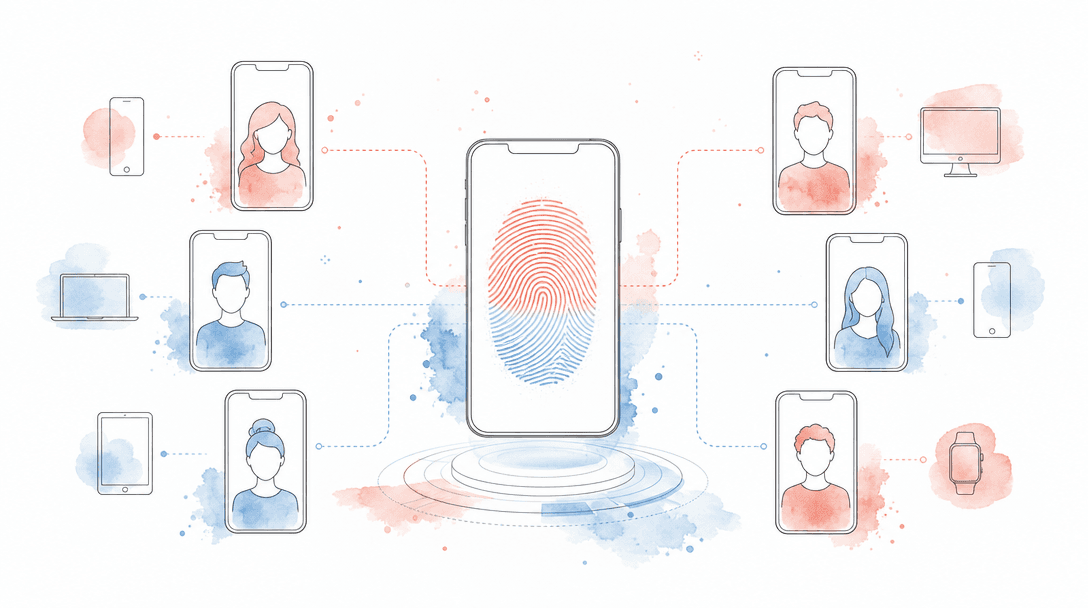
Device fingerprinting is the process of recognizing a device or device environment from a combination of technical signals. On TikTok, the useful mental model is not one magic ID. It is a bundle: phone model, operating system, app version, SIM country, carrier, GPS context, IP range, language settings, posting rhythm, session timing, and how the account behaves before and after publishing.
The mistake agencies make is treating TikTok like email software: upload assets, schedule posts, repeat. TikTok is a mobile-first entertainment app. Native behavior matters. That is why TokPortal posts inside the real TikTok app on real physical smartphones with local SIM cards instead of pushing every client through a single abstracted posting environment.
For a deeper breakdown of what happens after a video is published, read TikTok Algorithm 2026: How Organic Distribution Really Works.
Feature
Same-device multi-account stack
Distributed real-device stack
Device footprint
Geography
Posting surface
Operational signal
Best fit
Can you run many TikTok accounts for clients?
Yes, agencies can run many TikTok accounts for clients, but the operating model has to match the platform. A single social manager logging into every client profile from one phone is fine for basic admin work; it is not a serious distribution architecture for 50 client campaigns, multi-country launches or AI-generated creative testing.
The scalable setup separates four things: accounts, devices, geography and workflow. Each client or campaign should have a defined account pool, target country, warming plan and posting cadence. If the content needs native TikTok sounds, use a real in-app workflow rather than relying only on the official Content Posting API, because TikTok’s Content Posting API is designed for publishing access, not full native creative controls.
TokPortal’s distribution platform exists for this exact use case: content posting, comment management, analytics, Spark Codes and TikTok-native posting through real devices. Technical teams can connect directly through the TokPortal REST API, SDKs and webhooks.
20+
countries with real-device social distribution coverage
150,000+
accounts under TokPortal management
4,276
active business clients using TokPortal infrastructure
6B+
organic video views generated through TokPortal-managed distribution
TikTok account limits per device
TikTok does not publish a universal agency-grade number for how many client accounts should live on one device. The app supports account switching for normal users, but that is different from operating dozens of unrelated brand accounts as a distribution system. Treat the absence of a public limit as a reason to design conservatively, not as permission to concentrate every client onto the same phone.
A practical agency rule: one phone can be an admin convenience, but it should not be the core posting environment for unrelated client campaigns. The higher the client count, the more you need separate devices, local SIMs, account warming and country-matched operation.
This is also where many high-volume search tools are a distraction. A TikTok profile picture download tool, TikTok profile picture downloader, TikTok profile viewer, TikTok PFP downloader or “download pp TikTok” utility can help with research and asset checks, but none of them solves account-device concentration. Viewing a profile is not the same as building distribution infrastructure.
Safe TikTok multi account setup for agencies
Map accounts to campaigns, not to staff members
Create a campaign map that defines which accounts belong to which client, country, language and content pillar. Do not let one operator’s convenience become the structure of the distribution system.
Separate device context for serious posting accounts
Use real phones for accounts that matter. Keep device, SIM, location and app behavior aligned with the market the account is meant to reach.
Warm accounts before campaign volume
Run a warming phase before heavy posting. TokPortal supports niche warming for 7 credits so accounts build relevant behavioral history before they publish at volume.
Use native in-app posting when sounds or location matter
If the creative depends on TikTok sounds, location tags or in-app edits, publish inside the real TikTok app. Read <a href='/learn/tiktok-sounds-api' class='text-[#FF0050] hover:underline'>TokPortal’s guide to TikTok sounds and native in-app posting</a> for the practical difference.
Match cadence to the market
Posting time, language and local context matter. Use <a href='/learn/best-time-to-post-on-tiktok-by-country-2026' class='text-[#FF0050] hover:underline'>country-specific TikTok posting windows</a> instead of one global schedule.
Instrument the workflow
Track account age, country, device assignment, posts published, views, engagement and Spark Code handoffs. If the workflow is not measured, it will drift into shortcuts.
Original operating rule: device density is the hidden agency bottleneck
Where TokPortal fits — and where it does not
TokPortal is a fit when
- You run TikTok campaigns for multiple clients and need separated real-device posting.
- You generate large volumes of AI video or UGC-style creative and need distribution after production.
- You need country-specific posting across markets such as the USA, UK, France, Germany, Australia, Brazil, Japan, Mexico or Spain.
- You need native TikTok sounds, location tags, in-app edits, Spark Codes or webhooks in the same operating layer.
TokPortal is not the answer when
- You only manage one personal TikTok account and post manually.
- You need a lightweight content calendar but not real-device distribution.
- Your main job is research, such as profile viewing, profile-picture checks or competitor note-taking.
- You are looking for a shortcut instead of a human-in-the-loop publishing workflow.
- Real physical smartphones, not browser-only posting sessions
- Local SIM cards and country-matched operators in 20+ countries
- Native TikTok app posting for sounds, location tags and in-app editing
- Account warming options before campaign volume
- REST API, MCP support, TypeScript SDK, Python SDK and webhooks
- Pricing based on credits: 25 credits per account and 2 credits per video upload
If you are choosing between the official API, a scheduler and TokPortal, start with the creative requirement. For simple publishing, the official TikTok API may be enough. For native app features and multi-country organic distribution, read How to Post to TikTok via API in 2026 and the TikTok distribution infrastructure guide before you commit your client stack.
Price a real-device TikTok distribution setup
See how TokPortal credits map to accounts, warming, video uploads and native posting for multi-client TikTok campaigns.
What is TikTok device fingerprinting?+
Can I have multiple TikTok accounts on the same device?+
How should agencies manage many TikTok client accounts?+
Does the official TikTok Content Posting API solve device fingerprinting?+
Is TokPortal for profile viewing or profile picture downloads?+
Which countries does TokPortal support for TikTok distribution?+

Written by
Vincent Tellenne
Co-founder & CEO
Vincent is a co-founder and CEO of TokPortal. He works on the infrastructure and operating model behind scaled organic social media distribution.
Learn more about this topic with AI
Related Resources
10 Best TikTok Account Management Tools in 2026
Discover the 10 best TikTok account management tools in 2026. Compare features, pricing, and use cases to manage multiple TikTok accounts efficiently at scale.
How to Post on TikTok via API in 2026 (Step-by-Step Working Guide)
Post videos to TikTok automatically with the official Content Posting API. Working examples, auth setup, sounds, scheduling — everything that works in 2026.
How to Scale TikTok Marketing with 100+ Accounts in 2026
Learn how to scale TikTok marketing with 100+ accounts using real devices, native posting, and account warming. Complete guide for brands and agencies running multi-account organic campaigns in 2026.
The Complete Guide to TikTok Account Warming in 2026
Master TikTok account warming for maximum organic reach. Learn warming techniques, timelines, and how to automate the process with TokPortal's niche warming and deep warming features.
TikTok Distribution at Scale: The Infrastructure Guide
Learn how to build a scalable TikTok distribution infrastructure. From account farms to geo-targeting, this guide covers everything marketing pros need to grow at scale.
How to Add TikTok Sounds via API: Native In-App Posting Explained
Learn how to add TikTok sounds via API using TokPortal's native in-app posting. Add trending sounds, control volume levels, and use carousels — all programmatically.
From the guide to your first campaign
You make the content.
TokPortal runs the account operations.
Create and operate TikTok and Instagram accounts in your target market. Local operators handle the account work and native publishing. You control the brief, content and campaign from the dashboard, API or MCP.
- 01Choose your market
- 02Define each account
- 03Schedule your content
Review market availability and pricing before ordering. No reach forecast is built into your plan.