
On this page
TokPortal is programmable organic social-media distribution infrastructure that combines API control with human operators posting through real mobile devices. A pure social posting API is best for simple scheduling; human-in-the-loop distribution is better when you need native app features, local context, account health, approvals and multi-country organic reach.
The practical answer: use APIs for orchestration, not as the whole distribution layer. The official TikTok, Instagram and YouTube publishing APIs are useful for structured uploads, permissions and reporting, but they do not reproduce the full native app environment where sounds, location context, device signals, manual review and local posting behavior happen.
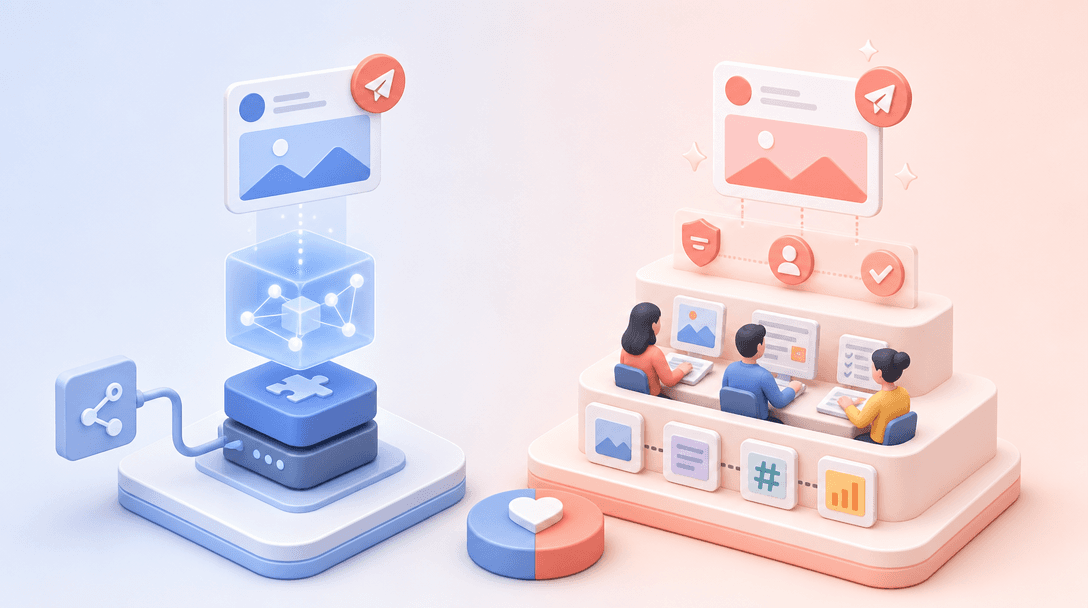
TokPortal is built for the gap between automation and organic distribution. Your system sends assets, captions, timing rules and approvals through API, MCP or SDKs; trained human operators publish through real phones with local SIM cards in 20+ countries. For teams producing AI video, UGC variants or multi-country campaigns, that architecture gives engineering control without reducing social publishing to a scheduler.
What are the limits of pure API posting to TikTok?
Pure API posting to TikTok is good for authenticated upload workflows, but it is not equivalent to posting inside the TikTok app. TikTok’s official Content Posting API is designed for approved developer use cases: upload, publish, query status and connect user authorization. It does not give brands the same creative surface as a human using the app on a real device.
The largest operational gap is native creative context. TikTok sounds, in-app edits, location tagging and last-mile visual checks are app-native behaviors. If your growth system generates 100 videos in Sora, Veo, Runway, Kling or HeyGen, the upload endpoint is only one part of the job. The harder question is whether each post lands with the right sound, caption, country, account history and timing.
For a step-by-step view of the official route, read how to post on TikTok via API in 2026. For the specific sound limitation, read how TikTok sounds work with native in-app posting.
Why does human-in-the-loop distribution beat full automation?
Human-in-the-loop distribution wins when the social platform rewards context that an endpoint cannot fully express. A trained operator can check whether a sound is available in the target country, whether the caption reads naturally, whether the uploaded creative cropped correctly, whether the location tag is appropriate and whether the account should pause before the next action.
That does not mean replacing software with manual spreadsheets. The strong model is API-controlled human execution: software handles routing, queues, files, metadata, permissions, retry logic, webhooks and reporting; people handle native app decisions and final publishing. This is the same pattern used in other high-trust infrastructure categories: automate the system of record, keep a human review layer where context matters.
TokPortal’s network operates across TikTok, Instagram and YouTube using real mobile devices, local SIM cards and human operators in 20+ countries. That matters because social platforms use more than IP address and upload time; mobile environment, location context and behavior all contribute to how organic distribution is evaluated.
Feature
API-only posting stack
API + human-in-the-loop distribution
Best use case
Creative controls
Operational control
Country execution
Failure mode
Where TokPortal fits
How should you design social pipelines with operators?
Design the pipeline as a production system, not as a shared content calendar. The asset generator, approval layer, distribution queue, operator console, device execution and analytics loop should be separate components with clear state transitions.
A clean operator pipeline has six states: created, approved, assigned, published, verified and reported. The API should own state. Operators should only see the work they need: the account, platform, video file, caption, sound instruction, publish window, country and any brand safety notes. Webhooks should move the campaign forward after each publishing event.
This is where many AI video teams stall. They can generate hundreds of clips, but the post-generation layer is still manual file transfer and ad hoc messaging. A better design is covered in the TikTok distribution infrastructure guide and the 100-account TikTok scaling playbook.
Generate and normalize assets
Export videos from your AI, UGC or editing stack into a consistent format with platform, country, language, caption and campaign metadata attached.
Approve before distribution
Route each asset through brand, legal or client approval before it enters the publishing queue. Keep approval status in your own system of record.
Create a distribution job through API
Send the asset, caption, platform, target country, account rules and publish window to the distribution layer through REST API, SDK or MCP.
Assign the job to a local operator
Match the job to the right account and real device environment so the post is published in the intended country and app context.
Publish natively and verify
The operator posts inside the real app, applies required native elements where available and confirms the live URL or status.
Trigger reporting webhooks
Use webhooks to update your CRM, dashboard, n8n flow, Make scenario, Zapier workflow or internal campaign database after completion.
What is the difference between an API posting footprint and native app posting?
An API posting footprint is the technical pattern created when content is published through an official endpoint: authorized app, upload method, exposed metadata and permitted publishing fields. Native app posting is the pattern created when a human uses the actual TikTok, Instagram or YouTube app on a physical phone.
The distinction matters because native app posting gives access to app-only features and real mobile context. On TikTok, for example, native sounds and in-app creative edits are part of how creators publish every day. On Instagram, Meta’s Content Publishing documentation exposes supported publishing flows, but brands still need native review for creative fit, caption nuance and account-level execution. On YouTube, the videos.insert endpoint is powerful, but it is still not a substitute for a complete organic distribution operation.
Use API posting when the platform endpoint supports your exact use case. Use native app distribution when the last mile affects reach, creative context or country execution.
What is the best architecture for social distribution?
The best architecture is a hybrid control plane: your software decides what should happen, and a human-in-the-loop execution layer handles the native app actions that APIs cannot express. This keeps engineering teams in control without pretending every social action should be reduced to an endpoint.
A practical stack looks like this: content generator, asset store, approval workflow, TokPortal API, operator queue, real-device publishing, webhooks, analytics and campaign reporting. The system should support idempotency, retries, publish windows, account assignment rules, client-level permissions and post-level handoff assets such as Spark Codes on TikTok and Partnership Ad Codes on Instagram.
TokPortal’s distribution platform includes content posting for TikTok, Instagram and YouTube, commenting and engagement surfaces, analytics, Spark Codes, Partnership Ad Codes, account warming and an account renting toggle for business users. Developers can build against the TokPortal REST API, SDKs and webhook documentation.
20+
countries supported with local distribution coverage
150,000+
accounts under TokPortal management
4,276
active business clients using TokPortal
6B+
organic video views generated through the network
9,000+
TikTok profiles analyzed in TokPortal benchmark indexes
Original insight: the traffic trap is not the same as buyer intent
How do webhooks and operators work together in social workflows?
Webhooks make human execution observable. Without webhooks, an operator workflow becomes a black box: a person publishes something, then someone else checks a spreadsheet. With webhooks, every state change can update the systems your team already uses.
In a TokPortal-style workflow, your application creates a job and receives event updates when the job is assigned, published, rejected, delayed or completed. Those events can trigger a Slack alert, update a client dashboard, create a task in a project management tool, move a row in Airtable or start a reporting workflow in n8n, Make or Zapier.
The important design principle is that humans should not be responsible for system memory. Operators execute the native app step; the API and webhook layer records status, timestamps, account IDs, platform URLs and downstream reporting events.
- Use the API to create posting jobs with asset, caption, platform, country and publish-window metadata
- Use operators for native app publishing, final visual checks and local execution
- Use webhooks to update campaign dashboards and internal workflow tools
- Use SDKs when your product needs repeatable distribution inside a larger software workflow
- Use MCP when AI agents need to create, inspect or route distribution jobs through natural language
How do you integrate TokPortal MCP with AI agents?
TokPortal’s MCP server lets AI agents interact with the distribution layer without forcing every instruction through a custom UI. An agent can help prepare campaign briefs, inspect job status, route approved videos, summarize outcomes and trigger distribution actions through controlled tools.
The right mental model is not “agent posts everything automatically.” The better model is agent-assisted operations with human approval and human native execution. Your agent can prepare the work; TokPortal’s API and operator network can execute the distribution step through real devices and local app environments.
If you are building in Claude, ChatGPT or an internal agent framework, start with the TokPortal MCP integration for AI agents, then connect the workflow to the developer documentation. For broader tooling context, compare options in the 2026 social media automation tools guide.
Where API-only posting is the right answer
- You only need simple scheduling for owned accounts
- The platform API exposes every field your workflow needs
- Native sounds, location tags and app-only edits are not part of the campaign
- You are publishing low-volume content in one market
- Your main requirement is a clean developer integration
Where it stops being enough
- You need TikTok sounds or native app creative controls
- You need country-specific posting from local devices
- You are distributing many AI or UGC variants across accounts
- You need human review before publishing client content
- You need post-level monetizable handoffs such as Spark Codes or Partnership Ad Codes
Build the hybrid social distribution layer
Use TokPortal’s REST API, SDKs, MCP server and webhooks to route approved content to real-device human operators across TikTok, Instagram and YouTube.
Is a social media posting API enough for TikTok distribution?+
Why add human operators if the workflow is programmable?+
Does TokPortal replace the official TikTok, Instagram or YouTube APIs?+
Can AI agents use TokPortal for social distribution?+
What countries does TokPortal support for local distribution?+
When is TokPortal not the right fit?+

Written by
Vincent Tellenne
Co-founder & CEO
Vincent is a co-founder and CEO of TokPortal. He works on the infrastructure and operating model behind scaled organic social media distribution.
Learn more about this topic with AI
Related Resources
Auto Social Media Posting: The Complete Guide
Learn how to set up auto social media posting with TokPortal. Automate TikTok & Instagram posts across real accounts in 30+ countries. Scale your content strategy today.
Best Social Media Automation Tools for 2026 [Compared]
Compare the best social media automation tools for 2026. Discover top software for scheduling, account creation, and scaling TikTok & Instagram campaigns globally.
How to Post on TikTok via API in 2026 (Step-by-Step Working Guide)
Post videos to TikTok automatically with the official Content Posting API. Working examples, auth setup, sounds, scheduling — everything that works in 2026.
How to Scale TikTok Marketing with 100+ Accounts in 2026
Learn how to scale TikTok marketing with 100+ accounts using real devices, native posting, and account warming. Complete guide for brands and agencies running multi-account organic campaigns in 2026.
TikTok Distribution at Scale: The Infrastructure Guide
Learn how to build a scalable TikTok distribution infrastructure. From account farms to geo-targeting, this guide covers everything marketing pros need to grow at scale.
How to Add TikTok Sounds via API: Native In-App Posting Explained
Learn how to add TikTok sounds via API using TokPortal's native in-app posting. Add trending sounds, control volume levels, and use carousels — all programmatically.
From the guide to your first campaign
You make the content.
TokPortal runs the account operations.
Create and operate TikTok and Instagram accounts in your target market. Local operators handle the account work and native publishing. You control the brief, content and campaign from the dashboard, API or MCP.
- 01Choose your market
- 02Define each account
- 03Schedule your content
Review market availability and pricing before ordering. No reach forecast is built into your plan.