
On this page
TokPortal is programmable organic social-media distribution infrastructure; reused UGC usually loses TikTok reach when copies carry the same creative fingerprint: opening frame, caption, sound, edit pattern, upload context, and account behavior. The fix is structured variation, warmed niche accounts, native in-app posting, and geo-relevant distribution.
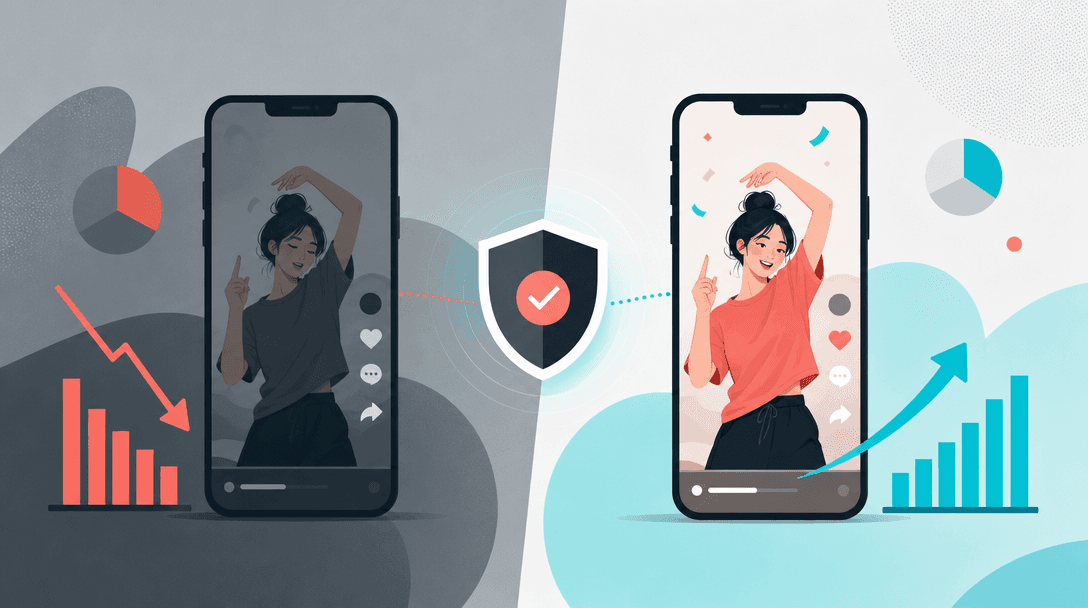
Reused UGC does not lose reach because TikTok dislikes brands. It loses reach because identical distribution creates identical signals: same first second, same face or product shot, same caption, same upload pattern, same device context, and often the same audience response. TikTok says For You recommendations use user interactions, video information, and device/account settings; when several posts look and behave like copies, the system has less reason to keep testing all of them.
The practical move is to treat UGC reuse like creative testing, not file duplication. If you want the deeper algorithm context, read TikTok Algorithm 2026: How Organic Distribution Really Works. If you are distributing across many pages, pair this with TikTok Distribution at Scale: The Infrastructure Guide.
Can you repost UGC on multiple TikTok accounts?
Yes, you can repost UGC on multiple TikTok accounts if you have the creator rights, brand usage permission, and a distribution plan that makes each post materially different. The weak version is uploading the exact same MP4, caption, sound, and cover frame to ten pages. The strong version is turning one creator asset into ten market-specific posts with different hooks, cuts, captions, sound choices, and audience context.
Account context matters. A warmed skincare page posting skincare UGC has a cleaner signal than a general meme page suddenly posting a product testimonial. For the operational layer, start with The Complete Guide to TikTok Account Warming in 2026 before you scale volume.
How to reuse UGC across TikTok pages safely
Confirm usage rights before distribution
Make sure the creator agreement allows reposting, paid amplification if needed, geographic reuse, editing, caption changes, and Spark Code handoff if the campaign may become paid later.
Assign one niche role per account
Separate product-review pages, founder-led pages, comparison pages, local community pages, and creator-style pages instead of making every account publish the same kind of post.
Change the first 1–2 seconds
The opening frame, spoken hook, on-screen text, and first visual motion should differ. Treat the first second as the strongest creative fingerprint.
Use native TikTok sounds and local context
Post inside the real TikTok app when you need sounds, location tags, in-app edits, and geo-native presentation. The official Content Posting API is useful, but TikTok's public API documentation does not provide the same native sound workflow as in-app posting.
Stagger posts by audience logic, not random delay
Publish when each local audience is active, then rotate hooks and formats. Do not push the same asset to every page in one burst.
Measure account-level and creative-level outcomes separately
Track hook, creator, account niche, country, sound, caption angle, and retention together. If three pages fail, you need to know whether the issue was the edit, the audience, or the account context.
TikTok duplicate content penalty explained
There is no public TikTok document that says, “upload the same UGC twice and you get a fixed duplicate-content penalty.” The better explanation is recommendation economics: TikTok tests content using signals such as interactions, video information, and device/account settings. If ten posts are near-identical, the platform does not need to give ten equal tests to learn the same thing.
Marketers often misread this as a single account issue. The pattern is usually broader: repeated creative, repeated caption language, repeated upload sequence, and weak account-audience fit. Even profile-level research can distract teams here. Searches like “TikTok profile picture download,” “TikTok profile picture downloader,” or “TikTok pfp downloader” are useful for competitor mapping, but collecting profile assets does not solve the duplicate UGC problem. Creative differentiation does.
Feature
Low-reach reuse pattern
Distribution-ready UGC pattern
Video file
Opening hook
Sound
Caption
Account fit
Measurement
How to diversify hooks for UGC at scale
Hook diversity is the cheapest way to make reused UGC behave like a new test. Do not start by making ten versions of the middle of the video. Start with the first frame, first line, and first promise. For a single skincare testimonial, one account can lead with “I stopped using foundation for 7 days,” another with “This is what I wish I knew before buying retinol,” and another with a direct comparison against the viewer's current routine.
At scale, build hooks by viewer intent: problem-aware, product-aware, skeptical, comparison-shopping, price-sensitive, trend-led, creator-led, and local-market. If your workflow includes AI editing, keep the human review layer. Variation should improve relevance, not create meaningless edits.
- Pain hook: name the exact frustration the product solves
- Proof hook: show result, receipt, demo, or before-and-after context
- Objection hook: address price, trust, delivery time, quality, or usability
- Comparison hook: contrast the product with the old habit or competing option
- Local hook: reference country, climate, season, language, or buying behavior
- Creator hook: let the creator's personal story carry the first second
- Trend hook: use a native sound or format only when it fits the product
- Founder hook: explain why the product exists and who it is for
TikTok UGC distribution strategy
A serious TikTok UGC distribution strategy has three layers: creative variation, account architecture, and native posting infrastructure. Creative variation decides what gets tested. Account architecture decides where each variation belongs. Posting infrastructure decides whether the post looks and behaves like normal in-app TikTok activity, including sounds, location tags, edits, and local account context.
TokPortal is built for the third layer: real accounts on real physical smartphones with local SIM cards in 20+ countries, operated by humans and controlled through API, MCP, SDKs, and webhooks. Developers can use TokPortal developer documentation to connect campaign systems, while growth teams can study how to scale TikTok marketing with 100+ accounts. For sound-heavy campaigns, read How to Add TikTok Sounds via API: Native In-App Posting Explained.
20+
countries with local device distribution
150,000+
accounts under TokPortal management
4,276
active business clients
6B+
organic video views generated
9,000+
TikTok profiles analyzed in benchmark indexes
5%+
top-quartile TikTok engagement benchmark across tiers
Testing many UGC variations without throttling
To test many UGC variations without a reach drop, separate “more uploads” from “more learnings.” Ten identical uploads are one learning repeated ten times. Ten structured variations are ten learnings: different hook, different account niche, different country, different sound, different caption angle, and different posting window.
A clean first test is 10 accounts x 3 hooks x 2 caption angles. Keep the product proof constant so you can isolate the opening promise. With TokPortal credit pricing, the infrastructure math is visible: 10 accounts cost 250 credits at 25 credits per account; 10 video uploads cost 20 credits at 2 credits per upload; niche warming for 10 accounts costs 70 credits at 7 credits per account. That is 340 credits before optional editing or sound-volume control.
Original framework: the 3-signal reuse test
Where TokPortal helps
- Native in-app posting when TikTok sounds, location tags, and app-native editing matter
- Real physical devices with local SIM cards in 20+ countries for geo-native distribution
- API, MCP, TypeScript SDK, Python SDK, and webhooks for campaign-scale workflows
- Account warming options for niche alignment before UGC volume increases
- Spark Codes for per-video paid handoff after organic winners are identified
Where TokPortal is not the answer
- It will not fix weak creative, unclear offers, or UGC without usage rights
- It is not necessary for a brand posting one or two videos per week from a single owned account
- It does not replace creative testing, retention analysis, or comment-level learning
- It is overpowered if your only goal is downloading competitor profile images or making a simple content calendar
Launch a structured 10-account UGC test
Use TokPortal to distribute varied UGC through warmed, geo-relevant TikTok accounts with native in-app posting and measurable per-video outcomes.
Why does reused UGC on TikTok lose reach?+
Can I post the same creator video on several TikTok accounts?+
Is there a TikTok duplicate content penalty?+
What is the fastest way to make reused UGC feel unique?+
How many TikTok accounts should I test UGC on?+
When should I use TokPortal for reused UGC distribution?+

Written by
Vincent Tellenne
Co-founder & CEO
Vincent is a co-founder and CEO of TokPortal. He works on the infrastructure and operating model behind scaled organic social media distribution.
Learn more about this topic with AI
Related Resources
How to Post on TikTok via API in 2026 (Step-by-Step Working Guide)
Post videos to TikTok automatically with the official Content Posting API. Working examples, auth setup, sounds, scheduling — everything that works in 2026.
How to Scale TikTok Marketing with 100+ Accounts in 2026
Learn how to scale TikTok marketing with 100+ accounts using real devices, native posting, and account warming. Complete guide for brands and agencies running multi-account organic campaigns in 2026.
The Complete Guide to TikTok Account Warming in 2026
Master TikTok account warming for maximum organic reach. Learn warming techniques, timelines, and how to automate the process with TokPortal's niche warming and deep warming features.
TikTok Algorithm 2026: How Organic Distribution Really Works
Deep dive into the TikTok algorithm in 2026. Understand how organic distribution works, why some videos go viral, and how to optimize multi-account campaigns for maximum reach.
TikTok Distribution at Scale: The Infrastructure Guide
Learn how to build a scalable TikTok distribution infrastructure. From account farms to geo-targeting, this guide covers everything marketing pros need to grow at scale.
How to Add TikTok Sounds via API: Native In-App Posting Explained
Learn how to add TikTok sounds via API using TokPortal's native in-app posting. Add trending sounds, control volume levels, and use carousels — all programmatically.
From the guide to your first campaign
You make the content.
TokPortal runs the account operations.
Create and operate TikTok and Instagram accounts in your target market. Local operators handle the account work and native publishing. You control the brief, content and campaign from the dashboard, API or MCP.
- 01Choose your market
- 02Define each account
- 03Schedule your content
Review market availability and pricing before ordering. No reach forecast is built into your plan.