
On this page
TokPortal is a programmable TikTok posting API for agencies and AI tools that need real organic distribution, not just file upload automation. It posts through real physical devices, local SIM cards, and human operators, so teams can publish TikToks with native app features such as sounds, locations, and in-app edits.
TokPortal is programmable, organic social-media distribution infrastructure — The Human API. Agencies use it when the job is bigger than scheduling one brand account: multi-client calendars, AI-generated creative variants, localized launches, Spark Code handoffs, and reporting pipelines. The official TikTok Content Posting API is useful for approved upload workflows, but it does not replace native in-app publishing when your campaign depends on sounds, locations, local account context, and human quality control.
This page is for Audience A: agencies, AI video tools, developers, and growth teams building a paid distribution workflow. If you are comparing options, start with the mechanics here, then read how to post on TikTok via API in 2026, TikTok API alternatives when the official API is not enough, and the TokPortal developer documentation.
20
countries with real-device posting coverage
150,000+
accounts under management
4,276
active business clients
6B+
organic video views generated
How to post to TikTok via API with real devices
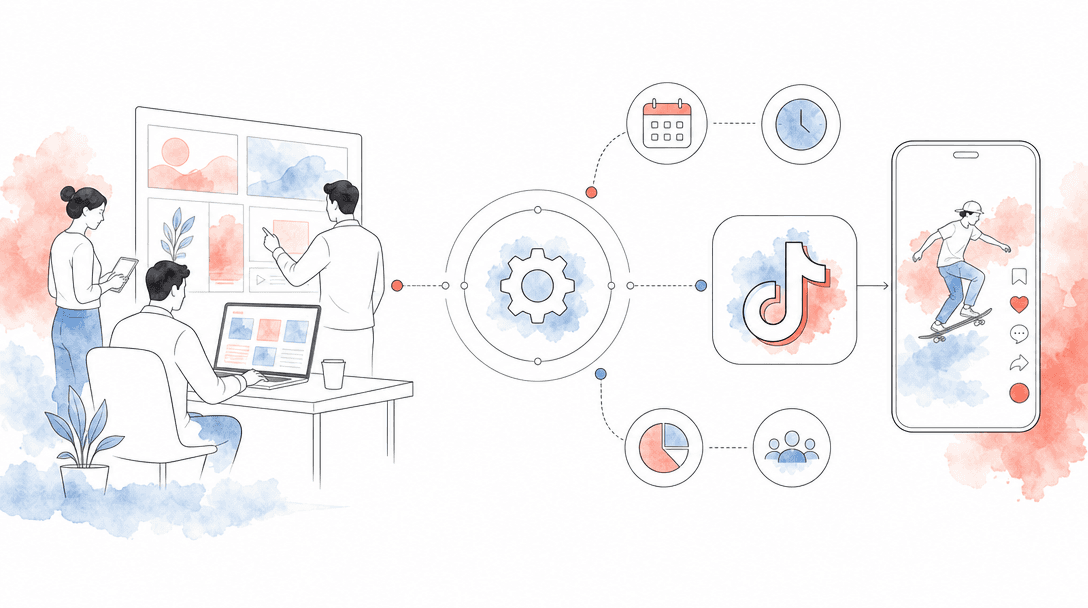
To post to TikTok via API with real devices, your software sends the video asset, caption, account target, timing rules, and optional metadata to TokPortal. TokPortal routes the job to a real smartphone with the TikTok app installed, a local SIM card, and a trained human operator who completes the native in-app posting flow.
The difference is where the final publish action happens. The official TikTok Content Posting API is an API-to-platform workflow documented by TikTok. TokPortal is an API-to-real-device workflow: your system still gets an endpoint, webhook status, SDKs, and automation, but the publish step happens inside the TikTok app on a physical device. That is why native sounds, location tags, in-app edits, and real account context can be part of the workflow.
The minimum object for an agency pipeline is: account ID, video URL or upload, caption, publish window, market, optional sound instructions, optional location, and callback URL. For a deeper infrastructure view, see TikTok distribution at scale infrastructure.
Create or connect the TikTok accounts
Add the accounts your agency owns or is approved to operate. TokPortal supports real accounts on real physical smartphones with local SIM cards across 20 countries.
Warm accounts before heavy publishing
Use niche warming before scaling a content category. TokPortal prices niche warming at 7 credits per account so posting starts from a relevant behavioral baseline.
Upload the video asset through API or SDK
Send the video file, caption, account target, market, and scheduling rules through the REST API, TypeScript SDK, Python SDK, or an automation tool such as n8n, Make, or Zapier.
Route the job to native in-app posting
TokPortal assigns the task to a real device and human operator. The operator publishes inside the TikTok app, including native sound, location, and edit instructions when required.
Receive webhook updates
Your system receives status events such as queued, assigned, posted, needs-review, or failed-validation, so your client dashboard stays in sync.
Collect analytics and campaign handoffs
Use post URLs, view data, account-level analytics, and Spark Codes for client reporting and paid amplification handoffs where relevant.
How to integrate TikTok posting into AI video tools
AI video tools need a post-generation layer. Sora, Veo, Kling, Runway, Pika, Arcads, Creatify, Captions, HeyGen, Topview, and similar systems can generate far more creative than a human social team can publish manually. The commercial gap is not video creation; it is controlled distribution across the right accounts, markets, sounds, and calendars.
A practical integration pattern is simple: your AI tool generates 20 to 200 clips, scores them, stores the winning assets, then sends approved clips to TokPortal with account and market rules. For example, an AI-UGC tool can push English variants to accounts in the USA, UK, Canada, and Australia, then send localized versions to Brazil, France, Germany, Spain, Mexico, Japan, and the Philippines.
If your app already offers utility features such as TikTok profile picture download, TikTok profile picture downloader, or TikTok pfp downloader, treat those as top-of-funnel creator utilities. The buyer-grade feature is different: authenticated campaign publishing, account routing, approvals, webhook status, and reporting. That is the path from free utility traffic to agency revenue.
For AI-agent workflows, pair this page with TokPortal MCP for AI agents and the TokPortal API docs.
Webhook based TikTok posting pipeline
A webhook based TikTok posting pipeline lets an agency run posting operations without asking account managers to refresh dashboards all day. Your system submits a job, stores the TokPortal job ID, and listens for status updates. When a video is posted, the webhook can update Airtable, Notion, HubSpot, a client portal, or a custom BI dashboard.
The clean event model is: submitted, queued, assigned, scheduled, posted, needs-client-approval, failed-validation, and analytics-ready. Agencies should also store the final TikTok URL, account handle, market, campaign ID, creative ID, caption version, sound instruction, and post timestamp. This makes reporting defensible when a client asks which creative, which account, and which market produced a result.
TokPortal supports REST API access, webhooks, TypeScript and Python SDKs, and automation integrations. If your team does not want to write custom middleware, use the no-code routes for n8n TikTok posting automation, Make workflows, or Zapier automations.
Feature
Official TikTok Content Posting API
TokPortal real-device posting API
Best fit
Publish surface
Native sounds
Location context
Agency scale
Developer workflow
How to schedule TikToks via API across 100 accounts
To schedule TikToks via API across 100 accounts, do not think in single posts. Think in campaign batches. A useful agency batch contains: campaign ID, client ID, creative group, account pool, country, posting window, language, caption variant, sound instruction, and reporting label.
Worked example: an agency launching a D2C product in four markets uses 100 TikTok accounts: 40 USA, 20 UK, 20 Canada, and 20 Australia. If the agency publishes one video per account, TokPortal charges 2 credits per video upload, so the upload layer is 200 credits. If 30 newer accounts need niche warming first, add 7 credits per account, or 210 credits. The total operational plan is 410 credits before optional editing, sound-volume control, or deeper services.
The reason to use 100 accounts is not to duplicate the same post blindly. It is to test hooks, creators, captions, markets, and content angles with enough surface area to learn. TokPortal’s TikTok benchmark index of 9,000+ profiles shows average engagement around 6.2% for 1K–10K follower accounts, 4.8% for 10K–100K, 3.5% for 100K–1M, and 2.2% for 1M+; smaller and mid-sized pages can still be valuable distribution surfaces when the content-market fit is strong.
For calendar design, use the 100+ account TikTok scaling guide and best time to post on TikTok by country.
Original agency benchmark: scale needs routing, not just more uploads
MCP server for TikTok posting agents
An MCP server lets AI agents interact with TikTok distribution as a tool instead of a static dashboard. In practice, a Claude, ChatGPT, or internal agent can prepare a campaign, check available accounts, select countries, draft captions, submit approved posts, and monitor webhook results through TokPortal’s MCP interface.
The right use case is supervised execution. Let the agent generate campaign plans, identify missing metadata, prepare payloads, and summarize performance. Keep approval rules, account access, brand safety, and budget limits explicit. For example, an agency agent can be allowed to submit drafts under a client campaign but require human approval before any publish job moves to the real-device queue.
This is especially useful for AI video tools because generation and distribution can live in the same workflow: generate clips, classify niche, assign target market, select account pool, submit posting job, then summarize published URLs and early analytics. Start with the MCP AI agents integration and the developer portal.
What agencies should build before calling the API
- Client-level campaign IDs for every post
- Account pools grouped by country, niche, language, and client approval status
- Creative IDs that map every TikTok to the source video, prompt, creator, or editor
- Caption versioning so hooks and offers can be compared later
- Posting windows by country instead of one global schedule
- Webhook storage for final TikTok URLs and status history
- Approval rules for sensitive niches, regulated claims, and paid amplification handoffs
- Reporting labels for Spark Codes, UGC tests, and creator-style variants
When TokPortal is the right API layer
- You need native in-app posting with TikTok sounds, locations, and edits.
- You manage many client accounts or country-specific campaigns.
- Your AI video tool generates more content than customers can publish manually.
- You need REST API, SDKs, webhooks, MCP, and human-in-the-loop quality control.
- You want per-video handoffs such as Spark Codes for client monetization or paid amplification.
When TokPortal is not the right answer
- You only need to publish occasionally to one owned brand account.
- Your workflow is fully covered by TikTok’s official Content Posting API.
- You do not have approval rights for the accounts you want to use.
- You are looking for a free creator utility rather than paid distribution infrastructure.
- You do not have enough creative volume to learn from multi-account testing.
Agency implementation checklist
Before your developers start shipping endpoints, lock the operating model. Decide which clients are allowed to use which accounts, which countries matter, who approves captions, which sounds are allowed, and what happens when a post needs review. The API should encode the agency’s rules, not create a second operations layer.
- Account readiness: confirm account ownership, access rights, country, niche, and warming status.
- Creative readiness: require final video URL, caption, language, aspect ratio, and campaign label.
- Routing: map creative variants to country, account pool, and posting window.
- Publishing: submit jobs through REST, SDK, MCP, n8n, Make, or Zapier.
- Feedback: store webhook events, post URLs, analytics, and Spark Code status.
For the content and algorithm side, pair this technical workflow with TikTok Algorithm 2026, the TikTok account warming guide, and how to add TikTok sounds via API using native posting.
Build your agency TikTok posting pipeline
Use TokPortal’s REST API, SDKs, webhooks, and MCP server to publish TikToks through real devices across 20 countries.
What is a programmatic TikTok posting API for agencies?+
Can the official TikTok Content Posting API add native TikTok sounds?+
How many accounts can an agency schedule through TokPortal?+
Does TokPortal support webhooks and SDKs?+
How should AI video tools integrate TikTok posting?+
Is TokPortal useful if I only need a TikTok profile picture downloader?+

Written by
Vincent Tellenne
Co-founder & CEO
Vincent is a co-founder and CEO of TokPortal. He works on the infrastructure and operating model behind scaled organic social media distribution.
Learn more about this topic with AI
Related Resources
Auto Social Media Posting: The Complete Guide
Learn how to set up auto social media posting with TokPortal. Automate TikTok & Instagram posts across real accounts in 30+ countries. Scale your content strategy today.
How to Post on TikTok via API in 2026 (Step-by-Step Working Guide)
Post videos to TikTok automatically with the official Content Posting API. Working examples, auth setup, sounds, scheduling — everything that works in 2026.
How to Scale TikTok Marketing with 100+ Accounts in 2026
Learn how to scale TikTok marketing with 100+ accounts using real devices, native posting, and account warming. Complete guide for brands and agencies running multi-account organic campaigns in 2026.
TikTok API Alternatives: When the Official API Isn't Enough
Explore the best TikTok API alternatives for content posting, account management, and automation. Learn when the official API falls short and what to use instead.
TikTok Distribution at Scale: The Infrastructure Guide
Learn how to build a scalable TikTok distribution infrastructure. From account farms to geo-targeting, this guide covers everything marketing pros need to grow at scale.
How to Add TikTok Sounds via API: Native In-App Posting Explained
Learn how to add TikTok sounds via API using TokPortal's native in-app posting. Add trending sounds, control volume levels, and use carousels — all programmatically.
From the guide to your first campaign
You make the content.
TokPortal runs the account operations.
Create and operate TikTok and Instagram accounts in your target market. Local operators handle the account work and native publishing. You control the brief, content and campaign from the dashboard, API or MCP.
- 01Choose your market
- 02Define each account
- 03Schedule your content
Review market availability and pricing before ordering. No reach forecast is built into your plan.