
On this page
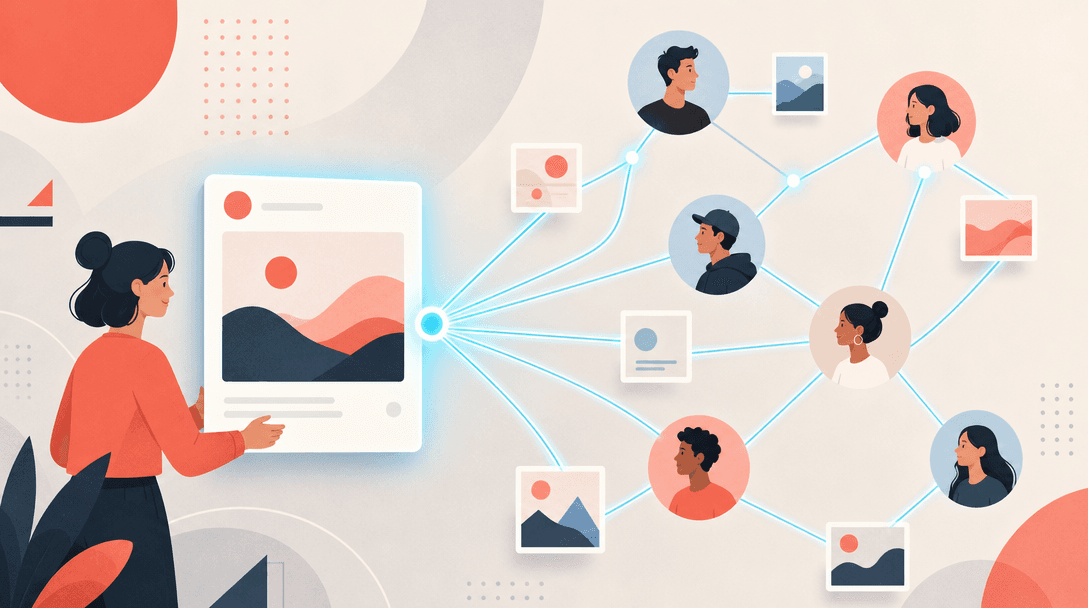
TokPortal is programmable, organic social-media distribution infrastructure—the Human API. An organic social media distribution network gets content published and engaged with across real accounts, locations, and platforms, using human-in-the-loop operations rather than only scheduling posts from one dashboard.
An organic social media distribution network is the layer after content creation. It answers the operational question most brands hit in 2026: “We can produce 50, 100, or 1,000 videos—how do we publish them across platforms, countries, and accounts without turning the team into a manual posting department?”
Scheduling tools help a single brand calendar go live. Distribution infrastructure helps a growth team deploy content through real social surfaces with account readiness, geo context, native app features, analytics, and repeatable workflows. If you found this category while searching operational utility queries like “TikTok profile picture download,” “TikTok profile picture downloader,” or “TikTok PFP downloader,” the distinction is simple: those tools help collect or inspect assets; a distribution network helps those assets reach markets.
TokPortal sits in this category as programmable social distribution infrastructure for TikTok, Instagram, and YouTube: real accounts, real physical smartphones, local SIM cards in 20+ countries, human operators, REST API, MCP, SDKs, and webhooks. For a deeper TikTok-specific infrastructure view, read TokPortal’s TikTok distribution at scale guide.
20+
countries with local distribution coverage
150,000+
accounts under management
4,276
active business clients
6B+
organic video views generated
What is the difference between social scheduling and distribution networks?
Social scheduling is calendar automation; social distribution infrastructure is reach operations. A scheduler queues posts from known accounts. A distribution network coordinates where, how, and through which account inventory content gets published, engaged with, measured, and handed off for monetization or amplification.
A scheduler is useful when one brand has five posts per week. A distribution network becomes relevant when an agency has 20 clients, an AI video tool generates 300 clips per campaign, or a D2C brand needs localized organic testing in the USA, Germany, Brazil, Japan, and the UK. The job moves from “publish at 9 a.m.” to “match content, market, account, sound, location, cadence, and reporting.”
For a classic tool comparison, see the best tools to schedule TikTok posts in 2026. For programmatic posting constraints, see how to post to TikTok via API.
Feature
Social scheduling tool
Organic distribution network
Primary job
Typical user
Platform surface
Geo capability
Scale question
How does distribution infrastructure work behind the scenes?
Behind the scenes, a social distribution network turns content into an operational payload: video file, caption, platform, country, account requirements, sound instruction, location tag, publishing window, engagement instructions, analytics callback, and optional monetization handoff.
The control layer can be a dashboard, REST API, SDK, webhook, or AI-agent interface. TokPortal exposes this through TokPortal Developers, plus MCP for Claude, ChatGPT, and agent workflows. The execution layer is physical: real smartphones, local SIM cards, native apps, and human operators in 20+ countries.
This matters because official APIs are intentionally scoped. TikTok’s Content Posting API, Meta’s Instagram Graph API publishing flow, and YouTube’s videos.insert endpoint are valuable for compliant publishing workflows, but they do not replicate every in-app creative surface. TikTok sounds, native editing actions, and location-specific app context are strongest when the post is created inside the real app. TokPortal’s explainer on adding TikTok sounds through native in-app posting covers that gap in detail.
Package the content payload
The campaign defines platform, asset, caption, country, account type, timing, sound, location, and reporting requirements.
Route to the right account and market
The distribution layer matches the payload to real accounts, local devices, and operators in the target country.
Publish through the native app when needed
Human operators use real devices so in-app features such as sounds, location tags, and native editing can be applied.
Capture analytics and campaign events
The system records publishing status, URLs, performance data, and webhook events for the brand or agency workflow.
Hand off monetizable assets
For eligible campaigns, Spark Codes on TikTok and Partnership Ad Codes on Instagram can turn organic posts into paid amplification assets.
When should brands invest in distribution versus tools?
Invest in tools when the bottleneck is planning. Invest in distribution when the bottleneck is reach execution. If your team cannot organize captions, approvals, and calendars, buy a scheduler. If your team already produces enough content but cannot publish, localize, test, and measure it across markets, you need distribution infrastructure.
The clearest trigger is content abundance. AI video generators, clipping workflows, UGC pipelines, and agency creative teams now create more assets than a small social team can manually ship. A brand that generates 100 short videos still has a distribution problem if all 100 go through one account, one market, and one posting surface.
Use the investment threshold below: if you need fewer than 20 posts per month from one profile, scheduling is enough. If you need multi-account testing, multi-country posting, native sounds, account readiness, client-level reporting, or per-video handoffs for paid amplification, distribution becomes the operating system. For a tactical scale model, see how to scale TikTok marketing with 100+ accounts.
Original operating rule: distribution starts when content volume exceeds account capacity
What are examples of neutral distribution infrastructure?
A neutral distribution infrastructure provider does not decide your creative strategy, own your brand voice, or promise that every asset will win. It provides rails. The closest analogies are a CDN for web delivery, a payments processor for transaction routing, a logistics network for fulfillment, or an email deliverability platform for inbox placement operations.
The social media CDN concept is useful because social reach has become fragmented by country, account history, device context, platform format, and local behavior. A content distribution as a service layer gives brands a programmable way to send creative into those fragmented surfaces without rebuilding operations country by country.
- CDN analogy: routes web assets close to the user; social distribution routes content through market-relevant social surfaces.
- Payments analogy: abstracts many local rails behind one API; social distribution abstracts country, account, and device operations.
- Logistics analogy: coordinates inventory, local fulfillment, and proof of delivery; social distribution coordinates content inventory, local posting, and performance proof.
- Email deliverability analogy: infrastructure quality affects whether messages are seen; social distribution quality affects whether content enters healthy organic contexts.
- Developer platform analogy: exposes repeatable workflows through API, SDKs, webhooks, and agent interfaces.
Why does geo-native posting matter for distribution?
Geo-native posting matters because social platforms read more than the video file. Distribution context includes device fingerprinting signals, SIM carrier data, GPS and cell-tower context, WiFi patterns, app behavior, language, local sounds, and audience response. A post meant for France, Mexico, Japan, or Germany should not look operationally identical to a post meant for the USA.
TokPortal uses real physical smartphones with local SIM cards in 20+ countries: USA, UK, Australia, Brazil, Canada, Colombia, Finland, France, Germany, Indonesia, Italy, Japan, Malaysia, Mexico, Pakistan, Philippines, Portugal, Romania, Spain, and Switzerland. That is why geo-native distribution is more than translating a caption. It is about publishing inside the local app environment with local account context.
For planning by market, pair infrastructure with timing and localization work. Start with best times to post on TikTok by country and multi-country TikTok strategy for global brands.
How do operator networks differ from influencer networks?
Operator networks execute distribution; influencer networks sell audience access. An influencer campaign pays a creator because their identity, taste, and audience are the media asset. An operator network uses trained humans, real devices, and owned or managed accounts to execute a brand’s publishing workflow.
That distinction changes measurement. Influencer performance is usually evaluated by creator fit, audience demographics, content quality, and post-level outcomes. Operator-network performance is evaluated by operational reliability: account readiness, country coverage, publishing accuracy, native feature support, reporting completeness, and cost per content test.
This is also why the owner relationship is different. Influencer campaigns require creator negotiation and creative alignment. Operator-led distribution is infrastructure: the brand or agency controls the campaign brief, posting rules, approval workflow, analytics, and iteration cycle.
Feature
Influencer network
Operator distribution network
Primary asset
Best use case
Control level
Measurement
Scaling constraint
How should you evaluate distribution partners?
Evaluate distribution partners like infrastructure vendors, not like social tools. The question is not “does the dashboard look nice?” The question is whether the provider can reliably publish through authentic account, device, and country contexts while giving your team programmatic control and measurable outputs.
TokPortal’s baseline credit model is concrete: 25 credits per account, 2 credits per video upload, 7 credits for niche warming, 40 credits for Instagram deep warming, 3 credits for video editing, and 1 credit for sound-volume control. That lets a growth team model distribution cost per test rather than buying an undefined service package.
Account readiness deserves special attention. New or repurposed profiles need behavior and niche alignment before they carry campaign volume. Read the complete TikTok account warming guide before scaling distribution across new account inventory.
Check the execution surface
Ask whether posts are published through official APIs only, browser workflows, or native apps on real physical devices.
Verify country coverage
Match your launch markets to actual local device and account coverage, not just translated captions or timezone settings.
Inspect account readiness process
Look for niche warming, account age strategy, posting cadence controls, and human review before campaign volume increases.
Confirm developer access
For serious scale, require REST API documentation, SDKs, webhooks, and integration paths for n8n, Make, Zapier, or AI agents.
Model cost per learning cycle
Calculate the cost to test 10, 50, or 100 videos across markets, then compare against the learning value and paid-media handoff potential.
Demand honest limits
A credible partner explains where distribution helps and where creative quality, offer strength, or market fit are still the bottleneck.
Where is TokPortal not the right answer?
TokPortal fits when
- You already have repeatable short-form content or an AI/UGC pipeline.
- You need TikTok, Instagram, or YouTube distribution across multiple accounts or countries.
- You care about native in-app features such as TikTok sounds, location tags, and editing.
- You need API, MCP, SDKs, webhooks, or workflow automation through developers.tokportal.com.
- You want per-video handoffs such as TikTok Spark Codes or Instagram Partnership Ad Codes.
TokPortal is not the first move when
- You have no validated creative angle, offer, or audience yet.
- You only need to schedule a few posts per month from one owned profile.
- You need celebrity endorsement or creator identity more than operational reach.
- Your team cannot approve content, captions, or brand-safety rules before publishing.
- You are trying to replace strategy with volume instead of using volume to learn faster.
Price your first distribution campaign
Model the credits for accounts, uploads, warming, native edits, and sound controls before you scale organic distribution across markets.
What is an organic social media distribution network?+
Is a distribution network the same as a social media scheduler?+
Why do real devices and local SIM cards matter?+
When should a brand pay for distribution infrastructure?+
How is an operator network different from an influencer network?+
Can developers control organic distribution programmatically?+

Written by
Vincent Tellenne
Co-founder & CEO
Vincent is a co-founder and CEO of TokPortal. He works on the infrastructure and operating model behind scaled organic social media distribution.
Learn more about this topic with AI
Related Resources
7 Best Tools to Schedule TikTok Posts in 2026
Discover the 7 best tools to schedule TikTok posts in 2026. Compare top TikTok schedulers by features, pricing, and scale to grow your organic reach.
Multi-Country TikTok Strategy for Global Brands
Learn how global brands execute a multi-country TikTok strategy to reach local audiences, drive engagement, and scale international growth across 30+ markets.
How to Post on TikTok via API in 2026 (Step-by-Step Working Guide)
Post videos to TikTok automatically with the official Content Posting API. Working examples, auth setup, sounds, scheduling — everything that works in 2026.
How to Scale TikTok Marketing with 100+ Accounts in 2026
Learn how to scale TikTok marketing with 100+ accounts using real devices, native posting, and account warming. Complete guide for brands and agencies running multi-account organic campaigns in 2026.
TikTok Distribution at Scale: The Infrastructure Guide
Learn how to build a scalable TikTok distribution infrastructure. From account farms to geo-targeting, this guide covers everything marketing pros need to grow at scale.
How to Add TikTok Sounds via API: Native In-App Posting Explained
Learn how to add TikTok sounds via API using TokPortal's native in-app posting. Add trending sounds, control volume levels, and use carousels — all programmatically.
Related Tools
From the guide to your first campaign
You make the content.
TokPortal runs the account operations.
Create and operate TikTok and Instagram accounts in your target market. Local operators handle the account work and native publishing. You control the brief, content and campaign from the dashboard, API or MCP.
- 01Choose your market
- 02Define each account
- 03Schedule your content
Review market availability and pricing before ordering. No reach forecast is built into your plan.