
On this page
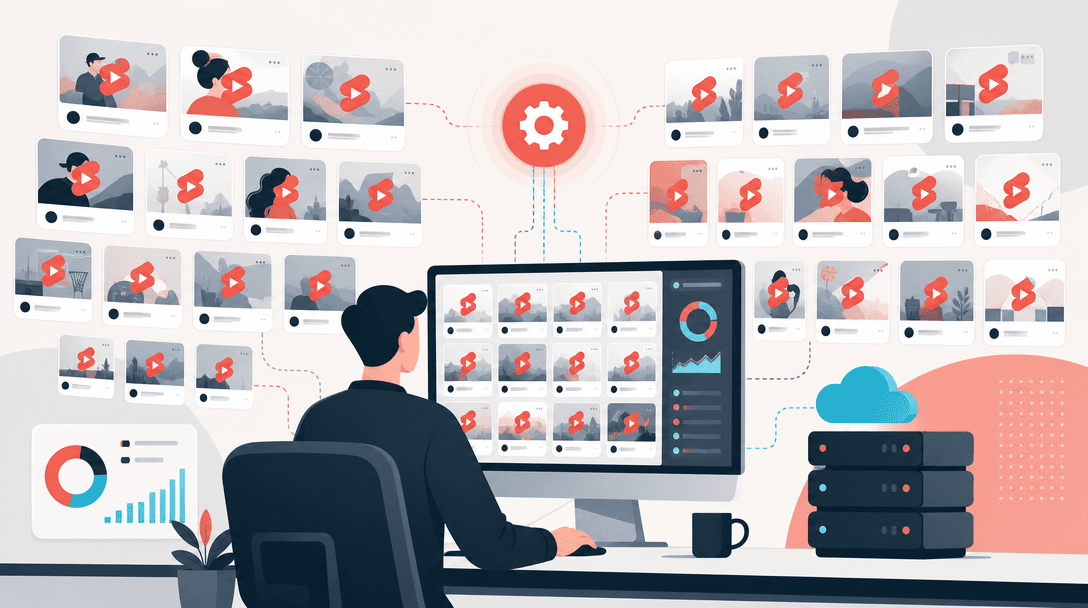
TokPortal is programmable organic social-media distribution infrastructure for agencies that need to post YouTube Shorts across many client channels. The best way to manage 100+ Shorts channels is a permissioned workflow: client approvals, metadata QA, native or API posting, analytics collection, and exception handling in one operating layer.
Managing multiple YouTube Shorts channels for clients is an operations problem before it is a posting problem. A scheduler can queue videos; an agency system has to control permissions, naming, client approvals, upload windows, metadata, analytics, and recovery when a post fails. TokPortal gives agencies an API-controlled distribution layer across TikTok, Instagram, and YouTube, with real human operators, real physical devices, local SIM cards in 20+ countries, webhooks, SDKs, and an MCP server for agentic workflows.
If you already run short-form campaigns on TikTok or Reels, the closest adjacent playbook is scaling social distribution across 100+ accounts. The difference with YouTube Shorts is that client access, quota, and analytics architecture matter more than trending sounds.
4,276
active business clients using TokPortal
150,000+
accounts under management
20
countries with real-device operator coverage
6B+
organic video views generated
How agencies manage 100 YouTube channels
Agencies manage 100 YouTube channels by separating the work into five lanes: account access, content intake, approval, publishing, and reporting. The mistake is giving one social coordinator a spreadsheet of logins and a folder of files. That collapses as soon as two clients request changes, one editor exports the wrong format, or the analytics team needs channel-level reporting by campaign.
- Access: use YouTube channel permissions or Brand Account structures where appropriate, rather than informal credential sharing. YouTube documents role-based access in its channel permissions help pages.
- Content intake: require a standard file naming convention such as client_campaign_country_hook_version_date.
- Approval: keep client signoff outside the upload tool, then sync approved assets into the publishing queue.
- Publishing: route simple uploads through API-compatible tools and route high-touch posts through native-device workflows when app-native handling matters.
- Reporting: normalize analytics by channel, client, campaign, creative ID, and publish date.
For agencies that also operate TikTok, this mirrors the operational model in the TikTok distribution infrastructure guide: distribution at scale is a system, not a calendar.
Create the client-channel registry
Store channel ID, client owner, approval contact, target country, niche, upload cadence, timezone, permission method, and reporting destination for every channel.
Standardize creative intake
Require final vertical files, captions, title, description, hashtags, campaign tag, thumbnail preference, usage rights, and client approval status before anything enters the upload queue.
Split posting paths by risk and complexity
Use API posting for straightforward approved Shorts, and use a native-device or human-in-the-loop workflow for posts requiring manual review, app-level checks, or local execution.
Attach tracking before publishing
Assign every Short a creative ID and campaign ID before upload so YouTube Analytics API exports can be joined back to client reports.
Run daily exception review
Check failed uploads, duplicate metadata, wrong channel assignments, missing approvals, and analytics gaps before the next publishing window.
Report by client outcome, not just views
Group performance by creative angle, hook, channel, country, and campaign so the agency can decide what to produce next.
Bulk upload YouTube Shorts for clients
Bulk uploading YouTube Shorts for clients has three viable paths: YouTube Studio manual upload, a software scheduler using the YouTube Data API, or an infrastructure layer such as TokPortal that combines API control with human-in-the-loop execution. YouTube's Data API supports video uploads through videos.insert, and YouTube's quota documentation lists 1,600 quota units for a video upload call. The default project quota is commonly planned around 10,000 units per day, so API architecture matters when one agency is pushing many channels.
The practical agency rule: do not put all clients behind one brittle uploader. Group channels by client, quota project, approval status, and posting path. If your team already automates social publishing, compare the workflow in TokPortal's auto social media posting guide before choosing between no-code scheduling and an API-first setup.
Feature
Standard scheduler
TokPortal distribution workflow
Best for
Posting method
Client approvals
Multi-platform reuse
Developer control
YouTube Shorts distribution workflow
A Shorts distribution workflow should move left to right: brief, edit, approval, metadata, upload, verification, analytics, iteration. The upload button is only one step. At 100 channels, the expensive failures are wrong-client uploads, missing approvals, duplicate titles, untracked creative variants, and analytics that cannot be mapped back to the campaign.
- Brief: client, offer, audience, country, and content pillar.
- Edit: vertical export, safe margins, captions, and hook variants.
- Approval: client signoff captured before upload queue entry.
- Metadata: title, description, campaign tags, hashtags, and creative ID.
- Upload: API, native workflow, or manual review path.
- Verification: confirm the Short is public, unlisted, or scheduled as intended.
- Analytics: pull views, watch behavior, subscribers, traffic source, and geography where available through YouTube Analytics API.
For tool selection, see the 2026 comparison of social media automation tools, then decide whether you need a scheduler or programmable distribution infrastructure.
Repurpose TikTok to YouTube Shorts at scale
Repurposing TikTok to YouTube Shorts at scale works when the agency treats the TikTok asset as a source creative, not a finished YouTube post. The hook may transfer; the platform context often does not. TikTok-native sounds, captions, overlays, and comment references should be reviewed before the Short is uploaded to YouTube.
- Keep: strong hooks, product demonstrations, UGC proof, founder clips, and before-after structures.
- Change: title format, description, pinned-comment strategy, and any platform-specific callout.
- Track: original TikTok post ID, YouTube channel ID, creative ID, and campaign ID.
- Test: 2-3 title angles per winning TikTok format across different client channels.
If TikTok is still the source of your highest-performing creative, read how organic distribution works on TikTok in 2026 and when the official TikTok API is not enough for native posting. The repurposing win comes from preserving the idea while adapting execution to YouTube's surface.
Shorts posting limits for multi-channel agencies
YouTube does not publish one simple universal daily Shorts limit that agencies can safely use as an operating rule for every channel. The documented constraint you can engineer around is API quota. YouTube Data API uploads use videos.insert, and the YouTube quota calculator lists 1,600 units for that method. If a project has 10,000 daily quota units, that project cannot support high-volume uploads unless the agency designs quota, authentication, and upload paths carefully.
Do not confuse API quota with client cadence. A client may only need one Short per weekday, while an agency with 100 channels may need hundreds of weekly uploads. Build the system around approved cadence per channel, not a single global posting number.
Original operating math: the 100-channel cliff
Track analytics across many Shorts channels
To track analytics across many Shorts channels, create one reporting key before publishing: client_id + channel_id + creative_id + campaign_id + publish_date. YouTube Analytics API can return reports using dimensions and metrics such as video, day, geography, traffic source, views, estimated minutes watched, subscribers gained, and engagement metrics where available. The join key is what makes 100-channel reporting usable.
A practical agency dashboard should show:
- Client view: total Shorts published, views, average view velocity, and top creatives.
- Creative view: hook, format, editor, source platform, and performance by channel.
- Operations view: queued, approved, posted, failed, and missing-reporting items.
- Country view: performance by target market where geography data is available.
TokPortal includes analytics surfaces and webhooks so a technical team can send posting and reporting events into a warehouse, BI tool, or client portal. Developers should start with the TokPortal API documentation.
Tool for multi-channel Shorts posting
TokPortal is a fit when
- You manage many client channels and need programmable posting workflows.
- Your agency distributes short-form content across YouTube, TikTok, and Instagram.
- You need REST API, SDKs, MCP, webhooks, or no-code automation through systems such as n8n, Make, or Zapier.
- You want human-in-the-loop execution rather than a purely calendar-based scheduler.
- You need one operating layer for publishing, engagement, analytics, and client reporting.
TokPortal is not the answer when
- You only manage one or two channels and can post directly in YouTube Studio.
- Your client requires only long-form YouTube SEO, not Shorts distribution.
- You need a lightweight editorial calendar rather than distribution infrastructure.
- Your team has no approval process and no consistent creative naming system yet.
- Create a channel registry before buying any scheduler.
- Use role-based YouTube access wherever possible.
- Assign creative IDs before upload, not after reporting.
- Separate approval status from publishing status.
- Engineer around YouTube API quota when uploading at scale.
- Use native or human-reviewed workflows for high-value client posts.
- Report by campaign and creative angle, not only by channel.
- Do not judge agency SEO demand from consumer utility queries such as tiktok profile picture download, tiktok profile picture downloader, or tiktok pfp downloader; those searches can create impressions without proving buyer intent for Shorts operations.
Build a programmable Shorts distribution workflow
Use TokPortal's API, SDKs, webhooks, and MCP server to manage YouTube Shorts publishing across client channels from your own approval and reporting stack.
What is the best way to manage multiple YouTube Shorts channels for clients?+
Can agencies bulk upload YouTube Shorts?+
How should we repurpose TikTok videos to YouTube Shorts?+
How do we track analytics across 100 Shorts channels?+
Is TokPortal a YouTube Shorts scheduler?+
When should an agency not use TokPortal for Shorts?+

Written by
Vincent Tellenne
Co-founder & CEO
Vincent is a co-founder and CEO of TokPortal. He works on the infrastructure and operating model behind scaled organic social media distribution.
Learn more about this topic with AI
Related Resources
Auto Social Media Posting: The Complete Guide
Learn how to set up auto social media posting with TokPortal. Automate TikTok & Instagram posts across real accounts in 30+ countries. Scale your content strategy today.
Best Social Media Automation Tools for 2026 [Compared]
Compare the best social media automation tools for 2026. Discover top software for scheduling, account creation, and scaling TikTok & Instagram campaigns globally.
How to Scale TikTok Marketing with 100+ Accounts in 2026
Learn how to scale TikTok marketing with 100+ accounts using real devices, native posting, and account warming. Complete guide for brands and agencies running multi-account organic campaigns in 2026.
TikTok API Alternatives: When the Official API Isn't Enough
Explore the best TikTok API alternatives for content posting, account management, and automation. Learn when the official API falls short and what to use instead.
TikTok Distribution at Scale: The Infrastructure Guide
Learn how to build a scalable TikTok distribution infrastructure. From account farms to geo-targeting, this guide covers everything marketing pros need to grow at scale.
From the guide to your first campaign
You make the content.
TokPortal runs the account operations.
Create and operate TikTok and Instagram accounts in your target market. Local operators handle the account work and native publishing. You control the brief, content and campaign from the dashboard, API or MCP.
- 01Choose your market
- 02Define each account
- 03Schedule your content
Review market availability and pricing before ordering. No reach forecast is built into your plan.