
On this page
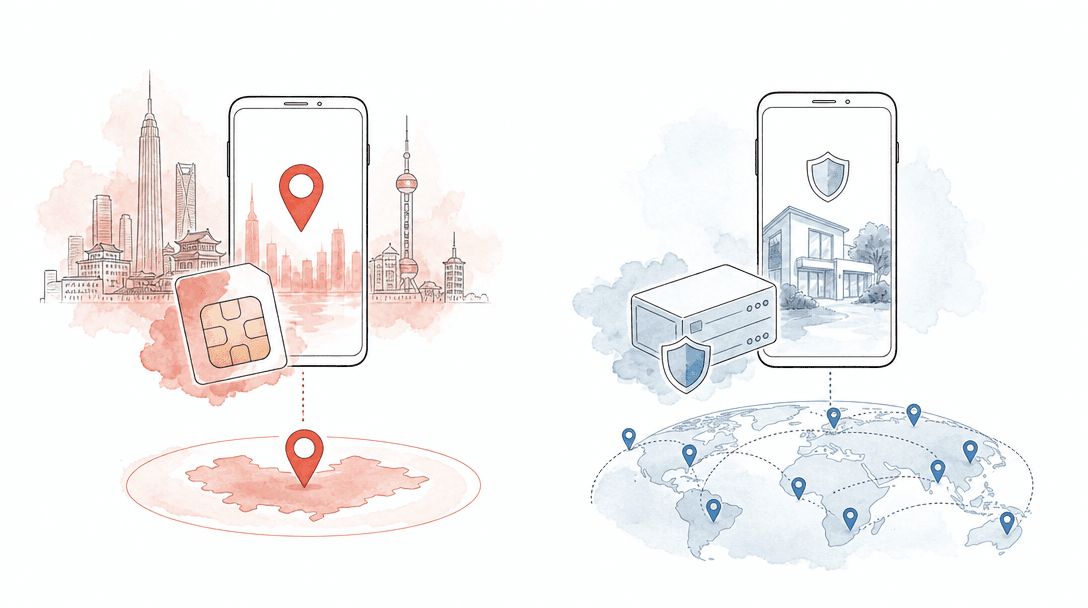
TokPortal is programmable organic social-media distribution infrastructure that uses real devices, local SIM cards, and human operators for geo-native TikTok posting. For authentic TikTok geo reach, a local SIM on a physical phone is stronger than a residential proxy because TikTok can read more than IP: carrier, device, GPS, WiFi, and behavior signals.
Local SIM beats residential proxy when the goal is authentic TikTok geo reach. A residential proxy changes the visible IP location, but TikTok can also receive device, network, app, and location signals described in its own privacy documentation. For brands, agencies, AI video tools, and growth teams, the practical choice is simple: use proxies for lightweight research workflows; use real local devices with local SIMs when the post itself must carry geo-native context.
TokPortal runs this as distribution infrastructure: real accounts on real smartphones, local SIM cards in 20+ countries, and human operators posting inside TikTok. If your team is building a campaign pipeline, pair this guide with the TikTok distribution infrastructure guide and the TokPortal developer docs.
20
countries with local TokPortal device coverage
150,000+
accounts under TokPortal management
4,276
active business clients using TokPortal
6B+
organic video views generated through TokPortal
Does a local SIM improve TikTok FYP targeting?
Yes, a local SIM can improve the consistency of TikTok For You Page distribution because it aligns the account’s network identity with the target country. It is not the only signal. TikTok can use app activity, device data, approximate location, IP address, carrier information, language, and engagement behavior, according to TikTok’s privacy documentation.
The mistake is treating “geo reach” as an IP-address problem. A UK residential IP on a device that behaves like it is elsewhere is a mixed signal. A UK SIM, UK mobile carrier, UK device activity, UK posting hours, UK sounds, and UK audience engagement create a cleaner country pattern.
For campaign planning, combine local device infrastructure with content timing. See best times to post on TikTok by country and how TikTok organic distribution works in 2026.
Residential proxy limitations for TikTok
Feature
Residential proxy setup
Local SIM + real device setup
Primary geo signal
Posting environment
Native TikTok sounds
Location tags and in-app edits
Best use case
Operational risk
A residential proxy is a routing layer, not a full TikTok distribution layer. It can make a request appear to originate from a consumer network, but it does not make the device local, does not provide a local mobile carrier relationship, does not create native in-app behavior, and does not solve local posting operations.
Use proxy providers when the job is non-publishing research: checking public search results, reviewing competitor profiles, or validating how a page appears in another country. Do not confuse those workflows with campaign distribution. Query demand around utilities like “TikTok profile picture download,” “TikTok profile picture downloader,” and “TikTok PFP downloader” is large, but that traffic is not the same intent as a brand trying to launch country-specific TikTok reach.
For publishing, the infrastructure question is whether the post enters TikTok through a normal local app session. That is why native in-app posting matters for TikTok sounds and location tags.
How do GPS, WiFi, and carrier data affect TikTok geo signals?
TikTok geo context is multi-signal. TikTok’s privacy documentation states that it may collect device information, network information, IP address, approximate location, and location information depending on settings and permissions. The business takeaway: IP address is one input, not the whole identity layer.
For TikTok geo reach setup, think in layers:
- Carrier layer: local SIM card, local mobile network, and country-specific telecom context.
- Device layer: real physical smartphone, app installation history, hardware and operating-system context.
- Location layer: GPS permissions where enabled, WiFi/cell environment, and approximate location signals.
- Behavior layer: watch history, interaction patterns, posting cadence, language, sounds, captions, and audience response.
- Content layer: local references, local creator formats, country-specific posting times, and trend fit.
A residential proxy only addresses part of the network layer. A local SIM on a real phone supports the carrier layer and makes the other layers easier to align.
Original framework: the Geo Integrity Score
Setup for authentic geo-native TikTok posting
Choose the target country before creating the posting workflow
Pick the country based on campaign revenue, language, product availability, and audience fit. Do not start with tooling; start with market intent.
Use a real physical smartphone in that country
The device should run the native TikTok app, not just a remote browser workflow. Physical devices preserve the normal app environment TikTok expects.
Install and operate through a local SIM card
Use a SIM card from the target country so carrier, number context, and mobile network identity align with the campaign market.
Warm the account in the correct niche
Before volume posting, build a pattern around the niche: watch relevant content, follow relevant creators, and engage naturally. For deeper operational detail, read the <a href="/learn/tiktok-account-warming-guide" class="text-[#FF0050] hover:underline">TikTok account warming guide</a>.
Post inside the TikTok app
Native in-app posting supports TikTok sounds, location tags, and in-app editing. The official TikTok Content Posting API is useful, but it does not provide the same native sound workflow.
Match creative to the country
Use local language, country-specific hooks, local references, and posting windows. Geo infrastructure cannot rescue content that looks imported.
Measure reach by account, country, and creative angle
Track retention, engagement, comments, and conversion by market. Scale the country-account pairs that show real audience pull.
How do multi-country campaigns work with local SIMs?
Multi-country TikTok campaigns work best when each country has its own account pool, local devices, local SIMs, and localized creative calendar. A single global account can still build brand authority, but it rarely gives a growth team enough controlled distribution by market.
TokPortal supports local posting infrastructure across the USA, UK, Australia, Brazil, Canada, Colombia, Finland, France, Germany, Indonesia, Italy, Japan, Malaysia, Mexico, Pakistan, Philippines, Portugal, Romania, Spain, and Switzerland. That matters when a brand needs separate campaigns for English-speaking markets, DACH, LATAM, Southeast Asia, or country-specific app launches.
A practical structure is:
- Country account pools: separate accounts per market, warmed to the relevant niche.
- Local creative variants: same offer, different hooks, captions, sounds, and references.
- Country reporting: compare retention, engagement, profile visits, and downstream conversion by market.
- Scale rules: add accounts where creative-market fit is proven, not everywhere at once.
For the operating model, read the multi-country TikTok strategy guide and how to scale TikTok marketing with 100+ accounts.
- Use one country-account pool per market, not one global account for every test.
- Localize hooks before localizing production quality.
- Keep posting windows country-specific.
- Use native sounds only when they match the market and campaign objective.
- Promote winning organic posts with Spark Codes when the video proves market fit.
- Report performance by account, country, creative angle, and downstream conversion.
How should you compare proxy providers vs SIM-based solutions?
When residential proxy providers are enough
- You need to view public TikTok pages from a country for research or QA.
- You are checking how profiles, captions, or public assets render in different regions.
- You are not publishing videos or trying to build country-native account history.
- You need a low-cost network layer for non-campaign workflows.
When SIM-based solutions are the better fit
- You need TikTok posts to be published from a real local app environment.
- You need native sounds, location tags, and in-app editing.
- You are running brand, agency, app, music, affiliate, or AI-video campaigns by country.
- You need repeatable distribution operations across several local accounts.
- You need human review before content goes live.
The buying question is not “which provider has the cheapest IP?” It is “which setup makes the publishing environment look normal for the target market?” Ask any vendor five questions:
- Is the content posted inside the real TikTok mobile app?
- Is there a local SIM card from the target country?
- Is the device physically operated in that country?
- Can the workflow use native sounds, location tags, and in-app edits?
- Can accounts be warmed by niche before campaign volume increases?
If the answer is mostly about IP pools, it is a proxy product. If the answer includes real devices, local SIMs, operators, account warming, native app posting, analytics, and API control, it is distribution infrastructure.
How do operators post from target countries?
Human operators post from the target country by using real smartphones, local SIM cards, and the native TikTok app. In TokPortal’s workflow, a brand uploads content and campaign instructions, then local operators execute posting and engagement tasks on real devices. The account owner keeps control of the assets, and the campaign team gets API-driven coordination without forcing TikTok posts through a limited publishing route.
This human-in-the-loop model is slower than a pure software queue, but it solves the hard parts that software alone does not: local device context, native sounds, location tags, in-app editing, account warming, and country-specific behavior. For technical teams, TokPortal exposes REST API access, webhooks, SDKs, and MCP support through the TokPortal developer platform.
The strongest pattern is hybrid: automate campaign orchestration, asset routing, approvals, analytics, and reporting; keep publishing inside the real app with a local operator when reach quality matters.
For TikTok geo reach, the country signal is not one switch. It is the agreement between the SIM, the device, the app session, the content, and the audience response.
— TokPortal Growth Infrastructure Team
Launch a local-SIM TikTok campaign in your target country
Use TokPortal to post through real devices, local SIMs, and human operators across 20+ countries, with API-controlled campaign operations.
Is a local SIM always better than a residential proxy for TikTok?+
Can a residential proxy improve TikTok geo reach by itself?+
Does TikTok use GPS, WiFi, and carrier data?+
What is the best setup for authentic TikTok traffic in another country?+
Can TokPortal run multi-country TikTok campaigns?+
When should I still use a residential proxy provider?+

Written by
Vincent Tellenne
Co-founder & CEO
Vincent is a co-founder and CEO of TokPortal. He works on the infrastructure and operating model behind scaled organic social media distribution.
Learn more about this topic with AI
Related Resources
Best Time to Post on TikTok by Country in 2026
When to post on TikTok to get more views — exact hours for 30+ countries in 2026. Free tool included. Check your country's peak engagement window now.
Multi-Country TikTok Strategy for Global Brands
Learn how global brands execute a multi-country TikTok strategy to reach local audiences, drive engagement, and scale international growth across 30+ markets.
How to Scale TikTok Marketing with 100+ Accounts in 2026
Learn how to scale TikTok marketing with 100+ accounts using real devices, native posting, and account warming. Complete guide for brands and agencies running multi-account organic campaigns in 2026.
The Complete Guide to TikTok Account Warming in 2026
Master TikTok account warming for maximum organic reach. Learn warming techniques, timelines, and how to automate the process with TokPortal's niche warming and deep warming features.
TikTok Algorithm 2026: How Organic Distribution Really Works
Deep dive into the TikTok algorithm in 2026. Understand how organic distribution works, why some videos go viral, and how to optimize multi-account campaigns for maximum reach.
How to Add TikTok Sounds via API: Native In-App Posting Explained
Learn how to add TikTok sounds via API using TokPortal's native in-app posting. Add trending sounds, control volume levels, and use carousels — all programmatically.
From the guide to your first campaign
You make the content.
TokPortal runs the account operations.
Create and operate TikTok and Instagram accounts in your target market. Local operators handle the account work and native publishing. You control the brief, content and campaign from the dashboard, API or MCP.
- 01Choose your market
- 02Define each account
- 03Schedule your content
Review market availability and pricing before ordering. No reach forecast is built into your plan.