
On this page
TokPortal is programmable, organic social-media distribution infrastructure — a Human API that connects your systems to real human operators using real phones and local SIMs in 20+ countries. Instead of software-only scheduling, it routes approved content through native TikTok, Instagram and YouTube apps via API, MCP and SDKs.
A Human API for social media posting is the layer between your software and real people operating real devices. For growth teams, agencies and AI content platforms, the problem is no longer generating enough videos; it is publishing them natively, in the right country, with the right app context, without reducing everything to a limited scheduler. TokPortal turns that human-in-the-loop layer into infrastructure: REST API, MCP, SDKs, webhooks and operator workflows connected to TikTok, Instagram and YouTube accounts on physical smartphones.
What is a Human API in marketing?
A Human API in marketing is a programmable workflow where software sends tasks to verified human operators, then receives structured status, approvals and analytics back. In social distribution, that means your system can submit a video, choose a platform, select a country, set a caption or schedule, and have the post completed inside the native mobile app by a real person using a real device.
This matters because the official social APIs are intentionally limited. TikTok's Content Posting API, Meta's Instagram Content Publishing API and YouTube's Data API support important publishing workflows, but they do not reproduce every native in-app action or local device signal. TokPortal exists for the gap between a normal scheduler and a real mobile publishing operation. For the technical route, start with the TokPortal developer documentation.
Human vs software-only social media automation
Software-only automation is best when the platform officially exposes the action you need: upload a file, schedule a post, fetch analytics, or manage a queue. A human posting layer is better when the task depends on the native app, local device context, or manual review before a post goes live.
The practical difference is not ideology; it is capability. Native in-app posting can use TikTok sounds, location tags and app editing flows that are not available through standard publishing endpoints. If your team only needs a calendar, use a scheduler. If your team needs geo-native distribution across many real accounts and markets, read the TikTok distribution infrastructure guide and design the operation as infrastructure, not as a spreadsheet of passwords.
Feature
Software-only scheduler
Human API posting layer
Execution environment
Best use case
Native app features
Operational control
When not to use it
How do you connect AI content to a human posting layer?
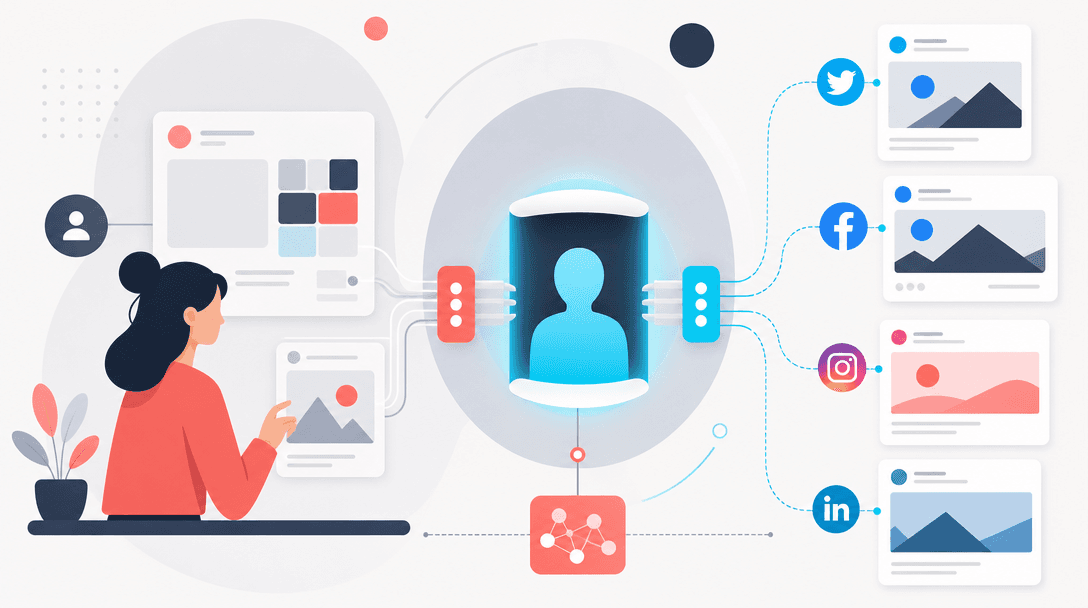
The clean architecture is generator → review → distribution. Your AI video tool creates variants in Sora, Veo, Runway, Kling, HeyGen, Captions or another editor. Your internal system scores and approves the assets. TokPortal receives the approved media and routes each post to the right account, platform, country and schedule.
This is the missing post-generation layer for AI video teams. Generating 100 clips is now easy; publishing those clips with native context is the bottleneck. TokPortal supports REST API access, MCP for AI agents, TypeScript and Python SDKs, plus webhooks for status updates. For TikTok-specific implementation details, compare native posting against the official endpoint in how to post to TikTok via API.
Generate and store approved assets
Create video variants in your AI or editing tool, then store the final approved files, captions, campaign IDs and target markets in your CMS or asset pipeline.
Send posting jobs to TokPortal
Use the REST API, SDKs, MCP server or an automation tool to submit the media, target platform, country, schedule, caption and any required creative instructions.
Route jobs to real-device operators
TokPortal assigns the job to suitable accounts and operators using real smartphones and local SIM cards in supported countries.
Publish inside the native app
The operator completes the approved posting workflow in the TikTok, Instagram or YouTube app, preserving native app features where available.
Receive status and analytics
Your system receives completion status, post URLs and analytics events through TokPortal dashboards, API responses and webhooks.
What are the use cases for a Human API on TikTok?
The strongest TikTok use cases are high-volume, country-specific and native-feature-dependent. A D2C brand can test 50 hooks across the US, UK and Germany. A music marketer can seed a sound through native app posting. An AI-UGC platform can offer distribution after generation instead of leaving customers with a folder of unused videos. A gaming studio can launch clips through accounts in markets where installs matter.
A Human API also helps teams separate research utilities from distribution. A TikTok profile viewer, TikTok profile picture downloader, TikTok PFP downloader or “download PP TikTok” workflow can help a strategist inspect creators and references, but it does not publish content or create reach. The distribution layer starts when approved assets move from research into real posting operations. For the broader channel view, use TikTok for Business in 2026.
20+
countries supported with real devices and local SIM cards
150,000+
accounts under TokPortal management
4,276
active business clients using TokPortal infrastructure
6B+
organic video views generated through TokPortal
How do you integrate a Human API with n8n or Make?
Use n8n or Make when your team wants automation without building a full internal app. The common workflow is: watch a folder or Airtable base for approved videos, enrich each row with campaign metadata, call the TokPortal API, then write the returned post status back to your system.
Developers should treat TokPortal like any other distribution rail: authenticated requests in, structured events out. Non-developers can still build useful flows with no-code automation, but the core object should remain the same: one approved video, one target platform, one account or account pool, one country, one schedule. If the workflow involves API posting, native sounds or automation logic, the two required references are the TokPortal API docs and the native TikTok sounds via API guide.
What are the benefits of human-in-the-loop distribution?
- Native in-app publishing for workflows that official posting APIs do not fully expose
- Country-specific execution through local devices and local SIM cards
- Human review before a post goes live, useful for brand safety and campaign QA
- Programmable routing from AI tools, CMS systems, spreadsheets, agents and internal dashboards
- Operational visibility through statuses, post URLs, analytics and webhooks
- Support for TikTok Spark Codes and Instagram Partnership Ad Codes as per-video handoffs
- Account warming options before scaling a campaign
- A neutral distribution layer that sits after creative production and before analytics
The real benefit is leverage. Your growth team keeps software-level control over briefs, assets, schedules and measurement, while the final mile happens in the same mobile environment where the audience consumes the content. That is why Human API infrastructure works best for AI video platforms, agencies, multi-country launches and teams operating more content than one social manager can publish manually.
It is not the answer for every brand. If you post twice a week from one headquarters account, a normal scheduler is simpler. If you need to test 100 videos, 10 angles, several countries and native TikTok features, read how to scale TikTok marketing with 100+ accounts before choosing tooling.
What quality controls should a Human API network have?
A serious Human API network needs controls at four layers: account quality, device quality, operator quality and campaign quality. Account quality means warm accounts, clear ownership records, stable credentials and niche consistency. Device quality means real phones, local SIM cards, location-appropriate app behavior and no emulator-dependent workflow. Operator quality means training, checklists, audit trails and completion evidence. Campaign quality means approvals, media matching, caption checks, schedule windows and post URL verification.
TokPortal adds account warming as a defined credit-based workflow: niche warming costs 7 credits, and deep warming for Instagram costs 40 credits over a 3-day manual process. For context on why this matters before distribution, see the TikTok account warming guide and the TikTok Algorithm 2026 guide.
Original operating test: the 3-part Human API checklist
TokPortal is a fit when
- You need native TikTok, Instagram or YouTube posting at scale.
- Your AI content tool generates more approved videos than customers can publish.
- Your agency runs multi-account or multi-country campaigns for clients.
- Your growth team needs API, MCP, SDKs and webhooks rather than a manual content calendar.
- You care about local device context, local SIM cards and human review.
TokPortal is not the answer when
- You only manage one or two owned brand accounts.
- You only need simple calendar scheduling through official platform integrations.
- You are buying paid media and do not need organic distribution infrastructure.
- You do not have approved content ready to publish.
- Your workflow requires unsupported countries or unsupported platforms.
Connect your content system to real-device posting
Use TokPortal's API, MCP server, TypeScript SDK, Python SDK and webhooks to turn approved videos into native TikTok, Instagram and YouTube posts.
What is a Human API for social media posting?+
How is this different from a social media scheduler?+
Can I connect AI-generated videos to TokPortal?+
Which platforms does TokPortal support?+
Do official APIs still matter if I use a Human API?+
What should I check before using a Human API provider?+

Written by
Vincent Tellenne
Co-founder & CEO
Vincent is a co-founder and CEO of TokPortal. He works on the infrastructure and operating model behind scaled organic social media distribution.
Learn more about this topic with AI
Related Resources
Auto Social Media Posting: The Complete Guide
Learn how to set up auto social media posting with TokPortal. Automate TikTok & Instagram posts across real accounts in 30+ countries. Scale your content strategy today.
Best Social Media Automation Tools for 2026 [Compared]
Compare the best social media automation tools for 2026. Discover top software for scheduling, account creation, and scaling TikTok & Instagram campaigns globally.
How to Post on TikTok via API in 2026 (Step-by-Step Working Guide)
Post videos to TikTok automatically with the official Content Posting API. Working examples, auth setup, sounds, scheduling — everything that works in 2026.
How to Scale TikTok Marketing with 100+ Accounts in 2026
Learn how to scale TikTok marketing with 100+ accounts using real devices, native posting, and account warming. Complete guide for brands and agencies running multi-account organic campaigns in 2026.
TikTok Distribution at Scale: The Infrastructure Guide
Learn how to build a scalable TikTok distribution infrastructure. From account farms to geo-targeting, this guide covers everything marketing pros need to grow at scale.
How to Add TikTok Sounds via API: Native In-App Posting Explained
Learn how to add TikTok sounds via API using TokPortal's native in-app posting. Add trending sounds, control volume levels, and use carousels — all programmatically.
From the guide to your first campaign
You make the content.
TokPortal runs the account operations.
Create and operate TikTok and Instagram accounts in your target market. Local operators handle the account work and native publishing. You control the brief, content and campaign from the dashboard, API or MCP.
- 01Choose your market
- 02Define each account
- 03Schedule your content
Review market availability and pricing before ordering. No reach forecast is built into your plan.