
On this page
TokPortal is programmable organic social-media distribution infrastructure for AI-generated UGC. The best way to distribute AI UGC videos is to separate generation from distribution: produce many variants, warm real accounts, post natively through real devices, localize by country, and measure winners by account, hook, sound, and geography.
AI UGC does not fail because teams cannot generate enough clips; it fails because they publish too many similar clips through too few distribution paths. A working AI content distribution strategy needs account readiness, native in-app posting, sound and location support, country segmentation, and clean measurement. TokPortal handles that distribution layer with real human operators, real physical devices, and local SIM cards in 20+ countries, controlled through API, MCP, SDKs, and workflows.
If your team is producing Sora, Veo, Kling, Runway, Pika, Arcads, Creatify, HeyGen, Topview, or Captions output, treat generation as step one. The growth system starts after export: account selection, warming, captioning, sound choice, posting cadence, Spark Code or Partnership Ad Code handoff, and winner reallocation.
20+
countries with real-device distribution coverage
150,000+
accounts under TokPortal management
4,276
active business clients
6B+
organic video views generated
AI UGC workflow from generation to posting
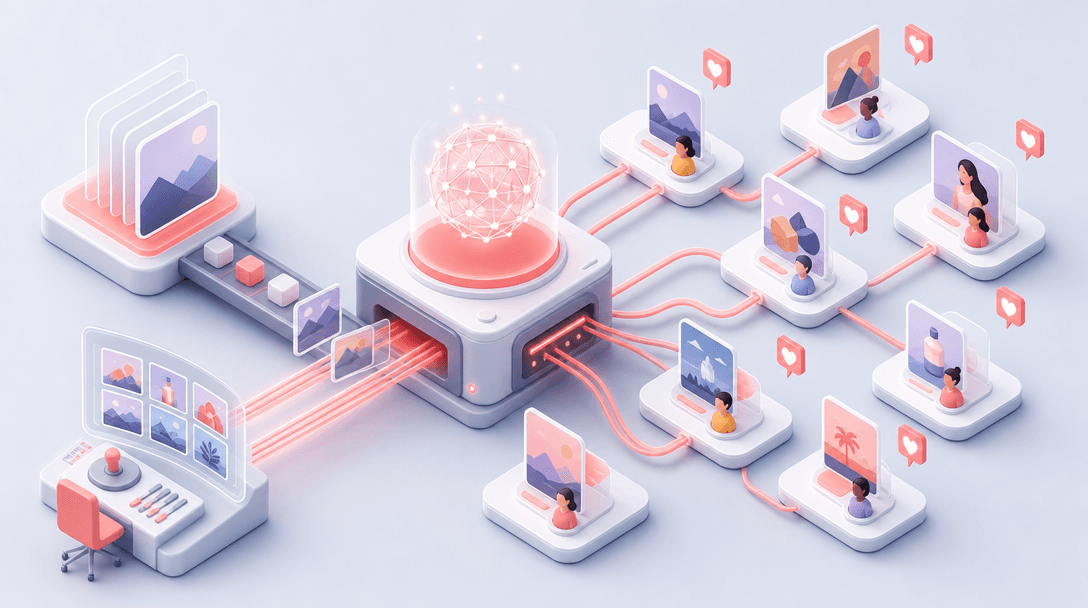
The clean workflow is: generate variants, score them, assign them to warmed accounts, post natively, measure early signals, then reallocate future clips toward the winning account-country-hook combinations. Do not send 100 AI-generated clips directly from a folder into one scheduler and expect organic reach to hold.
For TikTok specifically, native posting matters because the official TikTok Content Posting API supports programmatic publishing but does not provide the same in-app creative surface as a human using the TikTok app, including native sound selection and location context. See how native TikTok sounds work when posting through the real app and how TikTok posting via API works in 2026.
Generate 5–20 variants per concept
Change the hook, opening frame, voice, caption angle, product proof, background, and call-to-action. Treat one AI UGC script as a creative family, not one finished asset.
Score before publishing
Reject clips with obvious visual artifacts, repetitive phrasing, weak first two seconds, or a mismatch between avatar, language, product, and target country.
Map clips to account clusters
Assign each clip to accounts by niche, country, language, and audience fit. A beauty offer in France should not use the same distribution path as a finance offer in the USA.
Warm accounts before campaign volume
Use niche warming before commercial publishing so the account history matches the content category. TokPortal niche warming costs 7 credits; Instagram deep warming costs 40 credits and is a 3-day manual process.
Post natively inside the app
Use real app posting when the campaign needs TikTok sounds, local location tags, native editing, and an organic publishing pattern rather than a plain programmatic upload.
Measure by distribution unit
Track performance by account, country, hook, format, sound, and publish time. Scale the combinations that earn retention and engagement, not the clips the team likes internally.
How do you avoid low-trust patterns when posting AI videos organically?
The answer is not to hide that the content was AI-assisted. The answer is to publish like a real media operation: varied creative, account-topic fit, local context, human review, normal cadence, and platform-native execution. Low-trust patterns usually come from repetition: identical captions, identical timing, identical creative metadata, and accounts with no credible history in the niche.
TokPortal’s approach is human-in-the-loop distribution. Real operators post through real smartphones with local SIM cards, using the actual TikTok, Instagram, and YouTube apps. That matters because platforms evaluate device context, carrier data, GPS and cell-tower signals, WiFi environment, and behavioral consistency. A warmed local account posting in its niche is structurally different from a thin upload pipeline pushing the same file everywhere.
For account readiness, use the TikTok account warming guide. For larger operations, pair it with the TikTok distribution infrastructure guide.
Feature
Generation-only workflow
Distribution-first AI UGC workflow
Content volume
Posting surface
Account fit
Creative variation
Learning loop
Best practices for AI content on TikTok
- Lead with a human problem in the first two seconds; do not open with product explanation.
- Make every clip native to the feed: vertical framing, fast context, subtitles, visual proof, and no long intro.
- Use AI avatars only when the avatar matches the offer, language, age signal, and country context.
- Create one creative family per angle: pain-point hook, proof hook, comparison hook, objection hook, and founder-style hook.
- Localize captions, currency, examples, slang, and visual context by country instead of only translating the voiceover.
- Use TikTok-native sounds when the campaign depends on trend participation or format familiarity.
- Separate testing metrics from scaling metrics: early tests need retention and saves; scaling needs repeatable account-country performance.
- Turn winning organic posts into paid handoffs with Spark Codes on TikTok or Partnership Ad Codes on Instagram when the campaign proves demand.
TikTok’s own creative guidance consistently rewards clarity, native formatting, and fast audience relevance. The practical interpretation for AI UGC is simple: the clip can be AI-generated, but the distribution context must feel local and real. A finance app clip for the UK should reference UK money language; a beauty product clip for Brazil should not look like a translated US ad.
Use country-specific TikTok posting time guidance only after account fit is solved. Timing helps a good distribution system; it does not rescue a mismatched account or repetitive creative.
How many AI videos should you post per day per account?
For most brand accounts, start with 1–3 AI UGC posts per day per warmed account, then adjust by account age, niche, engagement quality, and creative uniqueness. New or lightly used accounts should start lower. Established niche accounts with consistent engagement can carry more volume when the clips are meaningfully different.
The mistake is thinking in total daily clips instead of clips per account cluster. A team with 100 AI videos per day should not force them through one or two accounts. A better setup is 25–50 warmed accounts, each receiving a small number of relevant posts, with performance reviewed by account and country. For the operational model, read how to scale TikTok marketing with 100+ accounts.
TokPortal pricing makes this calculable: account setup is 25 credits per account, video upload is 2 credits per video, niche warming is 7 credits, video editing is 3 credits, and sound-volume control is 1 credit. That means the distribution budget should be planned around account capacity, not only video count.
Original insight: utility traffic is not distribution intent
Multi-account strategy for AI-generated clips
A multi-account strategy is not just “more accounts.” It is a portfolio of distribution endpoints with different audience histories, countries, niches, and creative roles. The minimum viable structure is: test accounts, scale accounts, local-market accounts, and retargetable winner accounts that can hand off Spark Codes or Partnership Ad Codes after a post proves demand.
Build clusters around offer-market fit. Example: a language-learning app might use USA, UK, Brazil, France, Germany, Japan, and Mexico clusters, each with local captions, local examples, and account histories aligned with education, productivity, or student life. TokPortal supports real-device distribution in the USA, UK, Australia, Brazil, Canada, Colombia, Finland, France, Germany, Indonesia, Italy, Japan, Malaysia, Mexico, Pakistan, Philippines, Portugal, Romania, Spain, and Switzerland.
For global planning, use the multi-country TikTok strategy guide. If your team is building its own workflow layer, use TokPortal developer docs for API, SDKs, webhooks, and MCP access.
6.2%
average TikTok engagement rate for 1K–10K follower accounts in TokPortal benchmarks
4.8%
average TikTok engagement rate for 10K–100K follower accounts
3.5%
average TikTok engagement rate for 100K–1M follower accounts
>5%
top-quartile engagement threshold across TokPortal benchmark tiers
Where multi-account AI UGC distribution works
- You have many creative variants and need real market feedback before buying paid media.
- You need country-specific organic reach across TikTok, Instagram, or YouTube Shorts.
- You want native in-app features such as TikTok sounds, location tags, and manual editing.
- You manage agency or brand campaigns where one account cannot carry the testing volume.
- You need Spark Codes or Partnership Ad Codes from winning posts after organic validation.
Where it is not the answer
- You have not validated the offer, landing page, or basic audience pain point.
- Every AI clip uses the same hook, voice, caption, and visual structure.
- The campaign requires only one owned brand account and low posting volume.
- Your legal or brand team requires pre-approval for every asset but has no review workflow.
- You need paid-media attribution only and do not care about organic discovery.
Where TokPortal fits in the AI UGC stack
TokPortal sits after generation and before analytics. Your AI tool creates the clips; TokPortal distributes them through real accounts on real physical smartphones with local SIM cards and human operators. Campaign teams can control posting, engagement, analytics, Spark Codes, Partnership Ad Codes, and account renting through the platform, API, MCP server, TypeScript SDK, Python SDK, webhooks, n8n, Make, and Zapier.
The simplest stack is: AI video generator → creative scoring sheet → TokPortal account clusters → native posting → analytics → reallocation of winners. For technical teams, the TokPortal REST API at developers.tokportal.com is the control layer. For growth teams, the operating question is simpler: how many warmed accounts, in which countries, with what daily cadence, and which success metric decides the next batch?
Launch your first 10-account AI UGC campaign
Map your AI video volume to warmed accounts, native posting, country coverage, and measurable organic distribution before scaling to 100+ accounts.
What is the best way to distribute AI-generated UGC videos?+
Can I post AI UGC videos through the official TikTok Content Posting API?+
How many AI UGC videos should one account post per day?+
Do AI-generated clips need account warming?+
Should AI UGC be posted from brand accounts or rented creator accounts?+
When is TokPortal not the right solution?+

Written by
Vincent Tellenne
Co-founder & CEO
Vincent is a co-founder and CEO of TokPortal. He works on the infrastructure and operating model behind scaled organic social media distribution.
Learn more about this topic with AI
Related Resources
Multi-Country TikTok Strategy for Global Brands
Learn how global brands execute a multi-country TikTok strategy to reach local audiences, drive engagement, and scale international growth across 30+ markets.
How to Post on TikTok via API in 2026 (Step-by-Step Working Guide)
Post videos to TikTok automatically with the official Content Posting API. Working examples, auth setup, sounds, scheduling — everything that works in 2026.
How to Scale TikTok Marketing with 100+ Accounts in 2026
Learn how to scale TikTok marketing with 100+ accounts using real devices, native posting, and account warming. Complete guide for brands and agencies running multi-account organic campaigns in 2026.
The Complete Guide to TikTok Account Warming in 2026
Master TikTok account warming for maximum organic reach. Learn warming techniques, timelines, and how to automate the process with TokPortal's niche warming and deep warming features.
TikTok Distribution at Scale: The Infrastructure Guide
Learn how to build a scalable TikTok distribution infrastructure. From account farms to geo-targeting, this guide covers everything marketing pros need to grow at scale.
How to Add TikTok Sounds via API: Native In-App Posting Explained
Learn how to add TikTok sounds via API using TokPortal's native in-app posting. Add trending sounds, control volume levels, and use carousels — all programmatically.
From the guide to your first campaign
You make the content.
TokPortal runs the account operations.
Create and operate TikTok and Instagram accounts in your target market. Local operators handle the account work and native publishing. You control the brief, content and campaign from the dashboard, API or MCP.
- 01Choose your market
- 02Define each account
- 03Schedule your content
Review market availability and pricing before ordering. No reach forecast is built into your plan.