
On this page
A social media device operator is a human operator who uses real phones, local SIM cards, and native social apps to publish approved client content. TokPortal coordinates this work through trained operators in 20+ countries, turning reliable device management into paid remote operations work.
TokPortal is programmable organic social-media distribution infrastructure powered by real human operators using real phones. For operators, the opportunity is simple: if you can reliably manage devices, local SIMs, app sessions, posting windows, and proof-of-work, you can turn multiple phones into structured content-operations work.
This page is for people who want a practical device operator social media job, not generic creator advice. You will learn the phone setup, minimum device standards, internet requirements, campaign workflow, realistic income thinking with 5+ phones, and how to grow from a solo operator into a small device team.
20+
countries where TokPortal coordinates local device operations
150,000+
accounts under management across the TokPortal network
4,276
active business clients using TokPortal distribution infrastructure
6B+
organic video views generated through TokPortal campaigns
How to set up multiple phones for posting work
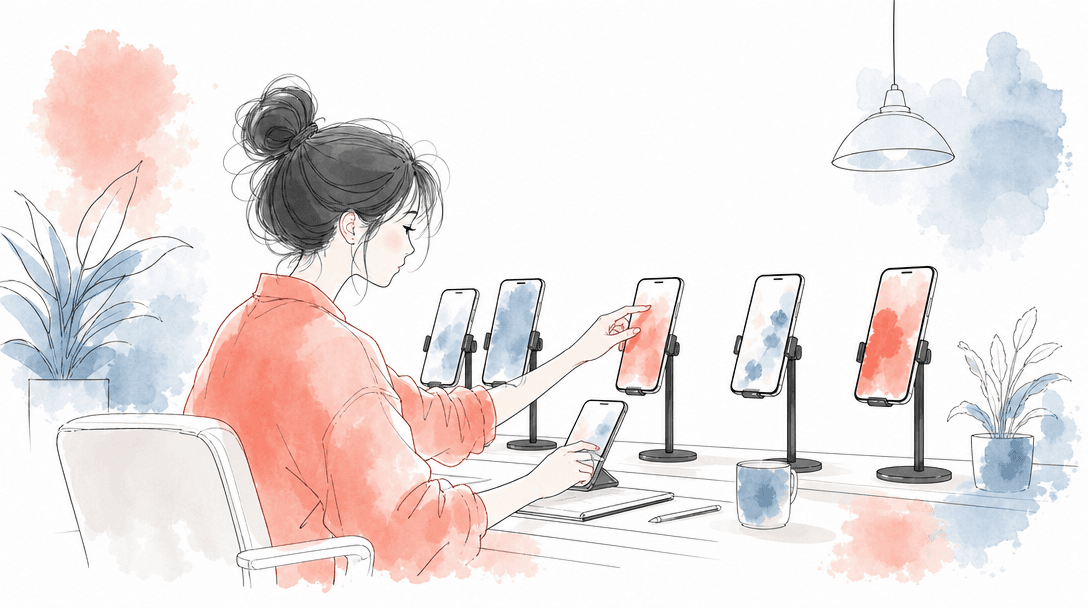
To set up multiple phones for posting work, treat the phones like an operations rack, not personal devices. Each phone needs a clear label, charger position, SIM identity, app session, country, time zone, and daily checklist. The goal is boring reliability: the right content goes live from the right device, at the right time, with the right proof returned after posting.
A practical starter setup is 5 phones: 4 active posting phones and 1 backup/QA phone. Keep each device physically separated, logged, charged, and assigned to a specific platform or account group. If you are supporting TikTok work, read TokPortal’s TikTok account warming guide before assuming a new device is ready for high-volume work.
Your desk should include a powered USB charging hub, labeled cables, a small phone stand or rack, a shared task board, and a quiet place to review captions, sounds, cover frames, and location tags. Device operation is not passive. It is closer to content QA, posting coordination, and local social-media execution.
Label every phone before using it
Use a physical label such as US-01, UK-02, or PH-03. Match the label to a tracker with phone model, SIM carrier, platform, time zone, charging cable, and current assignment.
Create a device tracker
Track battery health, storage, app version, last successful post, active account, SIM status, and any notes from campaign QA. A spreadsheet is enough for a solo operator.
Install only the required social apps
Keep the device clean. Install TikTok, Instagram, YouTube, or the specific apps required for the campaign. Avoid unnecessary background apps that drain battery or interrupt uploads.
Run a daily readiness check
Before campaign windows, confirm battery above 80%, storage available, SIM connected, app logged in, time zone correct, and notifications visible.
Use a posting checklist for every task
Check video file, caption, hashtags, sound instruction, location tag, posting time, account identity, approval status, and proof link before marking the task complete.
Keep one spare device ready
A spare phone protects your reliability when a battery fails, an app needs updating, or a file transfer takes longer than expected.
Minimum specs for social media operator phone
The minimum phone for social media operator work is any real iOS or Android device that can run the current TikTok, Instagram, and YouTube apps smoothly, upload video without crashing, hold a stable mobile connection, and keep enough storage for campaign files. In practice, operators should use recent, undamaged phones with healthy batteries, working cameras, current operating-system support, and at least enough storage to keep the device below capacity during uploads.
Do not buy the cheapest possible used phone if it overheats, drops mobile service, or cannot update the main social apps. A weak device costs more in missed campaign windows than it saves upfront. If you plan to support sound-based TikTok work, understand why native app access matters in TokPortal’s guide to TikTok sounds and native in-app posting.
Feature
Good operator phone
Poor operator phone
App support
Battery
Storage
SIM and signal
Operational use
Internet and SIM requirements for operators
Social media operators need stable internet and a real local SIM for the country they are operating in. TokPortal’s distribution model is built around real physical smartphones, local SIM cards, and human operators in countries including the USA, UK, Australia, Brazil, Canada, France, Germany, Indonesia, Japan, Mexico, Spain, Switzerland, and others.
For operators, the rule is consistency. Keep the device in the same country, with the same local mobile carrier profile, the same time zone, and a reliable WiFi or mobile-data backup. Do not build your workflow around location-masking tools or unstable shared connections. They create inconsistent operating conditions and make QA harder.
A good setup has two layers: primary WiFi for file handling and mobile data for native app activity. If your country has unreliable home internet, budget for mobile data packages and a backup power source. Campaign windows often depend on local posting behavior, so review best times to post on TikTok by country to understand why local availability matters.
How operators get assigned client campaigns
Operators get assigned client campaigns after they are approved, have verified device capacity, and can follow campaign QA rules. A campaign brief typically includes the platform, account or page, video asset, caption, hashtags, native sound instructions, location tag, scheduled posting window, approval status, and proof required after publishing.
TokPortal serves business clients that need organic distribution infrastructure across TikTok, Instagram, and YouTube. The client may be an AI video tool, agency, D2C brand, app company, music marketer, or growth team. The operator’s job is not to invent the campaign. The job is to execute the approved task exactly, from the correct device, inside the native social app, and return accurate completion proof.
If your current online work is lightweight creator utility work such as TikTok profile picture download requests, TikTok profile picture downloader support, or TikTok PFP downloader tasks, device-operator work is more structured. You are responsible for timing, file handling, QA, app state, local device readiness, and campaign confirmation.
For the client-side version of this infrastructure, read TokPortal’s TikTok distribution at scale guide.
Income potential with 5+ phones
Five phones do not guarantee a fixed income. They increase your capacity to accept assignments, cover more posting windows, and prove that you can operate reliably. Operator earnings depend on country demand, device quality, completion rate, QA accuracy, availability, platform mix, and how many accepted tasks you can complete without errors.
Use this simple capacity model: monthly operator capacity = active phones × usable posting windows × accepted tasks per window × completion quality. A 5-phone operator who misses instructions, posts late, or returns incomplete proof has lower value than a 3-phone operator who is always accurate. Reliability is the income multiplier.
TokPortal publishes account rental income benchmarks for creators who rent existing social pages, not guaranteed device-operator pay. As a reference point for adjacent creator monetization, TokPortal’s 2026 rental-rate index shows displayed monthly account-owner rates from $144–$250 for 100–1K followers up to $4,000–$12,000+ for 1M+ followers, with premium niches such as finance, beauty, tech, and crypto earning 30–100% more. That is a different path from device management, but it shows why reliable social-media operations have economic value.
The 5-phone threshold is about reliability, not hype
How to scale from solo operator to small team
- Start with one operator and 5 labeled phones before hiring anyone
- Document one checklist for device readiness, one for posting, and one for proof submission
- Add a second person only after the first operator can hit campaign windows consistently
- Separate roles into device prep, posting execution, file transfer, and QA review
- Keep every phone assigned to a person, country, SIM, and campaign group
- Review failed or delayed tasks weekly and fix the system before adding more devices
- Use a spare-device pool so one broken phone does not stop a campaign window
- Train new operators on accuracy before speed
The move from solo operator to small team should happen in stages. First, prove that you can run 5 phones without missed windows. Then move to 10–15 phones with one backup operator. Only after that should you consider a small rack, shared tracker, and daily QA review.
Small teams win by building repeatable operations: device labels, phone ownership, SIM logs, charging discipline, task acceptance rules, and proof standards. If you want to understand the business-client side of multi-account operations, study how brands scale TikTok marketing with 100+ accounts. Operators who understand the client’s growth problem make fewer mistakes.
A serious operator team should also understand platform behavior at a high level. TokPortal’s TikTok Algorithm 2026 guide explains why timing, local signals, engagement quality, and account history matter for organic distribution.
This work is a fit if
- You can follow detailed campaign instructions without improvising
- You already own multiple reliable phones or can maintain them
- You have stable local mobile connectivity and predictable availability
- You are comfortable with QA, screenshots, links, file handling, and task boards
- You want remote operations work tied to real social-media execution
This work is not a fit if
- You want passive income with no daily device checks
- You cannot keep phones charged, labeled, and updated
- You often miss scheduled windows or ignore exact instructions
- You only want one-off creator utility tasks and no campaign responsibility
- You are unable to work with local SIMs and consistent device conditions
Operator application checklist
Before applying, prepare a short inventory: number of phones, models, operating systems, battery condition, SIM carriers, country, internet backup, available posting windows, and whether you can support TikTok, Instagram, YouTube, or all three. Also prepare one photo of your device setup and a simple explanation of how you track tasks.
Do not overstate your capacity. A clean 5-phone setup with accurate tracking is better than claiming 20 devices you cannot manage. TokPortal values operators who protect campaign quality, communicate early, and treat client content as production work.
Build your account network with TokPortal
Choose your market, define your accounts and schedule your original content.
What does a social media device operator do?+
How many phones do I need to start?+
Can I do this as remote work?+
Do I need expensive flagship phones?+
How much can I earn with 5+ phones?+
What is the best way to grow from solo operator to team?+

Written by
Vincent Tellenne
Co-founder & CEO
Vincent is a co-founder and CEO of TokPortal. He works on the infrastructure and operating model behind scaled organic social media distribution.
Learn more about this topic with AI
Related Resources
Best Time to Post on TikTok by Country in 2026
When to post on TikTok to get more views — exact hours for 30+ countries in 2026. Free tool included. Check your country's peak engagement window now.
How to Scale TikTok Marketing with 100+ Accounts in 2026
Learn how to scale TikTok marketing with 100+ accounts using real devices, native posting, and account warming. Complete guide for brands and agencies running multi-account organic campaigns in 2026.
The Complete Guide to TikTok Account Warming in 2026
Master TikTok account warming for maximum organic reach. Learn warming techniques, timelines, and how to automate the process with TokPortal's niche warming and deep warming features.
TikTok Algorithm 2026: How Organic Distribution Really Works
Deep dive into the TikTok algorithm in 2026. Understand how organic distribution works, why some videos go viral, and how to optimize multi-account campaigns for maximum reach.
TikTok Distribution at Scale: The Infrastructure Guide
Learn how to build a scalable TikTok distribution infrastructure. From account farms to geo-targeting, this guide covers everything marketing pros need to grow at scale.
How to Add TikTok Sounds via API: Native In-App Posting Explained
Learn how to add TikTok sounds via API using TokPortal's native in-app posting. Add trending sounds, control volume levels, and use carousels — all programmatically.
From the guide to your first campaign
You make the content.
TokPortal runs the account operations.
Create and operate TikTok and Instagram accounts in your target market. Local operators handle the account work and native publishing. You control the brief, content and campaign from the dashboard, API or MCP.
- 01Choose your market
- 02Define each account
- 03Schedule your content
Review market availability and pricing before ordering. No reach forecast is built into your plan.